Wisconsin Permit Questions Wardens Hear Most
A Wisconsin warden may ask about registration, trail passes, safety certification, or where you have permission to ride. Those requirements are related, but one document does not replace the others. Knowing which applies to your machine and route can prevent a paperwork problem from ending a ride early.
What “Permit” Means for a Wisconsin ATV or UTV
Riders often use “permit” as a catch-all, but Wisconsin riding requirements can involve several separate things. A warden’s question may be about registration, a nonresident trail pass, an operator’s safety certificate, or permission to use a particular piece of land. Each answers a different question.
| Requirement | What it addresses | What it does not do |
|---|---|---|
| Wisconsin registration | Whether the machine is registered for the use indicated by its registration | It does not automatically allow riding on every road, trail, or private property |
| Nonresident trail pass | Whether an out-of-state machine has the required pass for applicable public trails | It does not replace registration or grant permission to ride closed areas |
| Safety certificate | Whether an operator who is subject to the requirement has completed the required training | It does not register the machine or create trail access |
| Local route permission | Whether a particular road or route is open to ATVs or UTVs under local rules | It does not authorize travel on roads that are not open |
| Landowner permission | Whether you may ride on private land | It does not replace requirements that apply on public trails or routes |
Start by identifying where you plan to ride. A public trail, a road route, private property, and a frozen lake are not interchangeable settings. A pass that applies to public trails does not make a closed road legal to ride, and registration alone does not give access to someone else’s land.
For help choosing the right registration category, see Which Wisconsin Registration You Actually Need. If you are still sorting out the difference between public and private registration, Public Use Versus Private Use in Wisconsin explains why the category matters.
Questions a Warden May Ask on a Ride
A warden’s questions will depend on the location, machine, and circumstances. Riders should be ready to explain what they are operating, where they are going, and why they believe they are permitted to ride there. The following are common subjects to prepare for, not a guaranteed script.
| Question or subject | What the warden may be checking | What to have ready |
|---|---|---|
| Is the machine registered? | Whether the registration applies to the machine and its use | Registration information and matching machine identification |
| Is this machine registered out of state? | Whether a nonresident trail pass is required for the public trail being used | Applicable pass and current display or proof instructions |
| Are you on an open trail or route? | Whether the location is open to your type of machine and use | Current local or land-manager information |
| Do you have permission to be here? | Whether the land is public, open, or privately accessible | Permission from the landowner where required |
| Are you required to have a safety certificate? | Whether the operator’s age and circumstances trigger a training requirement | Certificate or accepted proof, if required |
| Are you following local rules? | Whether the town or other authority has conditions for that route | Relevant local ordinance details, including hours or restrictions |
“Is the machine registered for this use?”
A registration document is useful only if the registration matches the machine and the activity. A machine registered for limited private use may not qualify for riding on a public trail. Check the registration category rather than assuming that any sticker or previous owner’s paperwork is enough.
If you bought the machine recently, confirm that the record is in the correct owner’s name and that any transfer is complete. The paperwork process is covered in Transferring a Wisconsin Registration Within Ten Days. If the registration card is not with the machine, Keeping the Registration Card With the Machine is a useful reminder of what to have accessible.
“Do you need a trail pass?”
This question is especially relevant to visitors riding machines registered outside Wisconsin. A nonresident trail pass may be required on applicable public trails, while a route on a local road can involve a different set of rules. Don’t assume that an out-of-state registration, a rental agreement, or a pass bought for another machine covers the ride you are taking.
Check the current pass requirement for the machine and area before leaving home, then follow the latest instructions for displaying or carrying proof. The details are covered in Which Wisconsin Trails Require a Pass and Passes for a Machine Registered Out of State.
“Is this trail or road open to you?”
A trail can be closed even when nearby roads are open, and a road route can have local conditions that do not apply to a trail. Route access is established locally, so a route shown on an old map, mentioned in a forum, or used on an earlier trip may not be open now.
Before riding, check current signs and the responsible local authority’s information. Pay attention to hours, seasonal closures, machine restrictions, and any posted detours. For a road ride, Finding a Wisconsin Town’s ATV Ordinance can help you understand why checking local rules matters.
“Do you have permission to ride here?”
A trail pass or registration is not permission to cross private property whenever it is convenient. If the route depends on a landowner’s consent, make sure that consent is clear and still applies. A gate that is open or tracks left by another machine do not prove that the property is open to public riding.
Situations That Commonly Cause Permit Confusion
Visiting Wisconsin with an out-of-state machine
Visitors sometimes assume their home-state registration settles every Wisconsin requirement. It may establish that the machine is registered at home, but it does not necessarily satisfy Wisconsin’s trail-pass requirement or local access rules.
Before the trip, check whether your intended riding area is a public trail, a local road route, or private property. Then verify the requirements for that location and the machine’s registration status. Renting or borrowing a machine does not necessarily transfer the owner’s documents or make every pass requirement disappear. For a state-specific starting point, see Wisconsin’s Non-Resident Trail Pass.
Riding a road route after a trail ride
A trail pass is not a general road permit. A road must be open to ATVs or UTVs under the applicable local rules, and riders must follow the conditions for that route. Do not use a trail map as proof that every connecting road is open.
At an intersection, follow route signage and take time to confirm the next segment before continuing. If the route ends or the signs are unclear, stop somewhere safe and check rather than guessing. What a Wisconsin ATV Route Actually Is explains the distinction between a route and a trail.
Operating someone else’s machine
If you are borrowing a machine, ask the owner about its registration category, current paperwork, and any applicable pass before riding. Do not assume that a sticker on the machine is current or that it belongs to that specific machine. The operator should also know whether they personally need a safety certificate.
For youth riders, age and machine type can affect the training and operating rules. Review Wisconsin ATV Safety Certificate Requirements and the rules that apply to the rider, not just the vehicle’s owner.
Riding on land you own or have permission to use
Private land can change which requirements apply, but “private” does not mean every rule disappears. The boundaries of the property, the rider’s age, the machine’s use, and any connection to public trails or roads can matter. Permission to ride on one property also does not authorize travel across neighboring land to reach it.
If a planned ride begins on private land and continues onto a public trail or route, check the requirements for each part of the trip. A private-use registration should not be treated as blanket authorization for public riding. See Do You Need Registration on Your Own Wisconsin Land? for the land-use question.
How to Prepare and Answer Clearly
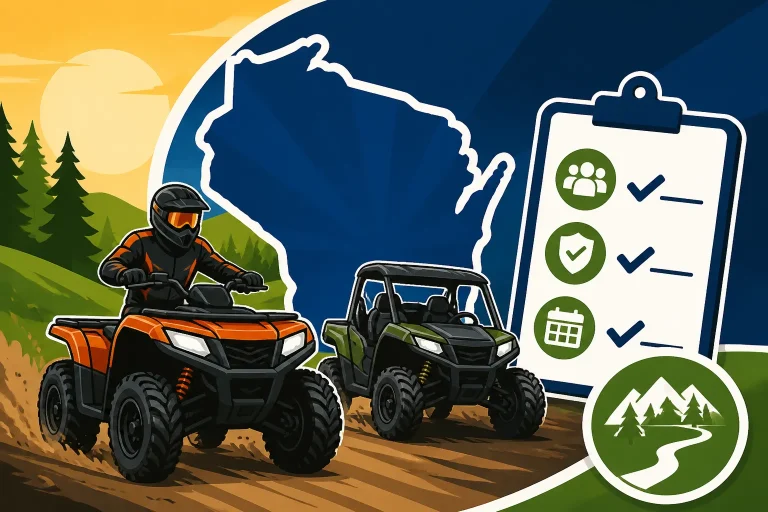
The simplest way to avoid a roadside paperwork scramble is to check the ride in advance. Use this process before each trip, especially when traveling to a different county or bringing a machine from another state.
- Identify the riding area. Decide whether the planned ride uses public trails, local roads opened as routes, private land, or more than one type of access.
- Check the machine’s registration. Confirm that the registration is current, belongs with the machine, and is appropriate for the intended use.
- Check whether a trail pass applies. Pay particular attention when the machine is registered outside Wisconsin. Confirm the current requirement for the specific public trail and follow the official display instructions.
- Review local access rules. Look for closures, route hours, machine restrictions, and signs at the trailhead or road.
- Confirm operator requirements. Check whether the rider must have a safety certificate and whether any age-based rules apply.
- Keep proof accessible. Carry or keep required documents where you can produce them without leaving the machine unattended or creating a roadside hazard.
- Ask before crossing private land. Get permission from the landowner instead of relying on maps, tracks, or assumptions.
If a warden asks a question, answer directly and calmly. Show the relevant paperwork, describe the route you are following, and ask for clarification if you do not understand what is being checked. Avoid arguing from what another rider told you or from an old map; those may not reflect current local access.
If you discover that you are on a closed route or lack a required document, do not continue farther in the hope that it will go unnoticed. Follow the warden’s directions and ask what safe, lawful next step is available. Afterward, confirm the requirement with the appropriate official source before riding again.
Permit questions are easier to manage when each requirement is treated separately: registration identifies the machine’s status, a trail pass may apply to certain public trails, certification concerns the operator, and local rules or landowner permission determine where the ride can go. Check all of them against the actual route, not just the machine.
Disclaimer
This article is for general informational purposes only and does not constitute professional advice. Laws, prices and regulations vary by location and change over time. Consult a qualified professional for guidance on your specific situation.