Wisconsin ATV Rules for First-Time Visitors
A first Wisconsin ride can involve more than unloading your machine and following a trail sign. Visitors need to sort out whether they need a trail pass, whether their machine must be registered in Wisconsin, and what training and route rules apply. The practical answer depends on where you ride and whether the machine is visiting or staying in the state.
Start with your machine and how long it will stay
For most visitors, the first distinction is between a machine brought in temporarily and one kept in Wisconsin. The Wisconsin DNR says nonresidents bringing an ATV or UTV into the state can operate on designated corridors and frozen waterways with a nonresident trail pass or a five-day trail use receipt. A nonresident who keeps the machine in Wisconsin must register it in the state.
That means a machine’s home-state registration does not automatically settle every Wisconsin riding requirement. Before you travel, check whether your planned places are open to the machine and whether they require a pass. The distinction between registration and a pass matters: registration identifies the machine under a registration system, while a nonresident pass or receipt is the listed way for a visiting rider to access eligible Wisconsin riding areas.
The Wisconsin DNR defines an ATV as a commercially designed, motor-driven device with a dry weight of 900 pounds or less and a width of 50 inches or less. A UTV is an off-highway vehicle with a dry weight of 3,000 pounds or less and a width of 65 inches or less. If the machine’s type is unclear, check its specifications and the state’s definitions before relying on its marketing name.
| Visitor situation | What to check before riding |
|---|---|
| You bring a machine from another state for a visit | Confirm the required nonresident trail pass or five-day receipt for the areas you plan to use. |
| You keep your machine in Wisconsin | The Wisconsin DNR says a nonresident who keeps an ATV or UTV in Wisconsin must register it in the state. |
| You ride a designated corridor or frozen waterway | The Wisconsin DNR says a nonresident may operate there with an annual trail pass or five-day trail use receipt. |
| You plan to ride a highway | Check the local ordinance, route signs and any applicable state-highway approval; do not assume a public road is open to ATVs or UTVs. |
For visitors who need a pass, the Wisconsin DNR lists an annual nonresident ATV/UTV trail pass for $35, expiring March 31, and a five-day trail use receipt for $20, issued for five consecutive days. These fees are listed by the Wisconsin DNR as of November 2026. Choose based on your travel plans, and confirm current requirements with the DNR before setting out.
The annual pass can be ordered before the trip. The Wisconsin DNR says a temporary operating receipt printed on plain white paper is issued when an annual pass is ordered, allowing immediate operation; the physical decal arrives by mail in approximately two weeks. Keep the receipt available until you have the decal, and follow current instructions for displaying the pass. For a closer look at who needs one and what it covers, see Wisconsin’s Non-Resident Trail Pass and Which Wisconsin Trails Require a Pass.
A short visit does not create a general exemption from registration and pass rules. The Wisconsin DNR lists limited registration exemptions, including machines owned by a government agency with the agency name displayed on the exterior, machines displaying a registration decal required by a tribe or band, and certain manufacturer-advertising machines in the state for no more than 15 days. Those narrow cases are not a substitute for checking the requirements that apply to an ordinary visitor’s recreational machine.
Check safety certification before the trip
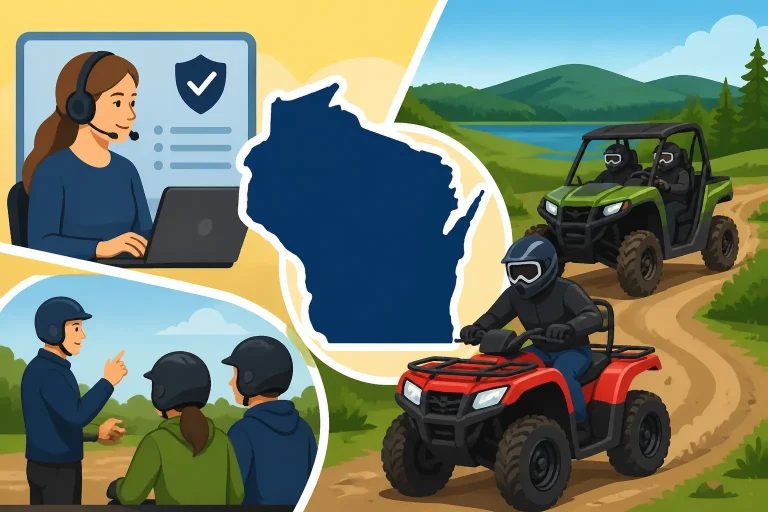
Safety certification depends on the rider’s age, birth date, machine type and riding location. According to the Wisconsin DNR, ATV and UTV operators born on or after January 1, 1988, must complete a safety certification course to operate on public riding areas if they meet the minimum age requirement.
For public riding areas, the Wisconsin DNR sets the minimum age at 12 for an ATV operator who has completed the required course, and 16 for a UTV operator who has completed the course. The DNR also says that operators of ATVs who are at least 12 and born on or after January 1, 1988, must have completed ATV safety certification; for UTV operators, the corresponding minimum age is 16. These rules make it important to check both the rider’s age and the vehicle being operated, rather than assuming an ATV qualification automatically covers a UTV.
The Wisconsin DNR requires operators to carry their safety certification card and show it to law enforcement officers when asked. If a young rider has completed training but does not have the card with them, the rider may not be able to demonstrate compliance during a check. Pack the card with the other documents you bring for the ride.
Children under 12 may take an ATV safety class, but the Wisconsin DNR says their certificate does not become valid until they reach age 12. That is different from having permission to operate on public riding areas before that age. A course completion alone does not override the minimum-age rule.
If a rider needs certification before traveling, check the Wisconsin DNR’s current course options and registration instructions. Wisconsin recreational safety students must obtain a Wisconsin DNR Customer ID Number when registering for a class. For more detail on age and course requirements, see Wisconsin’s ATV Safety Certificate Requirement, The January 1988 Birthdate Rule and Twelve for an ATV, Sixteen for a UTV.
Certification is only one part of a safe ride. The Wisconsin DNR advises operators to ride within their abilities, wear a helmet and seat belt, and ride sober. On a UTV, the Wisconsin Department of Transportation specifically reminds users to wear seat belts, which reduce the risk of being ejected. Bring gear that fits each rider, and do not treat a trail pass or course certificate as a substitute for basic protective equipment.
Understand where you may ride
A trail pass does not make every trail, road or public property open to riding. Before leaving home, identify the specific trail system, corridor or frozen waterway you intend to use, then check its current access rules and conditions. A county map or route sign can help with navigation, but neither should be treated as proof that every connecting road is legal for an ATV or UTV.
Highway access is particularly easy to misunderstand. According to the Wisconsin Department of Transportation, a roadway is not an ATV route unless the required ordinance has been enacted and the roadway is signed and posted according to law. An ATV route is on the roadway portion of a highway, not the shoulder or other parts of the right of way. Interstates are not open to ATV operation.
Local rules determine whether a road is designated, and state highways have additional requirements. The Wisconsin Department of Transportation says an ATV may use a state highway or connecting highway designated under route rules only when WisDOT approves the route. A town, village or city may authorize ATV operation on a highway with a speed limit of 35 mph or less within its boundaries by ordinance; according to WisDOT, that type of local authorization does not require WisDOT approval. State highways with speed limits over 35 mph remain off-limits without WisDOT approval.
Those details are a reason not to use a road as an assumed connector between trail sections. Look for signs and confirm the local ordinance for the specific road. A route open to ATVs is not automatically open to every type of off-highway vehicle, and a map line does not replace legal posting. For more context, see What a Wisconsin ATV Route Actually Is, Wisconsin Towns With Miles of Open Roads and Finding a Wisconsin Town’s ATV Ordinance.
Road crossings are different from riding along a road. According to the Wisconsin Department of Transportation, an ATV operator must stop completely before crossing a roadway, yield to pedestrians and vehicles using it, and cross by the most direct route possible. Where special bridge provisions apply, the operator must leave the highway as quickly and safely as practicable after crossing. Do not treat a crossing as permission to continue along the highway.
Frozen waterways also require a careful check. The Wisconsin DNR includes them among the places a nonresident may operate with the required trail pass or five-day receipt, but that does not mean every lake or section of ice is suitable or open. Check local access restrictions and current conditions before riding out. Wisconsin Rules on Frozen Lakes and Ice Thickness Before You Ride offer related planning considerations.
Prepare your documents and ride plan
A few checks before departure can prevent a frustrating trip back to the trailer or a citation on the route. Start with the exact riding area, because the pass, access and road rules depend on where you intend to operate. Then verify that each rider meets the safety requirements and can show the required card.
Use this pre-ride checklist:
- Confirm whether the machine is visiting temporarily or will be kept in Wisconsin. If it will remain in the state, the Wisconsin DNR says a nonresident must register it in Wisconsin.
- Check the current nonresident pass or receipt requirement for the specific riding areas on your plan.
- Verify rider age and certification status for the machine type and public riding area.
- Carry the safety certification card if the operator is required to have one.
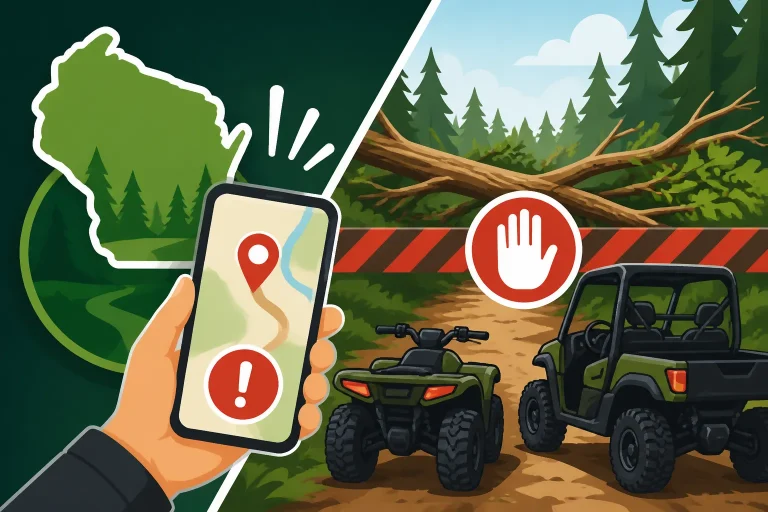
- Check trail status, local restrictions and road-route signs before using a connector.
- Wear a helmet; UTV occupants should use seat belts.
- Pack for the actual route and weather, and ride within the operator’s ability.
If you buy a machine during the visit or arrange for it to be transferred, separate transfer paperwork from visitor pass requirements. The Wisconsin DNR requires a buyer to complete an ownership-transfer application within 10 days after the transfer. Dealers must submit registration applications to the DNR within 5 days after the sale. Those deadlines concern ownership and registration; they are not the same as the requirements for riding a visiting machine on eligible public areas. See Buying a Used ATV in Wisconsin: The Paperwork and The Ten-Day Transfer Deadline in Wisconsin if a purchase is part of your plans.
Keep the trip flexible enough to respond to closures or a route that turns out not to be open to your machine. Confirm access with the responsible land manager or local authority, and consult the Wisconsin DNR’s ATV/UTV regulations for current safety, registration and operating rules. The Wisconsin Department of Transportation provides information about ATV and UTV operation on state highways. When in doubt, stop before entering a road or trail whose status is unclear rather than relying on a nearby sign or another rider’s assumption.
Sources
- Wisconsin Department of Natural Resources — All-terrain vehicle (ATV) and utility-terrain vehicle (UTV) registration | | Wisconsin DNR (checked November 3, 2026)
- Wisconsin DNR — Nonresident ATV and UTV Trail Passes | | Wisconsin DNR (checked November 3, 2026)
- Wisconsin Department of Natural Resources — ATV | Wisconsin DNR (checked November 3, 2026)
- Wisconsin DNR — Safety Education | Sign up for a safety education course | Wisconsin DNR (checked November 3, 2026)
- Wisconsin Department of Transportation — Wisconsin Department of Transportation All-Terrain Vehicles and Utility Terrain Vehicles on state highways (checked November 3, 2026)
- Wisconsin Department of Natural Resources — ATV Regulations | ATV riding in Wisconsin | Wisconsin DNR (checked November 3, 2026)
- Wisconsin Department of Natural Resources — ATV_flier.pdf (checked November 3, 2026)
- Department of Natural Resources — UTV_flier.pdf (checked November 3, 2026)
- Wisconsin Department of Natural Resources — Fatality Summary, Annual Reports and Incident Reporting | ATV riding in Wisconsin | Wisconsin DNR (checked November 3, 2026)
- Wisconsin Department of Transportation — Wisconsin Department of Transportation All-Terrain Vehicles and Utility Terrain Vehicles (checked November 3, 2026)
Disclaimer
This article is for general informational purposes only and does not constitute professional advice. Laws, prices and regulations vary by location and change over time. Consult a qualified professional for guidance on your specific situation.