Passes for a Machine Registered Out of State
An out-of-state registration may let you identify your ATV or UTV at home, but it does not automatically give the machine access to Wisconsin’s public trails. The key question is where you plan to ride: Wisconsin generally requires a nonresident trail pass for an ATV or UTV registered elsewhere when it is used on public riding routes or trails. Here’s how to sort out the pass, registration, and local access rules before you unload.
When an Out-of-State Machine Needs a Wisconsin Pass
Wisconsin treats the machine’s registration and its access to public ATV and UTV routes or trails as separate issues. A registration issued by your home state does not, by itself, replace the Wisconsin trail pass requirement.
If your ATV or UTV is registered outside Wisconsin and you plan to ride it on Wisconsin public routes or trails, expect to need a Wisconsin nonresident trail pass. The pass applies to the machine, not just to the person operating it. If you bring two machines, check the requirements for each one rather than assuming a single pass covers a group.
This applies to visitors as well as people who own property or keep a machine in Wisconsin. Having a cabin, hunting camp, or seasonal home in the state does not automatically make an out-of-state registration equivalent to Wisconsin registration. If you live in Wisconsin but kept your machine registered elsewhere, check the current rules for your situation before relying on that registration alone.
The pass requirement is different from having permission to ride. A pass does not open a closed trail, authorize riding on private land, or make every road legal for an ATV or UTV. You still need to follow local route designations, posted restrictions, and closures. The distinction between a trail and a route matters: Which Wisconsin Trails Require a Pass can help you identify where the pass question applies, but local access rules still determine where you may ride.
| Situation | What to check before riding |
|---|---|
| Machine registered in another state, used on a Wisconsin public trail or route | Whether the machine needs a Wisconsin nonresident trail pass |
| Machine registered in another state, kept on private land | Whether the planned riding stays entirely on land where you have permission |
| Machine registered in Wisconsin for public use | Whether its registration is current and what access it covers |
| Machine brought to a Wisconsin rental or guided ride | Whether the machine already has the required pass, and who is responsible for confirming it |
| Machine used on a town road route | Whether the local route is open and what operating rules apply |
The details can depend on how the machine is registered, where it will be operated, and the specific activity. For the state’s current pass rules and exceptions, start with Wisconsin’s Non-Resident Trail Pass and verify the requirements before you travel.
Registration, Pass, and Permission Are Different
It helps to think of three separate questions:
- Is the machine properly registered? Registration identifies the machine under the rules that apply to it. An out-of-state registration may remain relevant in Wisconsin, but it does not automatically satisfy every Wisconsin requirement.
- Does the machine need a Wisconsin trail pass? A machine registered outside Wisconsin generally needs the applicable nonresident pass to use Wisconsin public ATV or UTV routes and trails.
- Is the place you want to ride open to that machine? A valid registration and pass do not override a closure, local ordinance, landowner restriction, or rule about the type of machine allowed.
A pass is not a substitute for registration, and a registration is not a substitute for a pass when one is required. Likewise, neither document replaces permission to ride on private property. If your trip includes both public trails and private land, check the requirements for each part of the route.
Home-state registration and reciprocity
Travelers often assume that because their state registration is accepted elsewhere, it must be enough in Wisconsin too. That assumption can create trouble at the trailhead. Wisconsin’s nonresident pass requirement is a separate access rule, so do not count on another state’s registration sticker or card to satisfy it.
If the machine is registered in Minnesota, Illinois, Michigan, or another state, look up the specific guidance for that situation. The starting point can vary by home state; for example, Do Minnesota Riders Need a Wisconsin Pass? addresses one common case, while Wisconsin Registration for an Out-of-State Machine covers the registration question more broadly.
The pass is not a universal riding permit
Even after you obtain a pass, you still need to check that the trail or route is open and suitable for your machine. Public access may vary by county, town, forest, season, and trail conditions. Some roads may be designated for ATV or UTV use while nearby roads are not. A marked route is not an invitation to ride on every connecting road.
Check current local maps and closure notices close to your departure date. Spring thaw, maintenance, weather damage, and local decisions can change where riding is allowed. Follow posted signs and do not assume that a route shown on an old map remains open.
Getting the Pass and Displaying It Correctly
Before buying a pass, confirm that you are selecting the one that matches your machine and intended use. Use the current Wisconsin instructions rather than relying on a friend’s old paperwork, a previous season’s sticker, or a general statement about out-of-state registration.
If you buy online, check what you must carry or display while waiting for the physical pass, if anything. Keep the confirmation and any transaction information available, but do not assume a receipt alone meets the display requirement. Buying a Wisconsin Trail Pass Online covers the online process; the state’s current instructions should determine what is valid for your ride.
Once you have the pass, follow the placement instructions supplied with it. A decal that is hidden, attached to a removable part, or placed where it cannot be checked may cause confusion during an inspection. Do not invent a placement based on where a different state puts its registration decal. Use Displaying a Wisconsin Trail Pass for the display details and confirm that the pass is secure before hauling the machine.
A pass generally applies to a particular machine, so do not move one pass between vehicles or assume it covers a borrowed second machine. If a decal is damaged, lost, or will not stay attached, check the replacement process before riding rather than trying to make an altered or improvised decal work.
Check the validity period
The validity of a pass is not necessarily the same as the renewal cycle for your home-state registration. Check the pass’s printed expiration information and Wisconsin’s current rules when you buy it. The Wisconsin pass cycle is associated with the state’s annual renewal date; see The March 31 Expiration on a Wisconsin Pass and confirm the date that applies to the pass you hold.
This matters if you ride near the end of a season or plan multiple trips across the renewal period. A pass that was valid on a previous trip may not remain valid for a later one, even if the machine’s home-state registration is still current. Before each trip, verify both the registration and pass rather than judging validity by the sticker’s appearance alone.
Keep useful records together
Carry or have access to the documents and information needed to show that the machine and pass are in order. That might include the home-state registration record, the pass information, and any required proof of ownership or permission. Requirements can vary, so check current state guidance rather than treating this list as a complete legal checklist.
For a borrowed or rented machine, ask who obtained the pass and how you can verify it before the ride starts. Do not assume the owner’s registration or the rental agreement settles the pass question. Passes for a Borrowed Machine Up North and Wisconsin Pass Rules for a Rented Machine address those situations.
Plan the Whole Ride, Not Just the Pass
A pass is only one part of getting ready. Make sure the machine is legal for the kind of riding you plan, the operator meets applicable requirements, and the route is open to the machine. A public trail day can involve separate rules for registration, pass display, safety certification, age, equipment, and local access.
Before leaving home:
- Confirm the machine’s status. Check that its out-of-state registration is current and that the registration details match the machine.
- Check whether a Wisconsin pass is required. If you intend to use Wisconsin public ATV or UTV routes or trails, confirm the current nonresident-pass requirement for that machine.
- Verify the pass period and display instructions. Use the current official information, especially if the pass was purchased earlier or the trip falls near a renewal date.
- Choose an open route. Check the relevant county, town, or land manager’s map and closure notices. A pass does not guarantee access to every trail or road.
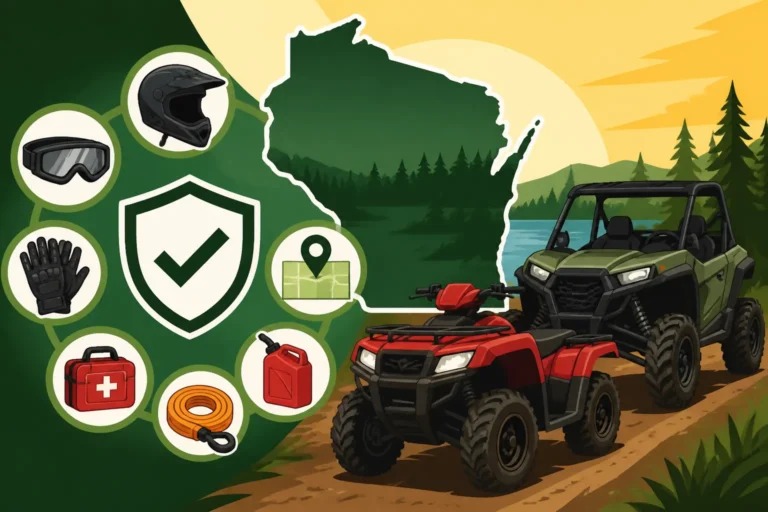
- Review rider and machine rules. Age, safety certification, helmets, lighting, sound, passengers, and other operating requirements may apply. Look at What Wisconsin Riders Need Before They Ride for a broader pre-ride checklist.
- Ask about special arrangements. For a borrowed or rented machine, confirm who is responsible for the pass and how it is displayed. For private land, get the landowner’s permission and verify whether your route leaves that property.
Road routes deserve particular care. A town may open specific roads to ATV or UTV use, but that does not mean every road in the area is open. Route rules can also include operating conditions that differ from trail rules. Read the signs at intersections, follow the posted route, and check the local ordinance or route map when you are unsure. A nonresident pass does not turn an ordinary road into a legal route.
The same caution applies to private land. If your entire ride stays on land you own or have permission to use, public-trail pass rules may not apply in the same way. But once you connect to a public trail or route, the public-use requirements become relevant. Do not ride across neighboring land or along an unmarked road simply because it appears to provide a convenient connection.
Finally, build in time for a last check. Trail status, route access, and operating conditions can change between planning a trip and arriving at the staging area. Keep the machine’s pass visible as instructed, respect closures, and be ready to turn around if the route is not open. If anything about the machine’s registration or pass status is unclear, resolve it before riding rather than hoping the paperwork will be accepted later.
Disclaimer
This article is for general informational purposes only and does not constitute professional advice. Laws, prices and regulations vary by location and change over time. Consult a qualified professional for guidance on your specific situation.