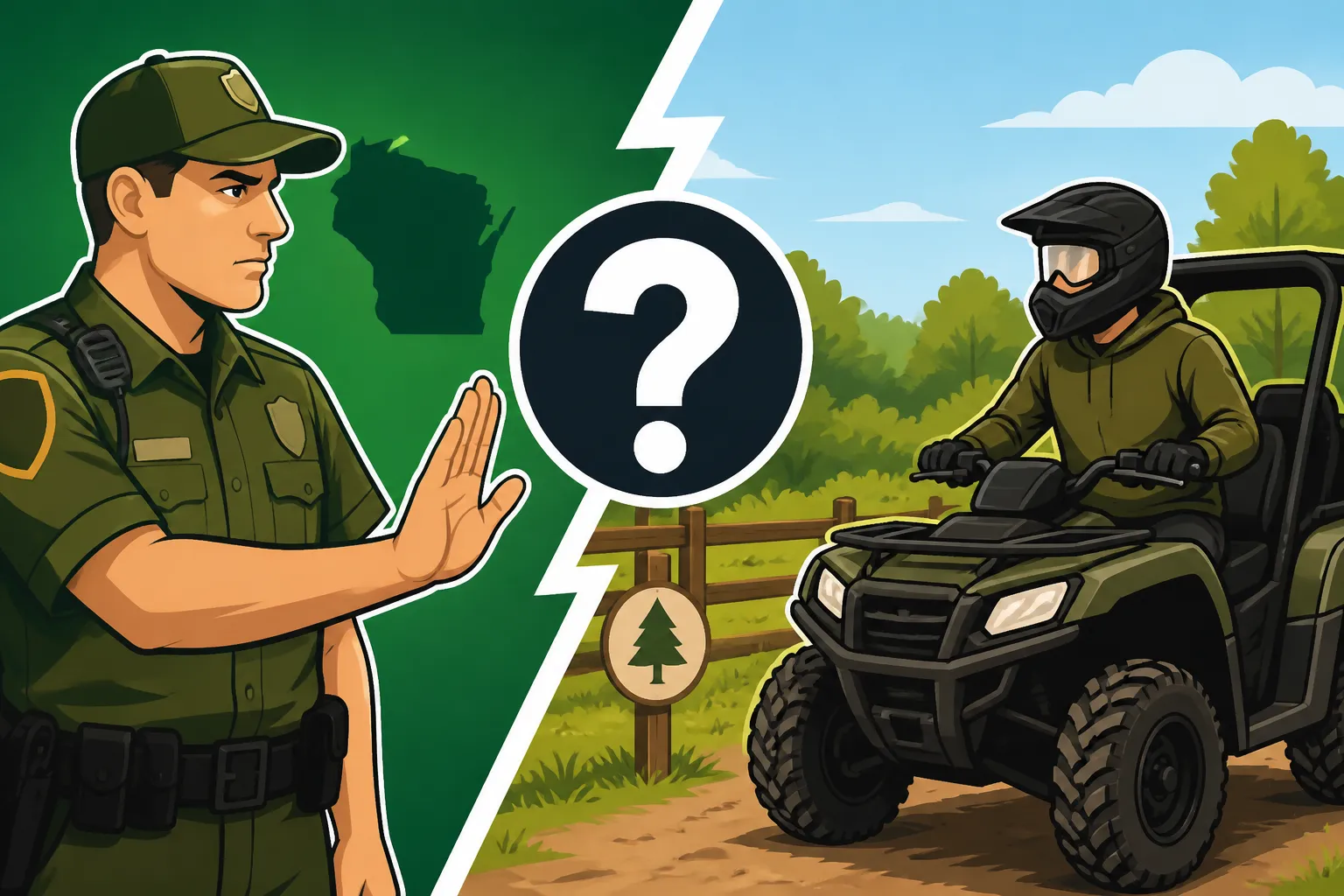
Can a Wisconsin Warden Stop You on Private Land?
A private driveway, farm lane, or wooded parcel can feel separate from public rules, but that does not automatically put an ATV or UTV rider beyond a warden’s reach. The key questions are what the warden is investigating, where the machine is being used, and whether the officer has a lawful basis to stop or approach you. Here’s how to think about those distinctions.
Private land does not automatically put a rider beyond a warden’s reach
“Private land” describes who owns the property. It does not, by itself, answer whether a Wisconsin conservation warden can investigate a suspected violation there. Wardens enforce conservation laws and may have authority to enforce other applicable laws, including rules affecting off-highway vehicles. The details depend on the situation.
That does not mean a warden has unrestricted permission to go anywhere on private property for any reason. It means property ownership alone is not a reliable way to conclude that an officer cannot approach, ask questions, or take action. The nature of the activity and the legal grounds for the officer’s actions matter.
For example, a warden might be investigating a report of illegal hunting, a suspected wildlife violation, unauthorized riding, or an ATV-related incident. A landowner’s permission to ride addresses access to the property; it does not necessarily settle whether the riding complies with other applicable rules. For background on permission and property access, see Riding a Friend’s Land by Permission in Wisconsin and Wisconsin Rules on Private Land.
A useful distinction is between being on private land and being inside a home or another highly private space. The legal protections for a residence and its immediate surroundings are generally stronger than for open land. A field, woods, or trail on private property does not carry the same expectation of privacy as the inside of a home. But that difference does not grant an officer unlimited authority: the reason for the entry and the circumstances still matter.
A warden’s lawful presence on a property may also depend on how they got there. The landowner or occupant might have consented to entry. The officer might have a warrant or an urgent reason to act. A specific law may also provide authority relevant to the investigation. If none of those considerations applies, the limits on an officer’s entry may become important. The answer is fact-specific, so it is risky to assume either that a posted boundary blocks every official approach or that an officer can enter every private area at will.
The word “stop” can mean different things, too. A warden might call out to a rider, ask to speak, investigate a complaint, or direct someone to stop during an enforcement action. Whether the encounter amounts to a detention, and whether there is a lawful basis for it, depends on what the officer does and the circumstances—not simply on the fact that the property is privately owned.
What kind of riding or suspected violation matters
Private-property ownership does not automatically exempt a rider from every ATV or UTV rule. At the same time, requirements for public trails and routes do not necessarily apply in the same way to every ride on land that is not open to the public. The machine, the location, the activity, and any applicable exception can change the answer.
| Situation | What private ownership does—and does not—tell you |
|---|---|
| Riding on land you own | Ownership may affect which rules apply, but it does not automatically waive every safety, registration, or conduct requirement. |
| Riding on a friend’s land | The owner’s permission helps establish that the ride is authorized by the landowner; it does not make the land public or settle every other legal requirement. |
| Riding on a marked trail or route | A trail or route may be subject to rules that differ from riding elsewhere on private property. Check the route’s status and local requirements. |
| A warden investigates a complaint | The fact that the land is private does not automatically end the investigation; the warden still needs a lawful basis for any enforcement action. |
| A warden wants to enter a home or private enclosed area | The protections and legal rules can be different from those that apply to open land. The specific circumstances matter. |
If you are riding on your own land, do not assume that the answer to “Do I need a pass?” also answers questions about registration, safety requirements, or other restrictions. Those are separate issues. Do You Need a Pass on Deeded Wisconsin Land? focuses on trail-pass questions, while Do You Need Registration on Your Own Wisconsin Land? addresses a different requirement.
Likewise, an invitation to ride on someone else’s property is not a general waiver of public-land or road rules. If the ride reaches a designated trail, a town route, a county road, or another area with its own requirements, those rules may matter even though the ride began on private property. The distinction between a property owner’s permission and a legal authorization to ride is important. See Riding Posted Land in Wisconsin for the separate issue of riding where access is restricted.
The activity being investigated matters as well. A warden responding to a suspected wildlife or hunting violation may be acting for a different reason than an officer checking an ATV on a public route. A rider should not assume that an ATV’s location determines the full scope of an investigation. Conversely, a report or a question from an officer does not, by itself, prove that a violation occurred.
For public trails, trail systems, and routes, the relevant requirements may be more specific. A private parcel can border or contain a route, or a trail may cross private land under an access arrangement. That does not necessarily mean every nearby area is part of the route—or that riding off the designated route is allowed. Wisconsin Passes and Trails That Cross Private Land and Wisconsin Trespass Law for Riders help clarify why land ownership, trail access, and permission are separate questions.
What to do if a warden approaches or tells you to stop
A calm, careful response is usually more useful than trying to settle the legal question in the moment. Do not speed away, hide the machine, or obstruct the officer. Those actions can turn a brief contact into a more serious situation and may create separate safety or legal concerns.
If the warden asks to speak with you, you can respond politely and listen to the question. If you are unsure whether you are free to leave, ask in a neutral tone: “Am I being detained, or may I go?” That helps clarify the nature of the encounter without arguing about property rights at the roadside.
If the officer directs you to stop, stop in a safe place and keep your movements visible. Avoid reaching suddenly into a bag, storage box, or vehicle compartment. If you need to retrieve documents or another item, say what you are about to do and wait for the officer’s direction. These are practical safety steps, not an admission that the officer’s actions are lawful.
You can ask what the officer is investigating and whether you are required to answer a particular question. If you believe the officer is entering a part of the property where entry is not authorized, state your concern calmly rather than physically blocking access. Do not interfere with the officer or try to resolve a dispute by force. If the encounter involves a search, you can clearly say that you do not consent, while avoiding any action that obstructs the officer. A statement of non-consent does not itself decide whether the search is legally allowed.
If the warden asks for information or documents, avoid guessing about legal requirements. Answer truthfully. If you do not know an answer, say so rather than supplying something inaccurate. Keep in mind that rules about what a rider must carry or produce can depend on the location and activity. Do You Carry Papers on a Wisconsin Trail? and What a Wisconsin Warden Asks a Rider For cover document questions in a riding context.
If you think the stop or entry was improper, make a note of what happened once you are safely able to do so. Record the time, place, names or identifying details you were given, what the warden said, what you said, and whether anyone else saw the encounter. Keep any notice or citation. Do not rely on memory alone if you later need to explain the situation to a lawyer or respond through an official process.
A citation is not a final decision on whether a violation occurred. Pay attention to any instructions and deadlines shown on the paperwork, and get legal advice if the matter could affect your rights, property, or ability to ride. For related enforcement context on routes and trails, see Warden Enforcement on Wisconsin Routes and Wisconsin Warden Checkpoints on the Trail.
How to reduce confusion before riding private property
Before unloading or starting a machine, confirm exactly where you have permission to ride and what that permission covers. Permission to use one field or trail does not necessarily include the neighboring parcel, a public road, a county forest, or a route that crosses the property. If the boundary is unclear, ask the landowner to point it out or provide a map.
Also ask whether the landowner has conditions for riding, such as which areas to avoid, when to stay off the property, or whether guests may bring additional riders. These conditions are about access and responsible use. They do not replace any separate requirements that may apply to the machine or to the specific place you plan to ride.
Check the machine’s status and the riding area’s rules separately. A private-land exemption, where one applies, may not answer questions about riding on a designated trail, a public route, or a road. Likewise, a trail pass does not establish permission to cross private property. If you plan to leave private land and connect to a public route or trail system, confirm what applies before you set out.
If there has been a complaint, a recent dispute with a neighbor, or an enforcement contact, avoid treating a new ride as a chance to test the boundary. Clarify access with the landowner, use a route you are authorized to use, and verify requirements through an appropriate official source when the situation is uncertain.
The practical takeaway is straightforward: private land is not a blanket shield from enforcement, but neither does a warden’s title mean every entry or stop is automatically lawful. The location, the reason for the contact, and the legal basis for the officer’s actions all matter. Respond safely, avoid escalating the encounter, and get qualified help if you need an answer about a specific stop or property.
Disclaimer
This article is for general informational purposes only and does not constitute professional advice. Laws, prices and regulations vary by location and change over time. Consult a qualified professional for guidance on your specific situation.