Wisconsin Snowmobile Trails and ATVs
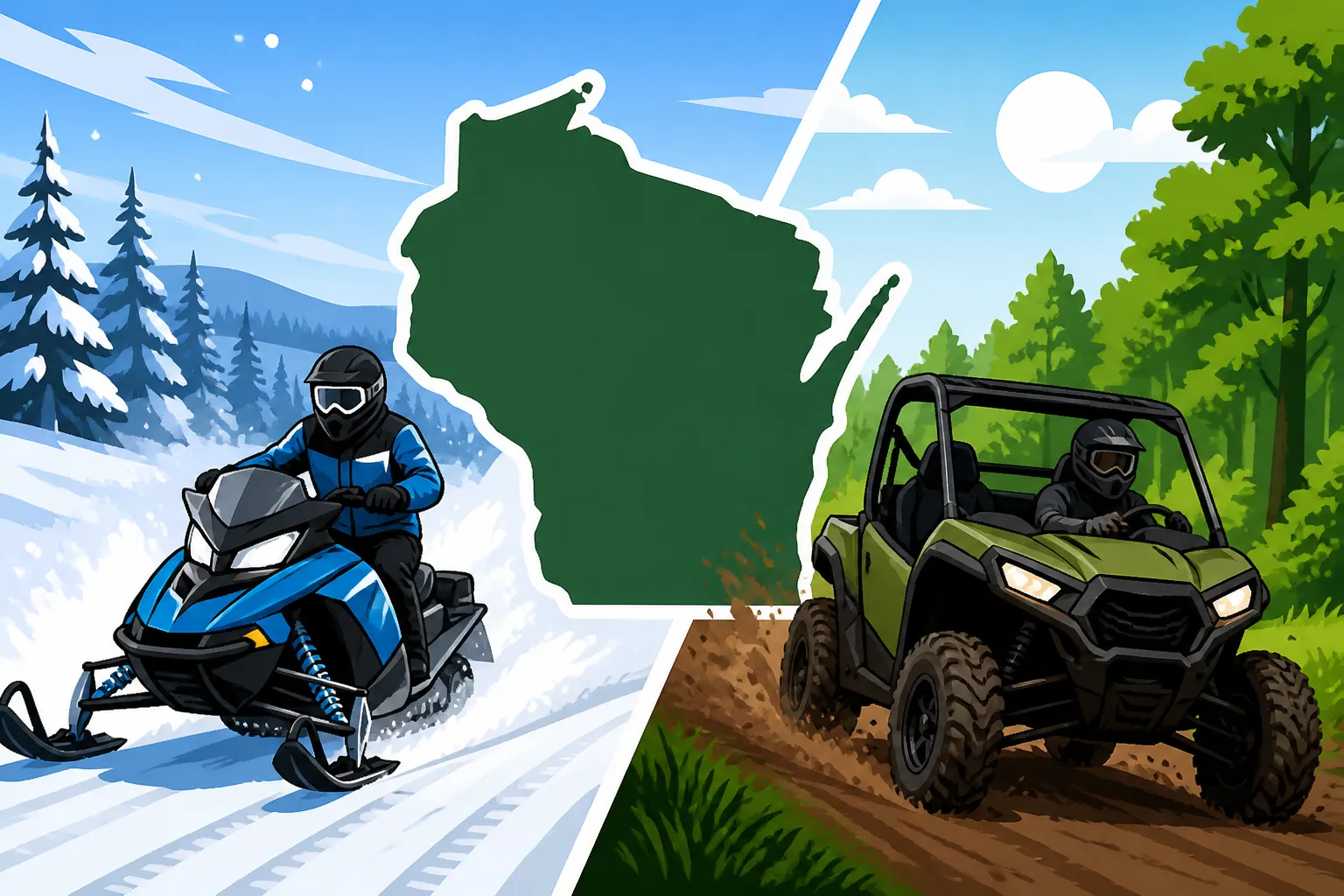
Wisconsin snowmobile trails can look like convenient ATV routes, especially when there is no snow on the ground. But a visible trail or an open gate does not mean ATVs and UTVs are allowed. The safe approach is to confirm that the exact segment is open to your machine, for the current season, and that you meet its registration and pass requirements.
A snowmobile trail is not automatically an ATV trail
Wisconsin has trails and routes managed by different landowners and public agencies. Some corridors are designated for more than one type of vehicle, but snowmobile access by itself does not grant ATV or UTV access. A trail may be open to snowmobiles in winter and closed to ATVs year-round, or it may allow ATVs only during a particular season. The permission depends on the specific trail and the authority managing it.
This distinction matters even when a route appears physically suitable for an ATV. A wide, dry track through a county forest can still be closed to motorized use outside the snowmobile season. Conversely, a local trail network may designate the same corridor for ATVs during snow-free months. Neither appearance nor past experience is a substitute for current local permission.
Also distinguish a snowmobile trail from a snowmobile route. A trail is generally an off-road corridor; a route may use roads or other designated connections. A road connection that allows snowmobiles does not automatically allow ATVs. Check Wisconsin Rules on Snowmobile Corridors and the applicable local road rules rather than assuming that a shared corridor has one set of permissions.
An ATV and a UTV may also face different practical restrictions. A narrow trail might be open to ATVs but too narrow for a side-by-side, or have posted width limits. The local trail authority’s rules and signs control. Do not assume that a UTV is permitted simply because a smaller quad can use the trail.
A useful starting point is to treat each trail segment as having its own answer to four questions:
- Is motorized recreation allowed on this land?
- Is ATV or UTV use specifically allowed?
- Is it open on the day and during the season you plan to ride?
- Does your machine meet the trail’s limits and carry the required credentials?
If any answer is unclear, check with the local land manager before unloading. County forest departments, trail associations, tourism offices, and the Wisconsin DNR may provide maps or notices, but the managing authority is the one to rely on for a particular segment. For a broader overview of Wisconsin riding areas, see Where to Ride an ATV in Wisconsin.
How to confirm access before you ride
Trail access can change by season, weather, maintenance work, and local decisions. A map can help you plan, but it may not reflect a temporary closure or the latest local designation. Use more than one check when possible: look at the relevant county or land manager’s current trail information, then confirm the signs at the entrance and along the route.
Check the exact location and season
Start with the trail system, county, or forest you intend to visit. Look for information that identifies ATV or UTV access specifically, not just “motorized use” or “multi-use.” Confirm the dates or conditions of access. A trail may be open to ATVs in summer but reserved for snowmobiles once winter conditions and local grooming begin.
Seasonal opening dates are not interchangeable across Wisconsin. Some trail systems close during spring thaw to protect wet soil, and a corridor that was open recently may be closed after rain or during maintenance. Review When Wisconsin Trails Open After Thaw and Wisconsin Trail Closures in April when planning a spring trip. If local notices say a trail is closed, do not ride around a gate or use a nearby track as a workaround.
Weather can matter even when a trail is technically scheduled to be open. Soft ground, standing water, or a damaged crossing may prompt a temporary closure or make riding harmful. Follow posted notices and barriers, and turn around if conditions are unsafe or the trail is visibly deteriorating. “It looks passable” is not permission to cause ruts or bypass a closure.
Read signs and gates as rules, not suggestions
At the trailhead, look for the vehicle types allowed, seasonal restrictions, direction of travel, width limits, and any local conditions. Continue checking signs along the route, especially where trails split, cross roads, or pass from one property to another. A shared trail can become snowmobile-only after a junction.
A gate’s position can be easy to misread. An open gate may be open for maintenance, a landowner, or another authorized user; it does not by itself establish ATV access. A closed gate or a clear closure sign means stop. Do not go around a barrier, even if tracks show that someone else did.
Trail markers and maps have different roles. A map may show a larger network, while signs identify the permitted path on the ground. If they appear to conflict, do not choose the interpretation that gives you more access. Stop and verify with the managing authority. Wisconsin Trail Signs and Markers explains how to use markers as part of a route check.
Check credentials separately from access
Permission to ride and permission to use a particular trail are different issues. Registration, a trail pass, or a snowmobile credential does not convert a snowmobile-only corridor into an ATV trail. First confirm ATV or UTV access; then check what your machine and rider need for that area.
On designated ATV trails, registration and pass requirements depend on the machine’s registration and the rider’s circumstances. Wisconsin-registered machines and machines registered elsewhere may be treated differently. Review Which Wisconsin Trails Require a Pass and, if you are visiting from another state, Wisconsin’s Non-Resident Trail Pass. A route that uses public roads can have additional rules that do not apply to an off-road trail.
For Wisconsin-registered machines, confirm whether the registration is current and appropriate for the intended use. Public-use registration and private-use registration are not the same thing. The detail that matters is not simply whether a registration decal is on the machine, but whether its status allows the planned public riding. See Public Use Versus Private Use in Wisconsin for the distinction.
Do not rely on a pass or registration from a snowmobile for ATV access. Each vehicle type and trail system can have its own requirements. Before the trip, verify the requirements for the machine you will actually ride, including any local permits or event rules.
| What to check | Why it matters | Where to verify |
|---|---|---|
| ATV or UTV designation | Snowmobile access alone does not authorize ATV use | Trail manager, county, or current local map |
| Dates and closures | Access may change by season, weather, or maintenance | Current notices and trailhead signs |
| Machine width and type | A trail may allow quads but restrict wider UTVs | Local rules and posted signs |
| Registration and pass | Credentials do not replace trail permission | Wisconsin DNR information and trail authority |
| Road connections | Road routes can have separate restrictions | Town or county rules and route signage |
Common mistakes and a safer trip plan
The most common mistake is assuming that a snowmobile corridor is open to ATVs whenever there is no snow. The second is relying on a map that shows a trail line without checking what vehicles may use it. A route map can show where a corridor goes; it may not answer whether your ATV is allowed there today.
Other errors are easy to avoid:
- Following tracks as proof of access. Another rider may have been authorized, mistaken, or simply riding illegally.
- Treating an open gate as permission. Check the signs and designation, not just whether the barrier is open.
- Assuming a pass covers every trail. A pass satisfies a credential requirement where applicable; it does not open a closed or snowmobile-only trail.
- Riding past a closure because the ground seems firm. Closures protect the trail and may remain in force even when conditions look manageable.
- Assuming a route allows every machine. UTV width or other local restrictions may differ from ATV rules.
- Confusing a trail with a road route. Road access can depend on local ordinances and may not continue onto an off-road snowmobile trail.
A simple planning routine reduces the chance of a wasted trip or a citation:
- Choose the trail system. Identify the county, forest, or other land manager responsible for the corridor.
- Find current access information. Look specifically for ATV or UTV designation and the dates it applies.
- Check for closures. Review weather-related, seasonal, and maintenance notices shortly before leaving.
- Confirm your machine’s fit and credentials. Check registration, pass requirements, and posted width or equipment limits.
- Carry a usable map. Save current information for offline use or bring a paper map, since mobile service can be limited in some riding areas.
- Follow signs on the ground. Stop at ambiguous junctions and do not cross a barrier or enter a restricted segment.
- Turn back if access is uncertain. A shorter ride is better than trespassing or damaging a closed trail.
If you are planning a longer trip across multiple counties, verify each trail system separately. A corridor may connect to another network without carrying the same rules across the boundary. The transition may be marked by a sign, but it is still your responsibility to know when the managing authority or allowed vehicle type changes. County maps and trail offices can help identify those transitions; Wisconsin County Forest Trail Systems is a useful starting point for finding areas to investigate.
When a trail is closed to ATVs, use an authorized ATV trail or route instead of trying to make the snowmobile corridor work. Wisconsin’s trail network offers many designated riding options, but access is local and conditional. Confirming the exact segment, season, machine type, and credential rules is the practical way to enjoy a ride without putting access at risk for the next visit.
Disclaimer
This article is for general informational purposes only and does not constitute professional advice. Laws, prices and regulations vary by location and change over time. Consult a qualified professional for guidance on your specific situation.