Wisconsin’s Non-Resident Trail Pass
An out-of-state plate can make a Wisconsin trail weekend feel straightforward—until you discover that your home-state registration may not cover every ride. This guide explains when nonresidents need a Wisconsin ATV or UTV trail pass, what it does and does not authorize, how to buy and display it, and what else to check before heading for the Northwoods.
What Wisconsin’s Non-Resident Trail Pass Is For
The pass is tied to trail access, not general permission to ride
Wisconsin’s nonresident ATV and UTV trail pass is for eligible machines registered outside Wisconsin that will be operated on Wisconsin public ATV trails. It is a trail-access requirement, not a general riding permit. Having a valid plate from Minnesota, Illinois, Iowa, or another state does not automatically mean you can ride every Wisconsin trail without a Wisconsin pass.
Think of the pass as one piece of the paperwork puzzle. Your machine still needs to meet applicable registration and operating requirements, and you must follow the rules for the specific trail or area. A pass does not give you permission to ride on closed trails, private land without consent, or a road that has not been opened to ATV or UTV traffic.
That distinction matters when you plan a trip. A rider might have a Wisconsin trail pass for a machine and still need to confirm that the intended route is open, that the vehicle is allowed there, and that local rules are met. For a broader explanation of the visitor’s requirements, see What Wisconsin Charges an Out-of-State Rider.
The pass is generally required for each eligible machine
The pass applies to a machine, not to the person holding the handlebars. If two nonresident riders bring two machines, do not assume one pass covers the whole group. Likewise, switching riders during the day does not ordinarily create a second pass requirement for the same machine, but lending that machine does not transfer the pass to another vehicle.
This machine-specific approach is easy to overlook when a family or group is organizing a trip. Someone may buy a pass for the lead ATV and assume the side-by-side behind it is covered too. Before leaving home, make a simple list of the machines you plan to ride and confirm that each one has the required documentation and pass.
A pass should also be treated as belonging to the machine it was issued for, rather than as a transferable ticket that can be moved among the family’s vehicles. If you replace or change machines, check the Wisconsin Department of Natural Resources’ current instructions about whether the existing pass can be moved or whether a new one is needed.
The standard annual pass has a published fee
Wisconsin’s standard nonresident trail pass is commonly listed at $35 per machine. Fees and purchase procedures can change, so confirm the amount shown through an official purchase channel before paying. The fee is a separate trip expense, not a substitute for your home-state registration, insurance, fuel, lodging, or any other required permit.
It helps to budget for the pass before you arrive. A group bringing three machines should plan for three separate passes rather than one group purchase. That way, the cost does not become a surprise at a trailhead or after you have already unloaded in a town such as Eagle River, Hayward, or Crivitz.
Keep the purchase confirmation and any required proof with your trip records. A confirmation can help if a sticker is delayed, misplaced, or damaged, but do not assume that a receipt alone satisfies the display requirement. Follow the current DNR directions for the physical pass and keep any supporting documentation available.
When a Nonresident Needs a Pass
Public ATV trails are the central distinction
The pass requirement is most directly associated with riding on Wisconsin public ATV trails. If your trip includes designated public trails, plan on checking the pass requirement for every nonresident machine before you go. A valid out-of-state registration is important, but it does not by itself establish that you have met Wisconsin’s separate trail-pass requirement.
Trail networks can connect different kinds of places: county forest trails, state forest areas, town roads, and signed routes. That can make it feel as though one set of rules applies to the whole day. In practice, rules may shift when you leave a trail and enter a road route or another land-management area. Check the official local map and signage, not just the map app or a route someone shared online.
Some riding areas also have seasonal closures, special restrictions, or limits on the types of machines allowed. A pass does not override those restrictions. Before you travel, review Which Wisconsin Trails Require a Pass and confirm the status of the particular trail system you plan to use.
A trail pass is not the same as registration
Registration identifies and authorizes a machine under the applicable registration system. A trail pass addresses access to certain public trails. Although the documents are related to legal operation, one should not be treated as a replacement for the other.
For example, a Minnesota-registered ATV may still need the Wisconsin nonresident trail pass to ride Wisconsin public trails. Conversely, buying the pass does not make an unregistered machine properly registered, correct an expired home-state registration, or satisfy every Wisconsin operating rule. If you are uncertain whether your home-state registration is valid for the type of use you intend, resolve that question before you trailer the machine north.
If the ATV or UTV is registered in Wisconsin, different rules may apply to the pass requirement. Wisconsin-registered machines generally do not need the nonresident pass simply because they are being ridden on Wisconsin trails. That does not mean every Wisconsin registration category works the same way for every type of riding. Review Machines Registered in Wisconsin and the Pass if your paperwork is Wisconsin-issued or you are comparing registration options.
Routes, roads, and trails are not interchangeable
An ATV route is not necessarily an ATV trail. Routes typically involve roads that have been opened to ATV or UTV use by the responsible local authority, while trails are designated off-road riding corridors. A nonresident trail pass does not itself authorize road use, and a public road being open to ATVs does not automatically mean the road is a trail.
This difference can affect an ordinary-looking ride through a Northwoods town. You may leave a forest trail, travel along a signed town road, and later rejoin the trail system. Each segment may have its own rules for registration, age, equipment, hours, insurance, and vehicle operation. A trail pass is only one requirement in that chain.
For a ride involving both roads and trails, confirm the full route rather than checking only the trail map. Look for the local ordinance and posted signs where you will enter a road segment. If your plans include town roads, What a Wisconsin ATV Route Actually Is can help clarify why road access should be checked separately from trail access.
| Riding situation | What to check before riding |
|---|---|
| Nonresident machine on a public ATV trail | Whether the machine needs a Wisconsin nonresident trail pass, and whether the trail is open |
| Machine on a signed ATV or UTV route | Local route access, registration, age, equipment, insurance, and operating rules |
| Machine on private land | Landowner permission and any rules that still apply to the machine or rider |
| Wisconsin-registered machine | Whether its registration category meets the requirements for the planned use |
| Rental machine | Whether the pass is included, properly displayed, and valid for that specific machine |
Reciprocity and Out-of-State Registration
A home-state plate does not automatically waive Wisconsin’s trail-pass rule
It is natural to expect neighboring states to recognize one another’s registrations in the same way. But reciprocity should not be assumed to mean that an out-of-state registration replaces Wisconsin’s nonresident trail pass for public trail use. The two documents serve different purposes, and Wisconsin’s trail requirements apply to visitors as well as residents.
This can catch people who have ridden in their home state for years without needing a separate trail sticker. They arrive with a current registration card, see the plate on the machine, and assume that is all a warden or trail official will expect. Before riding, verify the Wisconsin rule for the machine and the area rather than relying on what is required at home.
The same caution applies if your machine is registered in a third state but stored in Minnesota or at a Wisconsin cabin. Where you live, where the machine is stored, and where it is registered may all be relevant to different rules. For a Minnesota-specific starting point, see Do Minnesota Riders Need a Wisconsin Pass?.
The pass does not convert out-of-state paperwork into Wisconsin registration
Buying a nonresident pass does not change your machine’s registration state. It does not grant Wisconsin plates or convert a private-use registration into a public-use registration. Nor does it resolve a problem with mismatched ownership details, an expired registration, or missing proof of registration in your home state.
That is why it is useful to keep the machine’s documents together. Carry the valid registration or other required proof for the machine, the trail-pass documentation, and any insurance information required for the places where you intend to ride. Store them securely, but make sure you can produce them if asked.
If the machine was recently purchased, especially in a private sale, check that the registration and ownership records are in order before the trip. A pass purchase cannot fix missing transfer paperwork. If the machine is registered in Wisconsin rather than another state, review the relevant registration rules, including Wisconsin’s Public Use ATV Registration and Wisconsin’s Private Use ATV Registration, to understand which registration category applies to your situation.
Reciprocity does not replace local trail and route checks
Even if your machine’s home-state paperwork is accepted for a particular purpose, that does not guarantee access to every Wisconsin trail, route, or public property. Land managers and local governments may set restrictions about trail openings, vehicle width, hours, speed, noise, or other operating conditions.
A trip from a cabin near St. Germain to a trail connection near Eagle River might cross more than one jurisdiction. The safest plan is to check the trail system and towns you will actually use, rather than assuming a pass or registration makes every connection legal. A route that appears continuous on a phone map may include a road that is not open to ATVs or UTVs.
Keep in mind, too, that permission to use private property is separate from state trail access. A landowner can give you permission to ride on their land, but that does not authorize you to cross a neighboring property or join a public trail without meeting its requirements. Build the day’s route around confirmed access points and current signs.
Buying and Displaying the Pass
Choose an official purchase channel and enter the machine details carefully
Nonresident trail passes are available through Wisconsin DNR purchasing options, including online services and authorized agents. Before you buy, check that you are selecting the pass for the correct vehicle type and use. A small error in the machine’s identifying information can become stressful when you are already on the trail and need to show that the pass belongs to the vehicle.
Have the machine’s details and registration information nearby while completing the purchase. Read each field before submitting, particularly if your group has several similar ATVs or UTVs. It is surprisingly easy to enter the wrong registration number when you are working from a phone and switching between paperwork for multiple machines.
If you prefer to buy in person, confirm that the seller is an authorized agent and that the pass is available before making a special trip. For online purchasing details, see Buying a Wisconsin Trail Pass Online. For an in-person option, Wisconsin Agents That Sell Trail Passes can help you identify the type of local purchase location to look for.
Display the pass as directed
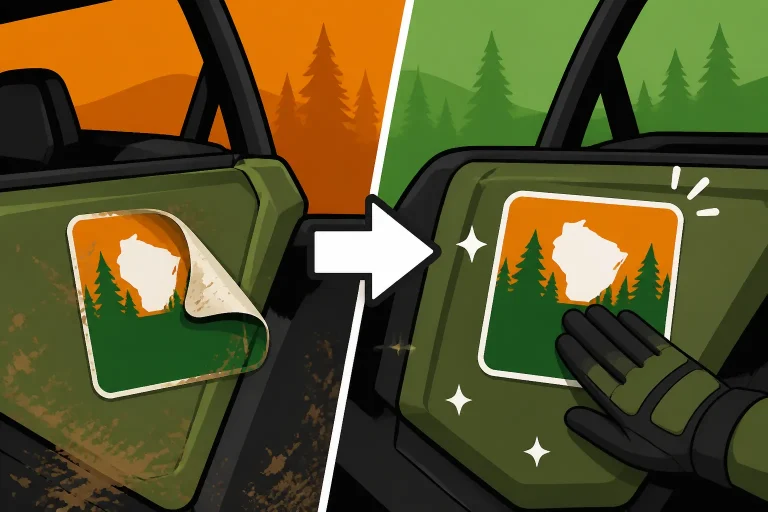
A pass is not useful if it is still in the glove box when the machine is inspected. Follow the current Wisconsin DNR directions for attaching and displaying it. The location and method matter because a sticker that is hidden by a cargo box, covered in mud, placed where it peels easily, or stuck to a removable accessory may be difficult to verify.
Prepare the surface before applying the decal. A clean, dry, relatively flat spot is generally more dependable than a dusty or wet panel. Avoid placing it where a rack, windshield, fender bag, or protective film will cover it. If you are unsure which panel is acceptable, use the official placement instructions rather than relying on another rider’s machine as a guide.
After you apply the pass, take a moment to check that it is firmly attached and visible. This small task is easy to forget when unloading at a busy staging area, especially after a long drive. For more on placement, see Displaying a Wisconsin Trail Pass. If the pass is damaged or comes off, consult the DNR’s replacement guidance before continuing to rely on it.
Keep proof and protect the decal during transport
A trail pass can be scuffed, peeled, or damaged while a machine is being loaded, strapped down, or hauled through bad weather. Check it after transport and before the first ride. A quick inspection at the trailer is easier than discovering a problem after you have entered a trail network.
Keep the receipt or confirmation in a place where it will not be soaked or lost. A digital copy can be useful as a backup, but it should not be treated as a substitute for displaying the pass unless current official instructions specifically allow that. If the sticker has become unreadable, do not assume that a photo of it will settle every question.
For a group trip, make one person responsible for checking each vehicle. A simple walk-around can confirm that every machine has its own pass, the decal is visible, and the registration information belongs to that machine. This is particularly helpful when machines are similar in color or model and are unloaded together at a crowded trailhead.
What the Pass Does Not Cover
It does not create permission to ride on a closed trail
Trail access can change because of seasonal closures, weather, maintenance, land conditions, or local decisions. A valid pass does not give you a right to ride through a closed gate or ignore a closure notice. Trail conditions can also differ across nearby counties, so one open system does not mean every system is open.
Closures are frustrating when you have already booked lodging or driven several hours. Still, riding around a barrier can damage land, create safety problems, and put access at risk for everyone. Check the current status before departing and again before unloading, especially during spring thaw or after heavy rain.
Have a backup plan that uses a confirmed open trail system, or adjust the trip if conditions make riding inappropriate. Carrying a pass is not a substitute for checking signage at the trailhead. If a sign conflicts with what you expected from a map or an older post, follow the posted restriction and seek clarification from the responsible land manager.
It does not replace safety certification or age rules
The pass is about trail access; it does not certify a rider or waive age-related requirements. Wisconsin has separate ATV and UTV rules involving safety certification, supervision, and the age of the operator. These rules can differ by vehicle type and riding situation, so families should not assume that buying one pass settles the legal requirements for a young rider.
Before traveling with children or teens, confirm who may operate each machine and what supervision or training is required. A parent may be comfortable with a young rider on private property, but public trail requirements can be different. Also check passenger rules: a machine designed for one rider should not be treated as a two-person vehicle simply because a passenger can physically sit on it.
The pass does not replace the rider’s responsibility to use appropriate protective equipment and follow operating rules. Start with Wisconsin’s ATV Safety Certificate Requirement and confirm the age and supervision rules that apply to your family. If your group includes riders of different ages, make those checks before the trip rather than sorting them out at the trailhead.
It does not automatically satisfy insurance, equipment, or local requirements
A trail pass does not guarantee that a machine meets noise, lighting, helmet, passenger, or insurance requirements. Some rules depend on where you ride, the vehicle type, or local ordinances. A visitor who is legally registered at home may still need to understand Wisconsin-specific requirements before riding a public trail or route.
Think of the pass as one line on a pre-ride checklist, not the checklist itself. Review the machine’s condition, required lights and safety equipment, and any local restrictions. If your trip uses town roads, confirm whether the town or county imposes additional requirements. Keep in mind that a route open to one type of machine may not be open to every ATV or UTV configuration.
It is also wise to check insurance coverage before departure. A household or recreational policy may have limitations that depend on the vehicle, rider, or location. Do not infer coverage from the fact that a pass was issued. Ask your insurer what applies to the machine and the planned use, and carry any proof that is required.
Planning a Wisconsin Ride as a Visitor
Check the whole route, not only the destination
A successful weekend is usually decided before the trailer leaves the driveway. Identify the trail system, trailhead, roads you may use to connect segments, and any towns or land-management areas along the way. Then confirm that the trail is open and that your machine and paperwork are suitable for each part of the ride.
This matters in popular riding areas where trails link communities and county forest land. A route around Rhinelander, Hayward, or Marinette may involve local trail networks and road connections with different operating rules. Do not assume that a line on a mapping app is a legal ATV route; verify it against official maps, local information, and on-the-ground signs.
Plan fuel and turnaround points, too. Some Northwoods stretches have long gaps between services, and cell reception can be limited. A map downloaded before you leave, a paper backup, and a realistic fuel plan can save a ride when the group is tired or conditions change. A pass gets you through one administrative step, but good route planning makes the day workable.
Make a document check part of loading the trailer
Before departure, confirm each machine’s registration, pass status, and identifying details. Make sure the pass is displayed as directed and that the machine’s paperwork is available. If a machine was borrowed, rented, or recently purchased, confirm who is responsible for the pass and what documentation should travel with it.
A checklist is useful because the details are easy to mix up when several people are loading. You might assign one person to each machine or make one person responsible for checking the whole group. Compare the machine’s plate or identifying number with the documents, then make sure the correct pass is attached to the correct vehicle.
It is also worth inspecting the trailer straps, tires, lights, and tie-down points before the drive. A decal can be damaged during loading, and a loose machine can create a much bigger problem than a missing receipt. Pack basic recovery and repair supplies appropriate to the route, and tell someone where your group plans to ride.
Confirm rental and borrowed-machine arrangements in advance
If you are renting an ATV or UTV, ask the rental provider whether the required Wisconsin trail pass is included and already displayed. Do not rely on a verbal assumption that “everything is covered.” Confirm which machine the pass applies to and whether you need to carry any documentation during the ride.
This is particularly important when a rental changes at the last minute. A replacement machine may have different paperwork or a different pass status, even if it looks identical to the one you originally reserved. Before leaving the rental location, check the decal, ask what routes and trails are permitted, and review any instructions about where the machine may be operated.
Borrowing a friend’s machine deserves the same care. Ask the owner about registration, pass status, insurance, and any restrictions on who may operate it. A friend’s reassurance is helpful, but it is still worth checking the actual paperwork and machine. For a more specific overview, read Wisconsin Pass Rules for a Rented Machine and apply the same careful questions to borrowed vehicles.
Common Visitor Mistakes and How to Avoid Them
Assuming a registration card is enough
The most common misunderstanding is thinking that a current out-of-state registration automatically covers Wisconsin public trail access. It may establish that the machine is registered in its home state, but visitors should separately confirm whether Wisconsin requires a trail pass for their planned riding.
Avoid this mistake by checking the pass requirement before travel, not after unloading. If you are bringing multiple machines, verify each one individually. The pass is not a rider’s group credential, and the registration card for one machine does not cover another.
Also check that the registration itself is current and matches the machine. A pass will not correct a registration lapse or a paperwork mismatch. If the machine has recently changed hands, get the ownership and registration details sorted out before making the trip.
Treating every open road as an ATV route
A paved or gravel road may look like an obvious connection between trails, but that does not mean ATVs or UTVs are permitted to use it. Route access is established locally, and signs or ordinances may set specific conditions. A trail pass does not grant a right to ride along any road that happens to appear on your map.
Use official route information and follow signs at intersections. If the group is uncertain whether a road segment is open, stop and confirm rather than guessing. An unplanned detour through a town can lead to a citation or an unsafe encounter with ordinary traffic.
This is another reason to plan the whole itinerary. Mark the legal connections between trail segments and identify where you will refuel or stop. It is more relaxing to know the route before the group is dusty, tired, and trying to make a decision at an unsigned junction.
Waiting until the trailhead to fix a paperwork problem
A missing pass, a damaged decal, or an expired registration is much harder to resolve at a remote staging area than at home. Some trailheads have limited cell service, and a purchase confirmation may not solve a display problem. Leaving paperwork until the last minute turns an easily fixed task into a frustrating interruption.
Do a document check a few days before departure and another check when loading. Confirm the pass is attached, the registration is available, and the machine is ready for the intended route. If a decal is missing or the purchase record looks wrong, contact the appropriate official channel before riding.
Keep a backup plan for practical issues. Save confirmation details, keep the machine’s information in an accessible place, and know how to contact the provider or agency that issued the pass. A little preparation lets you spend more of the weekend riding and less time trying to untangle paperwork beside a trailer.
Disclaimer
This article is for general informational purposes only and does not constitute professional advice. Laws, prices and regulations vary by location and change over time. Consult a qualified professional for guidance on your specific situation.