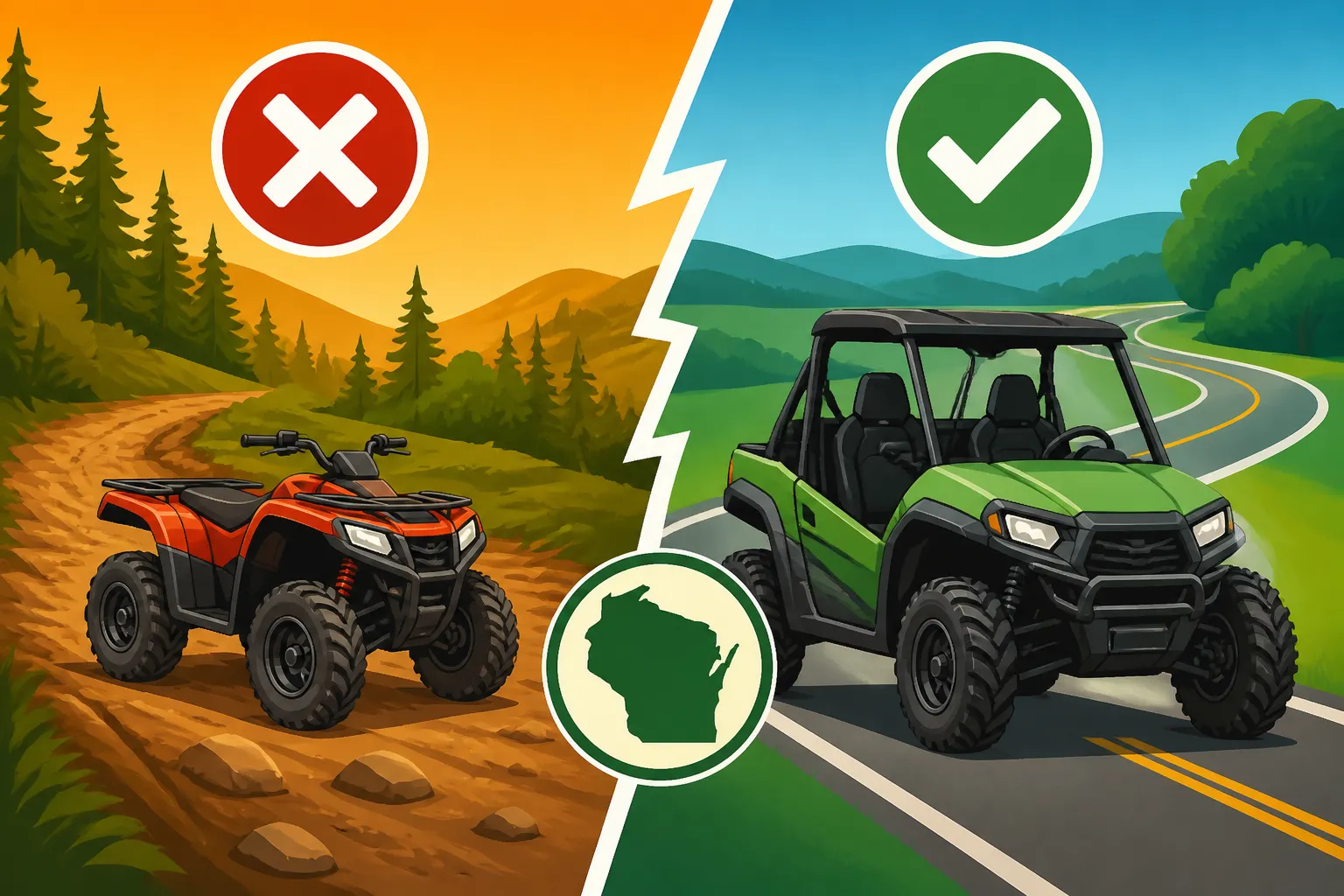
Why UTVs Are Treated Differently on Routes
It can be incredibly confusing to navigate Wisconsin's ATV and UTV rules, especially when you hit a road route and realize that side-by-sides often face different regulations than their ATV counterparts. Many riders feel frustrated by the seemingly arbitrary distinctions, wondering why their machine, which seems perfectly capable on trails, suddenly has different restrictions on town roads. This guide aims to clear up that confusion, explaining the core differences in how Wisconsin law treats ATVs and UTVs on public routes and why these distinctions exist.
The Foundational Differences: ATVs Versus UTVs in Wisconsin Law
First things first, it's crucial to understand that while they both fall under the umbrella of "off-highway vehicles," Wisconsin law makes a pretty clear distinction between an All-Terrain Vehicle (ATV) and a Utility Terrain Vehicle (UTV). This isn't just about what they look like, but about their design, capabilities, and the inherent risks or perceived safety features associated with each. It’s these foundational differences that ripple out into all the various rules and regulations.
What Defines an ATV in the Eyes of the Law?
When the Wisconsin Department of Natural Resources (DNR) talks about an ATV, they're generally referring to a motorized vehicle that's designed to travel on four low-pressure tires, has a seat designed to be straddled by the operator, and handlebars for steering control. Think about your classic quad – the kind you throw a leg over, much like a motorcycle. These machines are typically designed for single riders, though some manufacturers do produce models rated for two, often with a dedicated passenger seat behind the operator.
The traditional ATV, with its straddle seating and handlebar steering, places the rider in a more exposed position. While modern ATVs are incredibly stable and capable, their design leans more towards individual maneuverability and agility. Legislators often view them as more akin to a motorcycle or dirt bike in terms of operation and rider exposure. This perception plays a significant role in how rules, particularly those concerning youth operators and passengers, are crafted.
The Characteristics That Make a UTV Unique
A UTV, or Utility Terrain Vehicle, presents a very different picture. These machines are often called "side-by-sides" for a reason: the operator and passengers sit side-by-side in seats more akin to those found in a car or truck, rather than straddling a seat. They typically have a steering wheel, foot pedals for acceleration and braking, and roll-over protection structures (ROPS) that are often equipped with seatbelts. UTVs are generally wider, heavier, and have a greater carrying capacity than ATVs, often featuring cargo beds or extensive storage options.
The design of a UTV, with its automotive-style controls and enclosed cabin feel, gives a different impression of safety and utility. While they are still off-road vehicles, their size and passenger capacity make them feel much more like small cars to legislators and the general public. This "car-like" characteristic is a huge part of why the regulations shift. They are seen as capable of carrying more people and often traveling at higher speeds, necessitating different rules to ensure safety on shared public routes.
Why Wisconsin Legislators See Them Differently on Public Routes
The varying regulations between ATVs and UTVs on Wisconsin road routes aren't arbitrary; they stem from distinct legislative interpretations and public safety concerns. Lawmakers aren't just picking numbers out of a hat; they're trying to balance recreational access with the safety of all road users. Understanding this perspective can help riders navigate the rules with less frustration.
Perceived Safety and Design Philosophies
One of the biggest drivers behind the different treatment is the perceived safety of each vehicle type. ATVs, with their open design and straddle seating, put the operator in a very active role, using body english and skill to navigate terrain. While thrilling, this can also be seen as inherently more exposed, especially for younger riders or passengers. UTVs, on the other hand, with their roll cages, automotive-style seating, seatbelts, and often even doors, tend to be viewed as providing a greater degree of passive safety.
However, this perceived safety also comes with increased size and weight. A UTV, even a compact one, has a much larger footprint and mass than a typical ATV. When these larger, heavier machines operate on public roads—even designated road routes—they interact differently with other vehicles, bicycles, and pedestrians. The legislature must consider the potential for more significant impacts in collisions, which influences speed limits, age restrictions, and required safety equipment. This is where the practical application of rules regarding things like [Wisconsin Helmet Rules for Riders Under 18] comes into play.
Historical Context and Evolving Regulations
The evolution of off-road vehicle laws in Wisconsin also plays a part. ATVs have been around in their modern form for longer, and many of the original laws were written with these machines in mind. UTVs, particularly the recreational sport models, are a relatively newer phenomenon, and laws have had to catch up. When a new type of vehicle gains popularity, legislators often look at existing frameworks and adapt them, or create entirely new ones, to address the unique characteristics and potential impacts of the new machine.
This means that sometimes the rules feel a little piecemeal or like they are lagging behind the technology. The rapid advancements in UTV design, making them faster, more powerful, and more car-like, have forced lawmakers to reconsider how these vehicles fit into the existing traffic infrastructure, even on designated ATV/UTV road routes. What started as simple "utility" vehicles for farms has morphed into high-performance recreational machines, and the regulations have tried to keep pace, sometimes creating a patchwork of rules that can be challenging for riders to decipher.
Age and Safety Certificate Rules for Operators and Passengers
This is one area where the distinction between ATVs and UTVs becomes strikingly clear, especially for families looking to enjoy the trails and routes together. Wisconsin law sets different minimum age requirements for operating these machines on public trails and routes, and these rules are directly tied to the type of vehicle.
Minimum Age for Operation
For ATVs in Wisconsin, a person must be at least 12 years old to operate on public trails and routes. If they are born on or after January 1, 1988, they also need to possess an ATV safety certificate. This rule for ATVs is fairly straightforward, allowing younger riders to gain experience under supervision. You can find more detail on this in [Wisconsin's Rule for Riders Aged 12 to 15].
UTVs, however, have a higher bar. To operate a UTV on a public route or trail in Wisconsin, an individual must be at least 16 years old. This is a significant jump from the ATV requirement and often causes confusion and frustration for families with younger teenagers who might be perfectly capable of driving a UTV on private land. The rationale here typically circles back to the UTV's size, weight, and "car-like" nature. Legislators likely feel that the responsibility associated with operating a larger, multi-passenger vehicle on public ways requires a higher level of maturity and driving experience, similar to car licensing. [Wisconsin ATV Safety Certificate Requirements] are vital for understanding who needs what.
Passenger Rules and Youth Supervision
Passenger rules also differ significantly. While many ATVs are designed for a single rider, those rated for two passengers allow a passenger to ride behind the operator. For youth passengers under 18, specific helmet rules often apply. However, UTVs, by their very design, are built to carry multiple passengers, with various seating configurations. This is a key reason why they are treated differently.
Wisconsin law generally requires that all passengers in a UTV wear seatbelts if the machine is equipped with them – and most UTVs come standard with seatbelts. For youth operators (those 16 or 17 years old), or young passengers, there might be additional supervision requirements or restrictions depending on the specific route ordinance. This focus on passenger safety, especially in a vehicle that can carry several people, is a major component of UTV regulation on public routes. It's about protecting more than just the operator, and this is extensively covered in topics like [Passengers on a Wisconsin Road Route].
Equipment and Safety Features: What UTVs Need (or Are Assumed to Have)
The equipment requirements for ATVs and UTVs on Wisconsin routes diverge quite a bit, primarily because UTVs are often designed with features that ATVs lack. These differences influence safety expectations and what a rider might need to add to their machine to be compliant.
Standard Features and Legal Expectations
Most UTVs come from the factory equipped with features like a steering wheel, side-by-side seating, seatbelts for all occupants, a roll-over protection structure (ROPS), and often a windshield and doors. These are considered standard equipment, and their presence informs how the law treats UTVs. For example, if your UTV has seatbelts (which virtually all do), you are legally required to use them. This is a contrast to many ATVs, where seatbelts are generally not standard or required due to the straddle seating design.
On the other hand, a standard ATV might only have handlebars, a straddle seat, and basic lighting. While riders often add accessories like a front storage rack or handguards, these aren't typically safety features mandated by law for basic operation. The inherent design of the UTV, with its more "enclosed" passenger compartment, leads to more stringent expectations for occupant restraint and protection.
Aftermarket Additions and Compliance
While UTVs come with many features, owners often customize their machines. When riding on designated routes, some aftermarket additions become particularly important for legal compliance and safety. For instance, a full windshield might not be explicitly required on all routes, but it's a feature many UTV owners prioritize for comfort and protection, especially from kicked-up debris. Companies like SuperATV offer a wide range of windshields, mirrors, and other accessories designed to enhance both safety and convenience on public routes, helping riders meet or exceed expectations.
Other critical equipment for both ATVs and UTVs on routes includes proper lighting (headlights, taillights, brake lights) for visibility, especially during dawn, dusk, or nighttime operations. While many newer machines come with excellent lighting, older models or those with modified exhausts might need attention to ensure they meet the 96-decibel sound limit and have functioning spark arresters, as discussed in [The 96-Decibel Sound Test in Wisconsin]. The larger size of UTVs on routes often emphasizes the need for excellent visibility, both for the operator and for other drivers who might encounter the UTV.
Navigating Specific Route Restrictions and Municipal Ordinances
Even once you understand the statewide differences between ATVs and UTVs, it's vital to remember that Wisconsin's system allows for significant local control. This means that a specific town or county can impose additional rules or restrictions, and these often vary more for UTVs due to their size. Checking local ordinances before you ride is not just good practice; it's essential for staying legal.
Width Restrictions and Local Access
One of the most common ways UTVs face different treatment on routes is through width restrictions. While most ATVs are within a standard width range, UTVs come in a much wider variety of sizes, from compact 50-inch models to much wider sport side-by-sides that can exceed 70 inches. Some towns or counties, especially those with narrower road shoulders, specific historical bridges, or particular traffic flow concerns, may have ordinances that limit the width of vehicles allowed on their designated routes.
This can mean that your 64-inch sport UTV, which is perfectly legal on state trails, might be prohibited on certain town road routes where only machines up to 50 or 60 inches are permitted. These local variations are explicitly allowed under state law, which gives municipalities the power to tailor rules to their unique infrastructure and community needs. Riders often encounter this when planning trips through multi-county or multi-town trail systems, making it crucial to consult [Municipal Ordinances Wisconsin Riders Must Read].
Hours of Operation and Speed Limits
Another area of local variation that can affect UTVs differently relates to hours of operation and speed limits. While state law provides general guidelines, individual towns often set their own specific hours for ATV/UTV use on designated routes, especially in residential areas or near businesses. These hours might be more restrictive for UTVs due to their larger presence and potential for noise, particularly if aftermarket exhaust systems from companies like SuperATV are fitted.
Similarly, while the general speed limit on most Wisconsin ATV/UTV routes is often tied to the posted road speed limit (up to 35 mph or 45 mph in certain contexts), individual municipalities can lower these limits within their jurisdiction. A small town might enforce a 25 mph limit for all ATVs and UTVs on their routes for safety reasons, especially if the routes pass through busy downtown areas or residential zones. Always keep an eye out for route signage and local postings. This local control emphasizes why riders need to know [Route Signage Standards in Wisconsin] and follow local directives carefully.
Comparison Table: ATV vs. UTV on Wisconsin Road Routes
To help visualize some of these key differences, here's a handy comparison table for operating ATVs and UTVs on designated public road routes in Wisconsin. Remember, local ordinances can always add further restrictions, so this table covers general state-level distinctions.
| Feature / Rule | ATV (All-Terrain Vehicle) | UTV (Utility Terrain Vehicle / Side-by-Side) | Key Distinction |
|---|---|---|---|
| Seating Type | Straddle seat (like a motorcycle) | Side-by-side seating (like a car) | Fundamental design difference impacting rider position and protection. |
| Steering Control | Handlebars | Steering wheel | Automotive vs. motorcycle-style controls. |
| Minimum Operator Age | 12 years old | 16 years old | UTVs require older operators due to size, weight, and multi-passenger design. |
| Safety Certificate | Required for operators born on or after Jan. 1, 1988 | Required for operators born on or after Jan. 1, 1988 | Same requirement for certification, but higher minimum age for UTVs. |
| Seatbelts | Generally not standard or required | Standard and legally required to be worn by all occupants | UTVs are treated more like cars regarding occupant restraint. |
| Roll-Over Protection | Not standard | Standard (ROPS) | UTVs designed with structural protection for occupants. |
| Passenger Capacity | Typically single rider, some models rated for two | Designed for multiple passengers (2+), often with cargo bed | UTVs are inherently multi-passenger, leading to different safety considerations. |
| Width Restrictions | Typically within standard acceptable limits | More susceptible to local width restrictions (e.g., < 65") | Larger UTVs may be banned from narrower local routes. |
| Mirrors | Not explicitly required by state law for all ATVs | Often required (left/right side and/or rearview) or assumed | UTVs, being wider and multi-passenger, have greater visibility needs. |
| Windshield/Doors | Not standard or required | Often standard; may be required by some local ordinances | UTVs offer more enclosed experience, leading to different expectations. |
| Visibility on Routes | Smaller footprint, easier to see around | Larger footprint, can obstruct views more, requires care | UTVs' size means a greater presence on shared public routes. |
| Local Ordinances | Can set specific hours, speed limits, noise rules | More likely to have width limits, parking rules, specific hours | UTVs are more prone to additional local restrictions due to their larger size and impact. |
The Impact on Your Riding Experience
Understanding these distinctions isn't just about avoiding a citation; it's about shaping your entire riding experience in Wisconsin. For many riders, the differences between ATV and UTV rules can be a source of frustration, especially when they just want to enjoy the diverse trail systems and connecting road routes the state offers.
Planning Your Trip and Machine Choice
The regulations directly influence how you plan a ride. If you're heading to a new area, particularly where there's extensive use of town road routes, you absolutely need to verify local ordinances. A call to the county tourism office or the local DNR ranger can save you a lot of headache. Imagine pulling your wider UTV all the way to a Northwoods town, only to find out that a crucial connecting route has a 60-inch width limit that your machine exceeds. This is why resources like [Finding a Wisconsin Town's ATV Ordinance] are so important.
For families, the age restrictions are particularly impactful. If you have a capable 14-year-old rider, they can operate an ATV on a public route (with the safety certificate). However, that same 14-year-old cannot legally operate your UTV on that same route, even with an adult in the passenger seat. This might mean choosing to ride ATVs for a family outing or splitting up the group if some want to ride UTVs. The machine you choose directly dictates who can operate it and where it can legally go on public routes.
Promoting Safety and Responsible Riding
Ultimately, these different rules are in place to promote safety for all users of Wisconsin's public roads and trails. While some regulations might seem cumbersome, they are designed to account for the unique characteristics of each vehicle type and mitigate potential risks. Whether you're on a single-track trail or sharing a town road route with cars, bicycles, and pedestrians, responsible riding means adhering to all applicable laws. This includes wearing your seatbelt in a UTV, ensuring all your lights are working, and being mindful of posted speed limits and hours of operation.
Being an informed rider not only helps you avoid fines (which can be significant for things like [Penalties for an Unregistered ATV in Wisconsin] or operating underage), but it also contributes to the positive reputation of the entire off-road riding community. When riders consistently demonstrate respect for the rules and other road users, it helps ensure continued access to Wisconsin's fantastic network of ATV and UTV routes for years to come.
Disclaimer
This article is for general informational purposes only and does not constitute professional advice. Laws, prices and regulations vary by location and change over time. Consult a qualified professional for guidance on your specific situation.