What Wisconsin Riders Need Before They Ride
Before riding an ATV or UTV in Wisconsin, you need to know more than whether the machine starts and the trail is open. Registration, nonresident trail-pass rules, rider age, safety certification and local route ordinances can all affect where you may go. This guide lays out what to check before you unload, so you can sort out the paperwork and practical details before they become problems on the trail.
Start With Where You Plan to Ride
Wisconsin does not have one permit that automatically lets every machine travel everywhere. The right combination of registration, pass and local permissions depends on where you ride and how the land is managed.
A public trail, a town road designated as an ATV route, a private parcel and a frozen lake are different settings. Permission for one does not carry over to another. For example, a trail pass does not give you permission to ride a closed trail, and legal registration does not let you use a road that has not been opened to ATVs or UTVs.
| Where you plan to ride | Main things to check before leaving |
|---|---|
| Wisconsin public ATV or UTV trail | Registration status, nonresident trail-pass requirement, open status, machine and rider rules |
| Public riding area | Whether the area is open to your machine type, registration or pass requirements, posted restrictions |
| Town or county road route | Whether that specific road is designated as a route, local ordinances, required equipment and rider rules |
| Private land | Landowner permission, applicable safety rules, any registration or pass exemptions |
| Frozen lake or other ice | Local access rules, land-manager restrictions, ice conditions, registration and pass requirements for that location |
| A trip that combines trails and roads | All requirements for each segment; confirm the trail is open and the road is officially designated |
A route is not the same thing as a trail. A local government may open specified roads to ATV or UTV traffic, but that does not mean every road in the area is available. Check the local ordinance, official map or posted signs for the exact route. For background on the distinction, see What a Wisconsin ATV Route Actually Is.
A trail map also needs to be current. A route shown on an old map may have changed, and trail access may close because of weather, maintenance or landowner decisions. Check with the managing county, town, forest or other land manager before making a long drive.
If your ride includes both a public trail and a town route, plan for both sets of rules. A machine that can legally travel on one segment may not be eligible for another, and some routes have local requirements beyond statewide rules. Municipal Ordinances Wisconsin Riders Must Read is useful when you are planning to ride through a town or county.
Check Registration and the Nonresident Trail-Pass Rule
Registration and a trail pass are not interchangeable. Registration identifies a machine in the state’s system and establishes a use category. A trail pass is a separate requirement that can apply to machines registered outside Wisconsin when they are used on Wisconsin public trails or riding areas.
The main question is not simply, “Do I have a registration sticker?” Ask instead:
- Where is the machine registered?
- What kind of registration does it have?
- Will the trip include a public trail or riding area?
- Does the machine need a Wisconsin nonresident trail pass for that use?
- Is the trail or area open to the machine and rider?
If the machine is registered in Wisconsin
A Wisconsin registration may be appropriate for a machine used on public trails, but the correct registration category matters. A private-use registration should not be assumed to authorize riding on public trails. Check the terms of the registration and the riding location before you go.
If you are unsure which category fits, start with Public Use Versus Private Use in Wisconsin and Which Wisconsin Registration You Actually Need. Those topics explain why choosing a registration type based only on what the previous owner had can lead to trouble.
Pay attention to the registration record, decal and renewal timing. Keep the registration information with the machine or in a place where the operator can produce it when required. If you recently bought the ATV or UTV, make sure the ownership and registration details are in order rather than relying on the seller’s paperwork alone. Buying a Used ATV in Wisconsin: The Paperwork covers the documents worth checking in a used-machine sale.
If the machine is registered outside Wisconsin
A registration from another state does not automatically mean you can use every Wisconsin trail without another step. Wisconsin has a nonresident trail-pass system for certain machines registered elsewhere when they are used on public trails or riding areas. The pass requirement is tied to where and how you ride, so a road-only trip and a trail ride may have different requirements.
Before traveling, confirm the current rule for your machine type, the specific trail system and the kind of riding you plan to do. Do not rely solely on a seller, a friend’s past experience or a pass that was purchased for a different machine. Wisconsin’s Non-Resident Trail Pass explains the general framework, while Which Wisconsin Trails Require a Pass helps you think through where the requirement applies.
A pass generally does not replace the machine’s home-state registration. You may need both valid registration from your home state and the Wisconsin pass required for the public trail use. Keep proof of both available, and make sure the pass is displayed as instructed. If you are traveling from a nearby state, the relevant guides include Do Minnesota Riders Need a Wisconsin Pass?, Do Illinois Riders Need a Wisconsin Pass? and [Iowa Riders on Wisconsin Trails].
If the machine is not registered in Wisconsin or another state
A machine with no valid registration history is a separate problem. A bill of sale, old decal or verbal assurance from a seller is not necessarily enough to make it legal for public use. Sort out the machine’s ownership and registration eligibility before you plan a public-trail ride.
If the machine is newly purchased, confirm who is responsible for filing the registration and what records you need to keep. A dealer purchase may involve paperwork handled by the dealer, while a private sale can put more of the follow-up on the buyer. For a private purchase, review What a Wisconsin ATV Bill of Sale Should Carry and check the current process with the Wisconsin DNR or an authorized agent.
Do not treat a road route as a loophole
Some riders assume a nonresident trail pass is unnecessary because they plan to stay on roads. That may be true in some circumstances, but it is not a safe assumption for a trip that uses public trails or riding areas as well. Likewise, a pass does not authorize riding on a road that has not been opened to ATV or UTV use.
Mark your intended route before leaving and identify which sections are trails, which are designated roads and which cross private land. If a route changes during the trip, stop and check the map or signs instead of continuing on the assumption that the next road is open.
Confirm the Rider Meets Age and Safety-Certificate Rules
A machine can be properly registered and still be operated illegally if the rider does not meet the applicable age or safety requirements. Wisconsin’s rules can differ for ATVs and UTVs, and a young person’s eligibility may depend on age, safety certification, location and supervision.
The broad planning point is simple: check the rule for the specific machine and rider before the ride, not at the trailhead. Do not assume that a child who can operate a quad on private land can also ride it on a public trail.
Safety certification
Wisconsin has a safety-certificate requirement for many riders using public areas, with the rider’s date of birth relevant to whether the requirement applies. Completing a course is a practical way to learn safe operating habits as well as meet a legal requirement. A certificate issued elsewhere may be accepted in some situations, but confirm that before relying on it.
If you or another rider is unsure whether certification is required, review Wisconsin’s ATV Safety Certificate Requirement and The January 1988 Birthdate Rule. Check the current official guidance for the exact application of the rule to the rider, vehicle and location. Keep the certificate or proof of completion accessible, especially when a youth is operating.
A safety certificate is not a substitute for supervision where supervision is required. It also does not grant permission to ride on closed land or roads that are not designated routes.
Youth riders and machine type
Age limits and supervision rules are particularly important when children are riding. The minimum age rules differ between ATVs and UTVs, and the requirements for a younger operator may include safety certification and an adult’s presence. Do not rely on a child’s size or past experience as evidence that the rider is legally allowed to operate that particular machine in that particular place.
A youth who is allowed to operate an ATV is not automatically allowed to operate a UTV. Before bringing a child, check the relevant age and supervision guidance, including Twelve for an ATV, Sixteen for a UTV and Wisconsin’s Rule for Riders Aged 12 to 15. Also confirm whether an adult must accompany the rider and what qualifications that adult must have.
For a family ride, it helps to make a simple list of each person’s age, vehicle and role. Include operators and passengers. A child may be permitted to ride as a passenger under conditions that are different from the conditions for operating the machine. The passenger must also have a proper seat and protection; a person should not be carried on a machine that is not designed for that many occupants.
Do not confuse private-land rules with public-land rules
Private land can have different requirements from public trails and riding areas, but “private land” does not always mean your own property. If you are riding on a friend’s land, a hunting lease or a business’s property, get permission from the person who controls access and ask whether any site rules apply.
A permission to ride on one parcel does not extend to a neighboring field, forest road or trail. It also does not automatically exempt the rider from every safety requirement. Before a youth ride, clarify who is supervising and where the group is allowed to travel. For situations involving land you own or have permission to use, see Riding a Friend’s Land by Permission in Wisconsin and Wisconsin Rules on Private Land.
Read Local Route Rules and Check the Machine
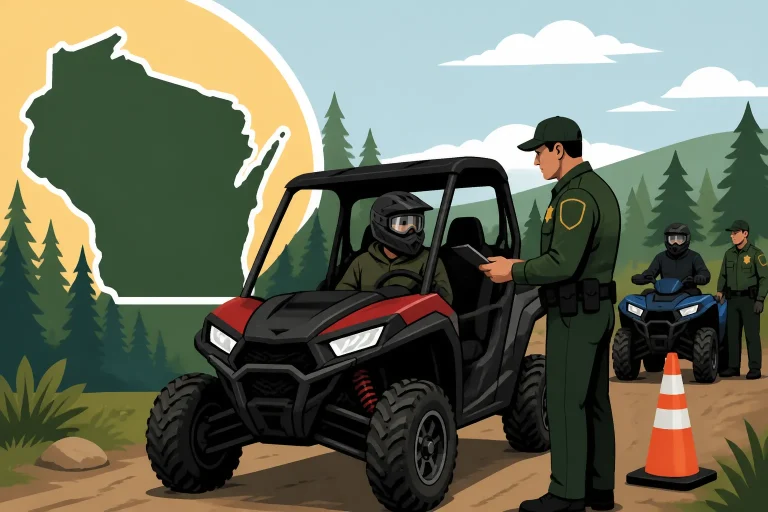
Statewide requirements are only part of the preparation. Towns and counties can set rules for designated ATV and UTV routes, including limits on where and when machines may travel. Equipment requirements, posted restrictions and enforcement may also depend on the location.
Verify every road segment
A road that looks suitable for an ATV is not necessarily open to ATV traffic. Look for official route signs and check the local government’s current map or ordinance. Pay particular attention when a route crosses a highway, passes through a town or ends near a trailhead.
Before riding, check:
- Whether the exact road is designated for ATV or UTV use
- Whether the designation applies to your machine type
- The route’s operating hours or seasonal limits
- Any local insurance or operator requirements
- Rules for crossings, speed, passengers and equipment
- Whether construction, flooding or other conditions have temporarily changed access
A local route can have restrictions that are not obvious from a statewide trail map. If a town’s posted signs and an older map appear to conflict, stop and confirm with the local authority rather than guessing. More route-planning help is available in Finding a Wisconsin Town’s ATV Ordinance and Wisconsin Road Rules Riders Get Wrong.
Inspect required safety equipment
Requirements can differ depending on the machine, rider age and location. Before departure, check the current rules for items such as helmets, eye protection, lights, exhaust and other required equipment. A rule that applies to a young rider may not be the same one that applies to an adult, and a road route can have requirements that are different from private-land use.
Even when an item is not legally required for every rider, it may still be sensible protection. A properly fitting helmet and eye protection can make a meaningful difference if a rider is thrown, struck by debris or caught in dust. If you buy safety gear through Amazon or another online marketplace, check the product’s actual safety rating, sizing and return policy rather than relying on a listing title or a customer photo.
A UTV’s seat belts, doors or nets should be used as designed. Do not carry more people than the machine has proper seating for, and do not assume a passenger can safely ride in a cargo area. For younger riders, confirm the applicable helmet and passenger rules in advance.
Make sure the vehicle is fit for public riding
A machine that runs well around the yard may not be ready for a long trail ride. Check tires, brakes, steering, throttle return, lights and the condition of any belt or drive components. Secure loose cargo and ensure that accessories do not interfere with the controls or required equipment.
Look for leaks, damaged wiring, cracked tires, loose wheels or an exhaust system that appears modified. An exhaust change can create a legal or nuisance issue if the sound level exceeds the applicable limit. Do not assume that an aftermarket part is compliant just because it was sold for an off-road vehicle.
For a used machine, inspect it before setting out for the first time. Ask about maintenance, previous damage and how the machine was used. A short test ride on private property, when permitted, can reveal handling issues, but it does not replace checking the paperwork. Inspecting a Used Machine in Wisconsin and Going Over a Machine Before You Hand Over Cash are useful before purchase.
Prepare Documents, Gear and a Practical Route Plan
Good preparation is partly about carrying the right documents and partly about making sure the whole group can complete the trip safely. A little organization at home is easier than trying to solve a paperwork or equipment problem in a parking area.
Keep the paperwork together
For each machine, gather the documents and information that may be needed for the trip. Depending on your situation, that can include:
- Registration information and any required proof
- A valid nonresident trail pass, when required
- Safety-certificate proof for riders who need it
- Insurance information if required by the location or your circumstances
- Owner or landowner permission for private-property access
- Emergency contacts and details about the machine
Keep documents protected from rain, mud and loss. A clear waterproof pouch or secure storage compartment can be more useful than loose papers in a glove box. If you carry digital copies, do not make them your only plan if your phone may lose power, get wet or have no service. Digital images can help you retrieve information, but confirm whether the specific location accepts them in place of an original or other required proof.
The registration record should match the machine you are riding. Check that the identifying number and registration details are consistent, especially after a sale, repair or transfer. If something does not match, resolve it before taking the machine onto public land.
Check trail status close to departure
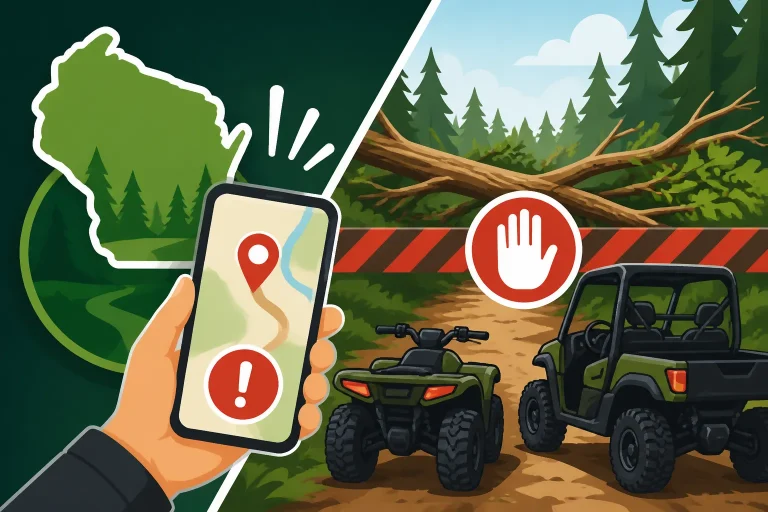
A trail that was open last week may be closed today. Seasonal closures, spring thaw, maintenance and weather can affect access. Trail status can also differ between neighboring counties or between two trail systems in the same region.
Check the managing agency’s current notices close to the day you leave. Look for information about:
- Seasonal opening or closure
- Temporary trail closures or detours
- Wet or damaged sections
- Road and trail connections
- Parking and staging access
- Restrictions for particular machine types
- Hours or other local operating limits
Do not assume that a closure sign applies only to the muddy patch directly in front of it. It may mark a longer restriction or a protected area. Respect posted closures even if another rider says they have gone through recently. Checking Wisconsin Trail Status Before You Drive and Why Wisconsin Trails Close for the Thaw can help you plan around changing conditions.
Plan fuel, parking and communications
A route plan should include more than the destination. Find out where you can stage a trailer, whether overnight parking is allowed and how far the ride is between fuel stops. A group that starts with a full tank can still run short if it takes a wrong turn, follows a longer loop or spends extra time idling.
Mobile coverage can be weak in some riding areas. Save a current map for offline use and carry a paper backup if the route is unfamiliar. Tell someone who is not riding where you plan to go and when you expect to return. If you ride alone, consider how you would contact help after a breakdown or injury.
Pack gear appropriate to the day and route. Useful items may include water, a basic first-aid kit, a tire repair option, a tool kit suited to the machine, a flashlight and weather-appropriate layers. An online marketplace such as Amazon can help you compare compact first-aid kits or map cases, but check the contents and size before ordering. A small kit is only useful if it contains items you know how to use.
Discuss the ride with the whole group
A group ride can become disorganized when riders have different expectations or machines. Before starting, agree on the route, pace, regrouping points and what to do if someone falls behind. Make sure each person knows who is leading and who is sweeping at the back.
Review the rules with younger riders and passengers. Explain how to stop safely, what to do if separated and why they should not leave the trail to catch up. Keep the group within the skill level of the least experienced rider, not the fastest machine.
If you are borrowing a machine, confirm who is responsible for the required registration or pass, what the owner allows you to do and whether the machine is insured for the intended use. A borrowed ATV may have valid paperwork but still be unsuitable for a particular route or rider.
Handle Special Situations Before You Travel
Some trips require more checking because the machine, rider or destination does not fit the usual pattern. These are the situations where a quick assumption can lead to a wasted trip.
Visiting riders and reciprocity
Visitors often ask whether their home-state registration is “recognized” in Wisconsin. The practical answer is to separate the questions: is the home-state registration valid, and does Wisconsin require a nonresident trail pass for the public trail use you plan? Recognition of a registration record does not necessarily remove a Wisconsin trail-pass requirement.
Confirm that the machine is registered in the correct category at home and that the registration is current. Then check the Wisconsin rule for the exact trail or riding area. If you are visiting on a machine borrowed from someone else, make sure the pass and registration apply to that machine, not just to the person operating it. Do not assume that one pass covers a group or multiple machines; verify the current terms for each vehicle.
If the trip is limited to a designated road route, still check local rules and your home-state registration requirements. If you add a trail section, the trail-pass question may change. The route plan, not simply your state of residence, determines what to confirm.
A machine used mostly on private land
Some owners use an ATV or UTV only on their own property. Others ride on private land by permission, at a cabin or on a hunting lease. Those uses can raise different registration and pass questions from riding a public trail.
Do not assume a machine is exempt just because it spends most of its time on private land. The moment you move onto a public trail, public riding area or designated road, additional requirements may apply. Check the rules for the exact place and use, and get permission from the landowner for every private parcel you cross. Do You Need Registration on Your Own Wisconsin Land? discusses the private-property question, while Wisconsin Permit Rules on Leased Hunting Ground is relevant if the property is leased.
Ice, hunting and special events
Riding on a frozen lake, traveling to a deer camp or joining an organized event can involve rules beyond ordinary trail access. Ice conditions are a safety issue as well as a legal and access issue. A winter trail route does not mean the adjacent lake is open to motorized travel, and a frozen surface should never be treated as proof that it can safely support a machine.
For event rides, club outings or guided trips, ask the organizer what permits, insurance or site permissions are required. Do not assume that an event’s promotion or registration process covers every rider’s machine paperwork. For a hunting trip, confirm access rules and any restrictions for the land or wildlife area you will enter. See Wisconsin Rules on Frozen Lakes, Wisconsin Permits for an Organized Ride and What a Visiting Hunter Needs to Ride Wisconsin Trails when those situations apply.
Machines with unusual registration or modifications
A machine brought from another state, assembled from parts, rebuilt after damage or modified for specialized use may need extra attention. Confirm that its identifying information is clear and that the registration records match the machine. If a VIN is damaged, difficult to locate or inconsistent with the paperwork, address that before the trip.
Also check whether the vehicle’s classification affects the rules. An ATV, UTV, off-highway motorcycle and other off-road vehicle may not share the same access or pass requirements. A machine’s appearance or the seller’s description is not always enough to determine its legal category.
Use This Before-You-Ride Checklist
Use this checklist the day before a ride, then do a quick final check at the staging area. It is meant to catch common oversights, not replace the official rules for your trail system.
- Name the riding locations. Separate public trails, public riding areas, designated road routes and private land.
- Check registration. Confirm that the machine’s registration is valid and appropriate for its intended use.
- Check the pass requirement. If the machine is registered outside Wisconsin, confirm whether a Wisconsin nonresident trail pass is needed for the trails or areas on your itinerary.
- Confirm the rider’s eligibility. Check age, machine type, safety certification and supervision rules for every operator.
- Verify local access. Review current maps, ordinances, signs, operating hours and any route restrictions.
- Check conditions. Confirm that the trail is open and that no seasonal, weather or maintenance closure affects the trip.
- Inspect the machine. Check tires, brakes, steering, lights, controls, exhaust, fuel and cargo.
- Prepare documents. Keep registration, pass and safety-certificate proof accessible as appropriate.
- Pack for the route. Bring water, basic repair and first-aid supplies, suitable clothing, maps and a way to communicate.
- Set group expectations. Agree on the route, pace, meeting points, passenger limits and what to do if someone gets separated.
If any answer is unclear, pause and confirm it with the Wisconsin DNR, the local government or the land manager responsible for the location. A short phone call or a current official notice is usually easier than discovering an access problem after unloading the trailer.
The key is to plan for the strictest segment of your ride. If your day combines public trails, town routes and private land, satisfy the requirements for each one. Keep the machine’s paperwork in order, confirm every rider’s eligibility and check the trail status close to departure. That preparation lets you spend the day riding instead of turning around to fix an avoidable problem.
Disclaimer
This article is for general informational purposes only and does not constitute professional advice. Laws, prices and regulations vary by location and change over time. Consult a qualified professional for guidance on your specific situation.