Wisconsin’s ATV Trail Aids Program
Wisconsin’s ATV Trail Aids Program helps turn registration and trail-pass revenue into maintained, signed and accessible riding opportunities. If you ride, volunteer with a club or work for a local government, understanding the program helps explain who can receive funding, what it can pay for and why trails sometimes close despite local efforts. Here’s how the system works—and how to find the current rules before planning around a grant.
What Wisconsin’s ATV Trail Aids Program Does
The ATV Trail Aids Program is a state grant program administered by the Wisconsin Department of Natural Resources. Its purpose is to help eligible local governments develop and maintain public ATV trails, routes and riding areas. The state supplies grant funding; local applicants plan and manage eligible work in their jurisdiction.
That distinction matters. The program does not mean every trail, road or club project automatically receives state money. A proposed project must fit the program’s current rules, have an eligible applicant and land within an approved public-use system. It also needs to be practical to build and maintain, and it must address the program’s priorities.
A typical grant-supported project may involve:
- Repairing or maintaining an established trail
- Improving drainage, surfaces or erosion control
- Replacing or repairing a bridge or culvert
- Installing or improving trail signs
- Developing a new trail segment or connector
- Making an existing riding area safer or more usable
- Completing eligible planning or design work
The exact work that qualifies depends on the grant category and current program guidance. A need that seems obviously connected to riding—such as a club’s equipment purchase, a private driveway or routine work on a road—may not qualify just because ATVs use it. Applicants need to match the proposed expense to the program’s eligible work and document why it is needed.
The program is part of a broader structure of public access and local responsibility. Wisconsin has trails on county forest land, other public property and land where public riding access has been arranged. A funded trail still needs appropriate land access, permission and management. A grant does not by itself create a public right to ride on a parcel or turn a closed road into an ATV route.
That is one reason riders may see uneven results from one area to another. A county or town may have a strong trail network but lack a ready-to-build project, the staff time to apply or the local resources to handle ongoing maintenance. Another area may have a clear project but need landowner agreements or environmental review before it can proceed.
If you want to understand the broader relationship between grant funding and trail work, How Wisconsin’s ATV Trail Aids Grants Fund Trails is a useful companion. For trail users, the simplest takeaway is that the program helps support public riding infrastructure, but it does not promise that every trail will be open, repaired or funded every season.
What the program is not
It is not an individual rider reimbursement program. A private owner generally cannot treat it as a way to pay for a personal trail or equipment purchase. It is also not a statewide guarantee that a particular route will remain open. A funded trail or route is still subject to local decisions, property access, operating conditions and applicable regulations.
Nor is it a substitute for a trail pass, registration, permission to ride or compliance with local rules. A grant may help pay for signs or maintenance, but riders still need to know whether their machine and planned ride meet the requirements. For related questions, see What Wisconsin Riders Need Before They Ride.
Where the Funding Comes From and What It Supports
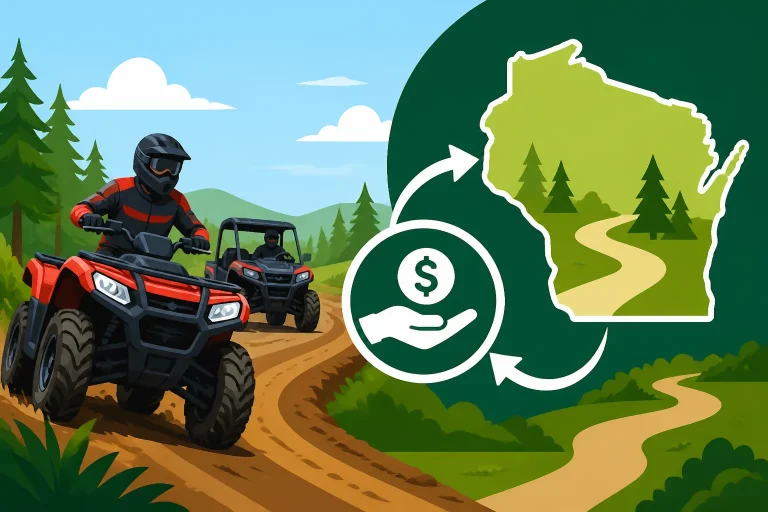
The program uses designated public revenue to support ATV recreation infrastructure. Registration and trail-pass revenue are among the funding sources associated with Wisconsin’s ATV program. Other designated sources may also contribute under state law and program rules. The mix and amounts can change, so applicants and riders should consult current DNR materials rather than rely on an old budget summary.
This funding arrangement connects participation to trail investment: revenue collected through the state’s ATV system helps support eligible public projects. It does not mean every dollar paid by a rider goes directly to the county where that rider travels. Program money is administered under statewide rules, then awarded or distributed through the applicable grant process.
For a closer look at how rider payments fit into the bigger picture, read Where Wisconsin Trail Pass Money Goes. The practical point is that the program is not simply a local club fund. It is a state-administered grant system with eligibility rules, records and public accountability.
Common kinds of eligible work
Projects often address the physical condition and usability of a public trail system. The grant category matters: maintenance, development and other project types may have different application requirements or limits. Before preparing a budget, an applicant needs to identify the right category and confirm which expenses fit.
Examples of work that may be considered, depending on current rules, include:
- Surface and drainage work: correcting washouts, improving water flow or stabilizing a trail surface.
- Structures: repairing or replacing trail structures where the project meets program and safety requirements.
- Signs and wayfinding: replacing damaged signs, adding required information or improving directions at junctions.
- Trail development: building an eligible segment or connection after land access and approvals are in place.
- Planning and design: preparing a project for future construction, if the current grant rules allow the work.
These are examples, not a promise that every item is grant-eligible in every situation. For instance, a culvert project could involve environmental, engineering or ownership questions that affect whether it can proceed. An applicant should check the current guidance before committing money or signing a contract.
Signage deserves particular attention because riders often notice a missing or confusing sign before they notice a grant-funded drainage improvement. Signs can help riders stay on the approved route, identify a crossing, follow a detour or understand a closure. But placement and sign specifications matter. The grant may cover only approved signs and installation work, not any sign a club chooses to put up. See Signage Funded by Wisconsin Trail Aids for more on this part of the program.
What grant funding does not automatically cover
A project can be useful and still fall outside the program. Ordinary operating costs, unrelated municipal work, private access improvements and purchases for general club use should not be assumed eligible. Nor should an applicant assume that a grant will cover the entire cost of a project.
A responsible budget separates proposed expenses by task and explains how each one serves the eligible trail system. It also accounts for costs that may not be paid by the grant, such as local contributions, work outside the grant scope or ongoing upkeep after the project is complete. The current application instructions are the final word on allowable costs.
Who Can Apply and How Local Partners Fit In
Eligible applicants are generally public entities responsible for public ATV trails, routes or riding areas. Depending on program rules and the type of project, that may include counties and other local governments. The DNR’s current eligibility list should be checked before anyone starts preparing an application. Who Can Apply for Wisconsin Trail Aids covers the applicant question in more detail.
ATV clubs and volunteer groups can still play an important role, even when they are not the grant applicant. A club may identify a problem, help document trail conditions, coordinate volunteers, provide local knowledge or work with a county on a project. The local government remains central to the formal process when public land, public funds or official trail management are involved.
A useful working relationship often looks like this:
- Riders or volunteers identify a specific trail need.
- The club or local group shares the problem with the government responsible for the trail.
- The responsible agency checks ownership, access, safety and environmental considerations.
- The applicant decides whether the work fits a grant category.
- The applicant prepares the scope, budget, schedule and supporting material.
- If awarded, the applicant completes the work under the grant agreement and keeps the required records.
The exact steps can differ by project. A straightforward sign replacement will not require the same planning as a new trail segment, bridge replacement or work near water. Still, starting with the responsible local government is usually more productive than assuming a club can apply directly for state money.
The role of land access
A grant application cannot solve an access problem on its own. If a proposed trail crosses private land, the applicant needs a lawful basis for public use and a clear understanding of the landowner’s conditions. For public land, the responsible agency may need to approve the project and confirm that it fits the land’s management rules.
This is especially important for new construction or rerouting. A line on a map is not enough. The route needs to be legally available, physically suitable and compatible with other land uses. The applicant may need to address drainage, wildlife, neighboring properties, road crossings or other concerns before the work is ready.
Local partners can help surface those issues early. A club that provides useful observations, photos and a clear description of the problem is more helpful than one that arrives with a fixed construction plan before the land manager has reviewed the site.
Why some projects are a local-government responsibility
Public trail systems need an accountable owner or manager. A local government can coordinate approvals, take responsibility for grant requirements and make decisions about public access. This helps ensure that funded work is not just completed but maintained and managed in a way that fits the approved system.
For clubs, that can mean patience. A volunteer group may know a bridge is failing, but the responsible agency may need to inspect it, determine whether the structure is safe and decide what work is permitted. The grant process can look slow from the trail, but the review is part of making sure public money is spent on a project that can be completed and sustained.
How the Application and Award Process Works
The process generally begins with a defined need, not with the application form. Before applying, a potential recipient should be able to explain what is wrong or missing, where the work will occur, who controls the land and how the proposed project will improve an eligible public riding system.
The application process, dates and required documents can change. The program’s current DNR instructions should be used for every application. A past deadline or old checklist is not safe to rely on. The application window has commonly been associated with a spring deadline; confirm the current date and submission requirements directly with the DNR. See The April 15 Grant Deadline for a focused explanation of why checking the current cycle matters.
A practical sequence for applicants
-
Identify the responsible public agency. Confirm which government or land manager oversees the trail, route or riding area. Do not assume that the agency handling one nearby segment manages the entire system.
-
Describe the problem precisely. State the location and the condition. “The trail needs work” is too broad. A stronger description identifies a damaged crossing, erosion point, confusing intersection or specific safety concern.
-
Confirm access and authority. Verify that the applicant has control over the site or permission to complete the work. For a new segment, identify the property and access approvals needed before treating the route as ready for construction.
-
Choose the right grant category. Review the current program rules and determine whether the project is maintenance, development or another eligible type. If the category is unclear, ask the DNR before building a budget around an assumption.
-
Develop a work plan and budget. Break the project into tasks, show how costs relate to those tasks and identify any local contribution or other funding needed. The program’s current rules determine which costs and match arrangements are acceptable.
-
Prepare supporting information. This may include maps, photographs, descriptions, plans, estimates, approvals or other material requested in the application. Good documentation helps reviewers understand what will be done and why.
-
Submit by the current deadline. Confirm the required form, method of submission and any supplementary documents. Do not assume that a prior year’s submission process is still in force.
-
Wait for an award decision before proceeding as though funds are guaranteed. An application is not an award. Applicants should understand which costs may be incurred before approval and which work must wait for a grant agreement.
-
Complete the approved scope and maintain records. If funded, follow the award conditions, document expenditures and report changes as required. A project that changes materially may need approval before the work continues.
This order helps prevent a common mistake: spending time pricing equipment or hiring a contractor before confirming that the site is eligible and the work is within the grant’s scope.
Why a strong application is specific
Reviewers need to judge not only whether a project is desirable but whether it is feasible and suitable for public funding. A clear application answers practical questions:
- Where exactly is the project?
- What problem does it address?
- Who owns or manages the affected land?
- What approvals or permissions are needed?
- What work will be completed?
- How were costs estimated?
- Who will oversee the work?
- How will the finished project be maintained?
- What happens if the project is delayed or costs change?
A map and a few well-labeled photographs can be more useful than a long general statement. A maintenance request should explain what condition has developed and what work is proposed. A new trail proposal should show the intended connection and the access arrangements, not only a line drawn on a broad county map.
Applicants should also separate the desired result from the proposed method. For example, a club may want a trail to remain usable after heavy rain. The land manager may determine that drainage changes, a surface repair or a short reroute is the appropriate solution. Starting with the problem leaves room to select a sound, eligible design.
How Projects Are Evaluated and Prioritized
The program has to make choices among projects, and not every eligible application can necessarily be funded. Evaluation involves more than deciding which trail is most popular. Reviewers may consider whether the project meets program objectives, how ready it is to proceed, its expected benefit and whether the proposed cost is reasonable for the work.
Wisconsin’s current grant guidance controls the specific review criteria and priority structure. Do not assume a project will score well simply because it is in a busy riding area or has strong local support. Applicants should read The Ranked Priorities in Wisconsin Trail Aids and compare their proposal with the current program criteria.
What can strengthen a project
A proposal is easier to assess when it provides clear evidence of need and a realistic plan. Useful information may include:
- A precise location and route connection
- Photos that show the existing condition
- A concise description of the safety, access or maintenance issue
- A complete scope that stays within the eligible work
- Landowner or management approvals
- Cost estimates that correspond to specific tasks
- A schedule that accounts for seasonal conditions and approvals
- A credible plan for future maintenance
Strong documentation does not guarantee funding. It does help reviewers distinguish a ready project from a broad idea that still needs scoping, permission or cost estimates.
Why a new trail may not be the top choice
Building a new segment is visible and exciting, but a maintenance project can be more urgent. A damaged structure, drainage failure or unsafe crossing may affect riders now and could worsen if left unattended. A new route also brings continuing obligations: signs, repairs, land access and coordination with nearby landowners.
A new trail should therefore be evaluated as a long-term commitment, not just an initial construction job. Applicants should be able to explain who will manage it after the grant-funded work is complete and how the trail fits the existing network.
Road routes are a different case
Riders sometimes ask why grant funding does not simply cover the roads they use to connect trails or reach a town. Road routes and off-road trails can have different legal, management and funding circumstances. A route on a public road may be governed by local authorization and roadway responsibilities, rather than qualifying as a trail project under the grant category a rider has in mind.
That does not mean a road route can never be connected to the broader ATV system. It means applicants should check the rules instead of assuming trail-aid money can pay for ordinary road maintenance. For detail, see Why Road Routes Rarely Qualify for Grants. Riders can also learn how a local route gets authorized in How a Wisconsin Town Opens an ATV Route.
What Riders Should Notice on the Trail
Most riders will never submit a grant application, but they see the program’s results firsthand. A signed detour, repaired drainage, a safer crossing or a stable trail surface may reflect work planned and funded through local and state coordination.
Those improvements do not remove the need for riders to follow current closures and restrictions. Trail status can change due to weather, damage, maintenance or local decisions. A grant-funded route is not necessarily open every day or in every season. Before a trip, check the responsible county or land manager’s current information as well as the relevant rules for registration and passes.
If you are unfamiliar with how trail closures and conditions are communicated, Checking Wisconsin Trail Status Before You Drive and Where Wisconsin Closure Notices Are Posted can help you build a pre-ride routine.
How to report a problem usefully
When you find a damaged sign, washed-out section or hazardous crossing, report it to the agency or trail manager responsible for that location. A useful report includes:
- The trail or route name, if known
- A nearby intersection, marker or recognizable landmark
- A map pin or coordinates, if available
- A clear photograph from a safe location
- A brief description of the problem
- Whether the issue blocks travel or creates an immediate hazard
Avoid riding around a closure or creating a new path through vegetation. That can make damage worse and may turn a fixable maintenance problem into a larger resource or access issue. If the trail has an official detour, follow it. For more on reporting a problem, see Reporting Trail Damage in Wisconsin.
A phone can help record a location, but do not rely on cell service in remote areas. A rider may carry an offline map, paper map or GPS device as a backup. A waterproof notebook or a phone mount from a retailer such as Amazon can be useful for personal trip notes, but no consumer product substitutes for official trail information or required signage.
Why closures are sometimes necessary
A closure can protect riders, natural resources or the trail investment itself. Saturated ground may be vulnerable to deep rutting. A damaged bridge may be unsafe. A maintenance crew may need exclusive access to a work area. In each case, keeping traffic off the site can prevent further damage and reduce the risk of injury.
That is frustrating when you have traveled to ride, but bypassing a closure often works against the long-term goal. It can widen the damaged area, create an unauthorized route or make the repair more expensive. If the posted information is unclear, contact the local trail manager rather than guessing.
What Clubs and Volunteers Can Do
Clubs and volunteers can help the program succeed without taking on responsibilities they are not authorized to perform. Their most valuable contributions often start with local knowledge: noticing recurring trouble spots, describing how a trail is used and helping the responsible agency understand where riders are getting confused.
Before organizing work, confirm who manages the site and what permission is required. A volunteer cleanup, sign replacement or trail modification may need approval. Even a well-intended project can cause problems if it changes drainage, affects a sensitive area or conflicts with an approved route.
Useful ways to support a project
- Keep observations specific. Note where water collects, where signs are missing or where riders repeatedly take the wrong turn.
- Share information with the right agency. A county forest trail and a town road may have different managers.
- Help document conditions. Photos, dates and location details make reports easier to verify.
- Support approved work. Ask whether volunteers can help with a project and what tasks are permitted.
- Communicate closures clearly. Share official notices rather than unverified rumors or old screenshots.
- Plan for maintenance. A new trail feature needs future inspection and care, not just a ribbon-cutting day.
Clubs that want to support a grant application should ask the public applicant what evidence or assistance would actually help. A detailed site report may be more valuable than an informal pledge to volunteer. If the agency needs estimates, a map or a description of rider use, provide those materials in a form that can be checked and retained.
Amazon may be a convenient source for a club’s general supplies, such as notebooks or basic personal safety items, but grant-funded purchases have to follow the grant agreement and public purchasing requirements. A club should not assume that buying something online makes the cost allowable or reimbursable. The applicant should confirm the rules before committing funds.
Similarly, purchasing trail signs or construction materials without approval can create compatibility, placement and reimbursement issues. Official signs may need to meet specifications, and installation may require land-manager approval. Ask before ordering. For a rider preparing to inspect or volunteer on a trail day, a small first-aid kit, gloves and a way to record locations can be sensible personal equipment; whether those items qualify as project costs is a separate question.
How to Check Current Program Information
Grant rules, deadlines, forms and funding availability can change. Use current DNR materials for the specific grant cycle, and confirm details with the appropriate program contact before developing a budget or starting work. A past application, a club message or an old web page may describe a previous process rather than the current one.
A practical verification checklist is:
- Confirm that the applicant is eligible.
- Confirm that the land and trail system qualify.
- Identify the correct project category.
- Review eligible and ineligible costs.
- Check whether a local match or other contribution is required.
- Confirm the current deadline and submission method.
- Verify what approvals must be secured before applying.
- Ask when work may begin and what records are required after an award.
For riders, the equivalent checklist is shorter: identify the trail manager, check current trail status, follow signs and closures, and make sure your machine and planned ride meet the relevant registration, pass and local requirements.
The Trail Aids Program is most effective when each part of the system does its job: riders report problems accurately, clubs share local knowledge, public agencies manage access and projects, and grant applicants follow the current rules. That process can take time, but it helps public money produce improvements that are legal, usable and maintainable.
Disclaimer
This article is for general informational purposes only and does not constitute professional advice. Laws, prices and regulations vary by location and change over time. Consult a qualified professional for guidance on your specific situation.