Group Size Limits on Wisconsin Public Land
A large ATV or UTV group can make a Wisconsin ride more fun, but it can also create a paperwork problem or block a narrow trail. There is no safe shortcut based on a statewide headcount: rules can depend on the land manager, the route, and whether the ride is organized. Check the right authority before inviting everyone.
Is There a Statewide Group Size Limit?
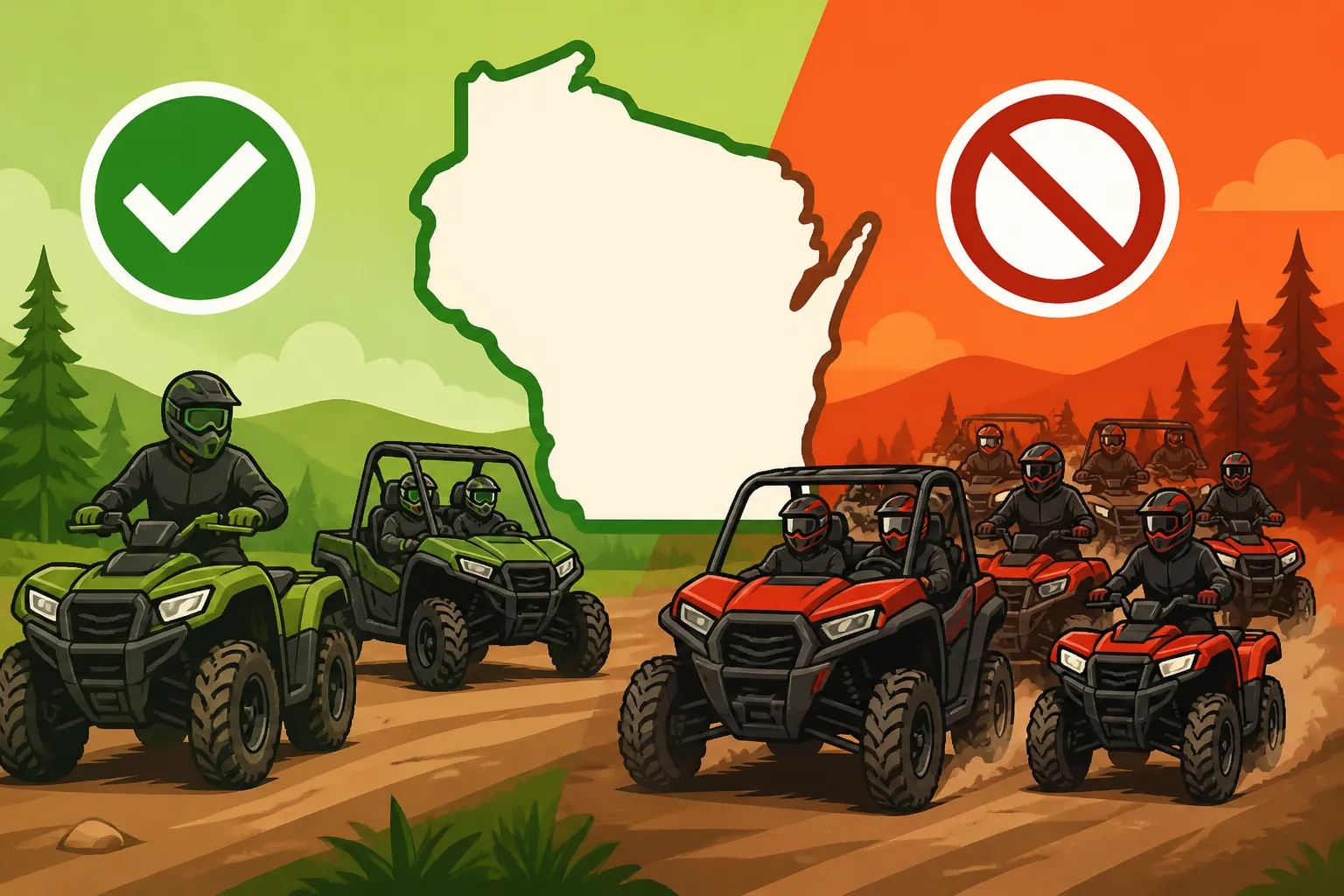
Wisconsin does not have one universal group-size limit that applies to every ATV or UTV ride on public land. A county forest, state-managed property, national forest area, or local route may have different rules. An organized event may also face requirements that do not apply to friends riding together.
That distinction matters. “Public land” describes who owns or manages the land; it does not mean every trail is open to every vehicle, at every time, or under identical conditions. A trail may cross land managed by different agencies, and local rules can change along the route. Some public trails also run over private property with permission, where access conditions still apply.
For ordinary recreational riding, the key question is not only how many machines are in your party. It is whether each machine is allowed on that particular trail, whether the trail is currently open, and whether the group can ride without obstructing other users. For an event, the organizer should also find out whether a permit or advance approval is required and whether the land manager sets a maximum group size.
A group limit may appear in an event permit, local ordinance, property-specific rule, or land-use conditions. It may be expressed as a limit on the full party, a limit on the number of vehicles, or a requirement to divide participants into smaller groups. Do not assume that a limit applies statewide just because it appears on one county’s paperwork. Likewise, do not assume that a rule is optional because it is absent from a general statewide summary.
| Riding situation | What to check | Practical approach |
|---|---|---|
| A few friends riding together | Trail access, closures, local rules, and safe spacing | Confirm the route and ride in manageable clusters |
| A large private group ride | Local group rules and whether advance approval is needed | Contact the land manager before setting a date |
| A club ride, poker run, or fundraiser | Event permit, route approval, insurance, and permit conditions | Get written requirements before promoting the event |
| A ride crossing more than one property | Rules and access status for each land manager’s section | Check the whole route, not just the starting trailhead |
| A group on a county forest trail | County-specific forest and trail rules | Use the county’s current map and official notices |
For background on how local roads and trails fit together, see What a Wisconsin ATV Route Actually Is. If your ride includes a public trail network, County Forest Rules Wisconsin Riders Follow is a useful starting point, but the relevant county’s own current rules remain the deciding source.
How to Find the Rule for Your Ride
Start by identifying the land manager for every section of the planned route. A map may show trails without making the management boundary obvious. Trail maps, posted signs, county forestry information, and official notices can help establish who is responsible for each segment. If the ride crosses a boundary, check with each authority rather than relying on the rules for the first trailhead.
Then look for the rule in the sources most likely to govern that property:
- Check the current official trail map and notices. Confirm that the route is open to your vehicle type and that there are no seasonal closures, detours, or restrictions. A map from a previous season may no longer reflect current access.
- Read the property or county rules. Look for language about organized rides, events, group size, staging, parking, and resource protection. Rules may be posted on the land manager’s website or at the property.
- Contact the responsible office if the language is unclear. Give the date, location, approximate number of machines, type of event, and whether you expect public attendance. Ask whether approval is required and whether any group-size conditions apply.
- Check whether another permit is involved. A special-use or event permit can carry requirements beyond the general recreational rules. See Wisconsin Permits for an Organized Ride and Wisconsin Club Event Requirements for related issues.
- Keep the answer with the organizer’s records. Save the permit, email, map, and any instructions. Share the important restrictions with ride leaders and participants before they arrive.
A quick phone call can prevent a costly misunderstanding, especially when a group is large enough to affect parking, trail traffic, or other visitors. Ask a concrete question: “We expect about this many machines on this route on this date. Does the property set a group limit, and do we need advance approval?” That is more useful than asking only whether ATVs are generally allowed.
If a route crosses a county line or joins a town route, check each part separately. The land manager for a trail may not be the same authority that sets rules for a connecting road. Finding a Wisconsin County Trail Map and Checking Wisconsin Trail Status Before You Drive can help with route planning, but neither replaces confirmation of event-specific conditions.
Ordinary Group Ride Versus Organized Event
A casual ride among friends and a public event are not always treated the same way. A group of friends may be using a trail under ordinary access rules, while a club ride, fundraiser, guided trip, or advertised gathering may require advance approval. The difference can depend on how the ride is organized, where it takes place, how many people attend, and whether the land manager needs to manage impacts.
An event may affect more than the trail itself. Participants need somewhere to stage and park; vehicles may arrive in a short window; and trail users may encounter repeated waves of machines. An organizer may need to provide a route plan, schedule, safety measures, proof of insurance, or a plan for managing waste and damage. Requirements vary, so do not use another club’s old permit as proof that your event can proceed under the same terms.
When requesting approval, be ready to explain:
- The proposed date and hours.
- The property, trail segments, and staging location.
- The expected number of machines and riders.
- Whether the ride is open to the public or limited to invited participants.
- Whether there will be registration, fees, food service, signs, or volunteers.
- How participants will be briefed and how the group will respond to an incident.
- Whether the route uses more than one land manager’s property.
If the land manager approves the event with a maximum number or other restrictions, treat those conditions as part of the permission. Do not increase the attendance or change the route without asking whether the approval still covers the revised plan.
A group that does not need an event permit still needs to follow ordinary access rules. Keep within the designated route, obey closures, and avoid stopping where the party blocks a trail or a junction. For route-specific rules, see Municipal Ordinances Wisconsin Riders Must Read and Wisconsin Towns With Miles of Open Roads. Public roads and public trails are not interchangeable, and a large group should know which kind of route it is using.
Managing a Large Group on the Trail
Even where no fixed group cap applies, a very large party can create safety and access problems. A long line of machines can separate at intersections, make passing difficult, and leave riders unsure whether the group has turned or stopped. Dust, noise, and congestion can also affect other trail users and nearby residents.
The simplest solution is to set a group plan before the engines start. Choose a lead rider who knows the route and a sweep rider who stays behind the last machine. Agree on regrouping locations that are safely off the trail. At junctions, have riders stop only where they can clear the route and avoid blocking signs, gates, driveways, or intersections.
For a large outing, divide the participants into smaller clusters with space between them. The appropriate size depends on trail width, visibility, traffic, terrain, and the group’s experience; there is no one number that works everywhere. The purpose is to reduce bunching, not to evade a legal limit. If a permit or local rule sets a maximum, each cluster and the full event must follow the condition as written.
Before departure, brief everyone on:
- The approved route, direction of travel, and any turnarounds.
- The location of regrouping points and what to do if someone is separated.
- The need to stay on marked trails and respect closures.
- How to communicate a breakdown, injury, or route change.
- The expectation to leave room for other trail users to pass where it is safe.
- The requirement to ride within the limits of the machine and the rider.
A group leader should not assume every participant has the same paperwork or qualification. Confirm that riders have the required registration or trail access credentials for the machine and route, and review any age or safety requirements that apply. What Wisconsin Riders Need Before They Ride covers related preparation, while Wisconsin Pass Rules for a Rented Machine may help when some participants are using rentals.
If your ride includes more than one vehicle type, confirm that every type is allowed on every section. ATV and UTV access can differ, and trail width restrictions may matter. Wisconsin Trails Rated for Full-Size Rigs and Narrow County Trails and Machine Width can help flag fit issues before the group arrives.
Finally, have a fallback plan. A temporary closure, poor conditions, or an unexpectedly crowded trail may make the planned route unsuitable. Check official updates shortly before leaving, and be willing to reduce the group, change the route, or postpone the event. Wisconsin Trail Closures in April and Trail Conditions After a Wet Wisconsin Spring explain why access can change with conditions.
A reliable rule of thumb is simple: verify the land manager’s current requirements, get written approval when an event needs it, and organize the ride so that the party does not overwhelm the trail. The answer to “How many can ride together?” is property-specific; the answer to “How do we keep the ride responsible?” starts with planning and clear communication.
Disclaimer
This article is for general informational purposes only and does not constitute professional advice. Laws, prices and regulations vary by location and change over time. Consult a qualified professional for guidance on your specific situation.