Taking a Wisconsin Machine to Michigan
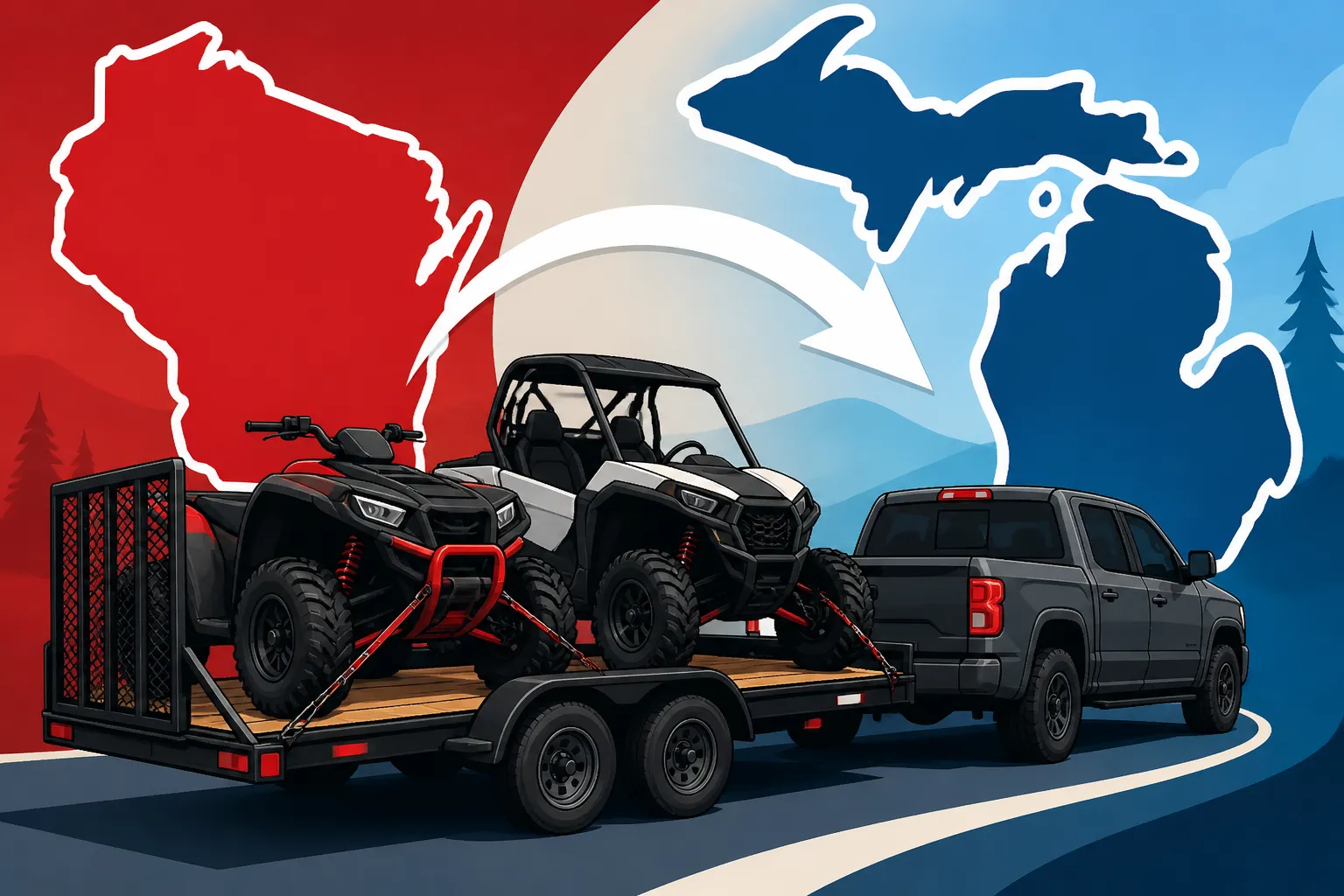
Taking a Wisconsin ATV or UTV into Michigan raises a practical question: does your Wisconsin registration let you ride there? It proves a connection to Wisconsin’s registration system, but Michigan sets its own rules for permits, trails, roads, and equipment. Check those requirements before you tow across the border so you know what to buy, where you can ride, and what to carry.
Wisconsin registration does not settle Michigan permit requirements
A Wisconsin registration is not a universal permit to ride on another state’s public lands. Michigan uses its own off-road vehicle system, and a Wisconsin registration card does not automatically establish that your machine has every Michigan authorization it needs.
Michigan commonly uses an ORV license and a separate ORV trail permit. They serve different purposes: the license authorizes certain ORV use, while the trail permit is associated with riding designated ORV trails and routes. Whether a permit is required depends on the machine, the land, and the kind of riding planned. Exemptions may also apply, so do not assume that a Wisconsin plate, decal, or registration category qualifies you for one.
Before leaving, check Michigan’s official ORV information for current requirements and any exemption that may apply to an out-of-state machine. Confirm the rules for your specific vehicle type rather than relying only on its Wisconsin paperwork. Michigan’s terminology may also differ from Wisconsin’s: an ATV or UTV may be covered by Michigan’s broader “ORV” rules.
| What you have or plan to do | What it tells you | What to check in Michigan |
|---|---|---|
| Wisconsin registration | The machine is recorded under Wisconsin’s system | Whether Michigan requires an ORV license, trail permit, or both |
| A Wisconsin trail pass | It applies to eligible riding in Wisconsin | Whether Michigan permits are needed separately |
| A planned route on public land | The destination may have ORV access | Which trails, roads, and connections are open to your machine |
| A Wisconsin road-use setup | It may satisfy some Wisconsin requirements | Whether the specific Michigan road is open to ORVs and what local rules apply |
Wisconsin registration types are useful context, but they do not replace checking Michigan’s requirements. If you need to sort out what your Wisconsin registration actually covers, see Wisconsin’s Public Use ATV Registration and Wisconsin’s Private Use ATV Registration. For general out-of-state registration questions on the Wisconsin side, Wisconsin Registration for an Out-of-State Machine explains that registration questions depend on the state and the machine.
A Wisconsin trail pass is also not a Michigan permit. It is intended for Wisconsin riding, not as a substitute for another state’s requirements. If you are comparing how those passes work for visitors riding in Wisconsin, Wisconsin’s Non-Resident Trail Pass and Passes for a Machine Registered Out of State cover the Wisconsin system. For Michigan, start with Michigan’s rules.
Confirm before you buy a permit
Check the official Michigan guidance before purchasing permits, especially if the machine is registered in Wisconsin and you have heard that an out-of-state registration might qualify for an exemption. Ask whether the exemption applies to your machine and to the location where you plan to ride. If the guidance is unclear, contact the responsible Michigan agency or land manager and describe the machine, its registration, and your intended route.
Keep a record of the answer and any purchase confirmation with your travel documents. That is more useful than assuming a Wisconsin decal will be accepted or that another rider’s advice applies to your situation.
The trail or road determines where you may ride
A permit is only one part of the question. It does not make every trail, forest road, or public roadway open to every type of ORV. Check the rules for the specific Michigan land unit and route, including restrictions on vehicle width, season, operating hours, and connections between trail segments.
Michigan’s designated ORV trails and routes are not interchangeable with every road that appears on a map. Some public roads may be open to ORVs under local rules, while others are not. A route that connects two trail sections can have its own requirements. Do not use a Wisconsin road-route designation as evidence that a Michigan road is open.
Before setting out:
- Identify the trail system or land area you plan to visit.
- Find its current map and access rules from the responsible land manager.
- Check whether your ATV or UTV fits the system’s vehicle-width and type limits.
- Confirm seasonal openings, closures, and any local road-route rules.
- Plan legal connections between your staging area, trail, fuel stop, and lodging.
- Check for notices shortly before departure, since closures and conditions can change.
Be particularly careful when a route reaches a town road, county road, highway, private parcel, or another public land unit. An open trail does not authorize riding across land that is not part of that trail. Follow posted signs and stay on designated routes.
Road access is a separate question
A Wisconsin machine that is allowed on certain Wisconsin roads does not automatically become street legal in Michigan. Road access may depend on the particular road, local authorization, vehicle requirements, and restrictions that apply to ORVs. Even where a road is open, there may be rules about where to travel, how to cross another road, and what equipment the machine must have.
Do not rely on your vehicle’s lights, mirrors, plate, or Wisconsin road-use status as proof that it can travel on a Michigan public road. Verify the Michigan rules for that specific road and vehicle. When a legal crossing is permitted, use the designated crossing and follow posted signs; do not ride along a road simply because you need to reach the next trail.
A county or town rule can also differ from the next jurisdiction’s rule. If your trip depends on road access, identify each road segment in advance and check the responsible local authority’s information. If the route is unclear, choose a confirmed trail connection or transport the machine instead.
Prepare the machine and paperwork before crossing the border
Good preparation reduces the chance of being turned away at a trailhead or delayed during a compliance check. Carry your Wisconsin registration information and any Michigan permit or purchase confirmation that applies. Keep the machine’s identification details available, and make sure the VIN on the vehicle is legible and matches the documents.
If the machine is borrowed, rented, or registered to someone else, bring written permission or the rental paperwork. Confirm who is responsible for obtaining any required Michigan permit. A registration card alone may not show that you have the owner’s permission to operate the vehicle.
Inspect the machine before the trip. Check brakes, tires, steering, lights, and the equipment required for the kind of riding you plan to do. For a UTV, check that seat belts and other occupant restraints are present and working. Make sure any permit decal is displayed as Michigan instructs, rather than placing it where Wisconsin decals normally go. Follow Michigan’s current instructions for placement and keep proof of purchase accessible in case the decal is damaged or difficult to read.
If someone under 18 will ride, check Michigan’s age, supervision, helmet, and safety-training requirements for that rider and vehicle. Requirements can depend on age and circumstances. Do not assume Wisconsin rules apply across the state line; Wisconsin Helmet Requirements Under 18 is useful for understanding Wisconsin’s side, but Michigan’s requirements need their own check.
It is also worth confirming your insurance coverage before travel. A policy may have limits on where a machine can be used or what situations are covered. If you are unsure, ask your insurer whether the planned Michigan use is covered. A permit does not provide liability or damage coverage.
A practical pre-trip checklist
Use this checklist a few days before departure, then check for last-minute closures or rule changes before loading the trailer.
- Confirm whether your machine needs a Michigan ORV license, trail permit, or both.
- Verify any claimed exemption using official Michigan guidance.
- Check that the permit is valid for the specific machine and riding location.
- Review current maps and closures for each trail or public land area.
- Confirm road access separately; do not assume the Wisconsin road rules carry over.
- Check vehicle-width restrictions and any limits that distinguish ATVs from UTVs.
- Carry Wisconsin registration, Michigan permit proof, and any owner or rental permission.
- Confirm helmet, safety training, age, passenger, and equipment rules for everyone riding.
- Inspect the machine and ensure its VIN and documents match.
- Check insurance coverage for the planned use in Michigan.
If you are making a multi-state trip, keep the requirements separate in your planning notes. Wisconsin registration, a Wisconsin trail pass, and Michigan ORV authorization answer different questions. Wisconsin Registration for an Out-of-State Machine can help with Wisconsin’s registration framework, but only Michigan’s current rules can confirm what is required for riding there.
The safest assumption is straightforward: take your Wisconsin paperwork with you, but do not treat it as permission to ride anywhere in Michigan. Confirm the permit requirements and route access for the places you intend to visit, then carry the proof and follow the rules for each trail or road.
Disclaimer
This article is for general informational purposes only and does not constitute professional advice. Laws, prices and regulations vary by location and change over time. Consult a qualified professional for guidance on your specific situation.