Wisconsin Rules for Riders Sixteen and Over
Navigating the rules and regulations for ATV and UTV riding in Wisconsin can often feel like trying to untangle a stubbornly knotted fishing line, especially once you're past the youth rider stage but still need to ensure you're compliant. Whether you're a seasoned adult rider or just hit that magical 16th birthday, understanding the specifics of what's expected of you, your machine, and your passengers is absolutely crucial to avoiding frustrating fines and ensuring everyone has a safe and enjoyable time on our beautiful trails and routes. This guide is here to cut through the confusion and lay out the essential Wisconsin rules specifically for riders aged 16 and over, covering everything from registration to road routes.
The Baseline: General Rules for Adult Riders (16+)
Once you reach the age of 16 in Wisconsin, many of the restrictions that apply to younger riders start to shift, but that doesn't mean it's a free-for-all. There's still a clear framework of rules designed to keep everyone safe and preserve the access we all cherish. Understanding these foundational requirements is your first step to responsible riding in the Badger State.
Registration is Non-Negotiable
First things first: your machine needs to be properly registered. This isn't just a suggestion; it's a legal requirement for riding on any public land, including state trails, county trails, and approved road routes. Wisconsin offers different types of registration depending on how you plan to use your machine, and it's essential to have the correct one.
For most recreational riders, you'll be looking at a public use registration. This type allows you to ride on designated trails and routes throughout the state. It's what signals to wardens and other riders that you've paid your dues and are legally permitted to enjoy Wisconsin's expansive riding opportunities. Without it, you're looking at potential citations, which nobody wants when they're out trying to relax. You can learn more about this by checking out [Registering an ATV in Wisconsin].
If your machine never leaves your own private land, you might qualify for a private use registration, which is a bit different and often cheaper. However, as soon as one tire touches public land, including a road route or a public trail, you absolutely must have that public use registration. Don't risk it; ensuring your machine is properly registered is one of the easiest ways to stay on the right side of the law.
Safety Certification: When it Applies, When it Doesn't
This is a common point of confusion for riders, particularly those who are past their teens but might be new to ATV or UTV riding. In Wisconsin, if you were born on or after January 1, 1988, you are required to complete an ATV or UTV safety certification course to operate on public lands. This includes all trails and designated routes.
If you were born before January 1, 1988, you are generally exempt from this certification requirement. This means many adult riders who've been around for a while don't need to worry about taking the course. However, even if you're exempt, taking a safety course is always a good idea to brush up on rules, etiquette, and safe operating practices. It never hurts to be better informed, especially with rules that sometimes change. For a deeper dive into this, you can look at [Wisconsin ATV Safety Certificate Requirements].
Helmet Use: The 18+ Distinction
When it comes to helmets, Wisconsin has a clear age cutoff. While all riders under the age of 18 are required to wear a helmet when operating an ATV or UTV on public lands, this rule changes once you hit 18. If you are 18 years old or older, wearing a helmet is generally optional.
Now, just because it's optional doesn't mean it's a bad idea. I've seen too many situations where a simple tip-over could have had much more serious consequences without a helmet. Many experienced riders choose to wear one regardless of the law, especially when navigating challenging terrain or higher speeds. It's about personal safety and protecting yourself, not just about what a warden might tell you. Remember, the trails can be unpredictable, and a good helmet is arguably the most important piece of safety gear you own. While you don't have to if you're 18+, it's a smart choice.
Hitting the Trails: What You Need to Know
Wisconsin boasts an incredible network of ATV and UTV trails, offering everything from sandy pine forests to challenging rocky climbs. For riders 16 and over, accessing these trails comes with its own set of responsibilities and specific requirements that go beyond just registration and safety certification.
Trail Passes for Non-Residents and Exemptions
This is a big one, especially if you're visiting Wisconsin from another state. If your ATV or UTV is not registered in Wisconsin, you are required to purchase a Non-Resident ATV/UTV Trail Pass to ride on designated public trails. This pass helps fund the maintenance and development of the very trails you're enjoying, so it's a crucial part of supporting the riding community.
However, if your machine is registered in Wisconsin, you do not need an additional trail pass. Your Wisconsin registration already includes the funding mechanism for trail maintenance, so you're all set. This distinction often trips up out-of-state visitors, so make sure you check if you need one before you head out. Nobody wants to drive all the way up north, unload their machine, and then find out they can't legally ride. You can find more details about this at [Wisconsin Non-Resident Trail Pass Cost].
Decal Placement and Visibility
Once you have your registration and any necessary trail passes, the next step is to make sure they're properly displayed on your machine. Those decals aren't just for show; they're how wardens quickly verify your compliance. Your registration decals typically need to be prominently displayed on both sides of the machine, usually on the cowl or fender where they are easily visible.
The non-resident trail pass also requires specific placement, often on the forward half of the machine, clearly visible from the front or side. The exact requirements are usually printed on the pass itself or included with your registration materials. Taking the time to properly clean the area and affix your decals securely will save you a headache later, especially after a few muddy rides or cold weather excursions. Wardens are out there specifically to check for these, and a missing or improperly placed decal is an easy way to get stopped. Make sure you read [Displaying a Wisconsin Trail Pass] for precise guidance.
Essential Gear and Machine Requirements
Beyond registration and passes, your machine itself needs to meet certain standards to be legal on Wisconsin trails and routes. This includes things like proper lighting, a functioning exhaust, and spark arresters.
For example, when riding between sunset and sunrise, or during times of limited visibility, your ATV or UTV must have at least one headlight that emits a white light and a taillight that emits a red light. Both need to be visible for a certain distance. Many aftermarket companies, like SuperATV, offer robust lighting upgrades that can enhance your visibility and ensure you meet these requirements, often exceeding factory standards for safer night riding.
Your exhaust system also needs to be up to snuff. Wisconsin law requires ATVs and UTVs to be equipped with a muffler in good working order and a spark arrester that has been approved by the U.S. Forest Service. This is crucial for preventing wildfires, especially in our dry Northwoods summers. The sound limit for ATVs and UTVs in Wisconsin is 96 decibels, measured at 20 inches from the exhaust outlet, at a 45-degree angle. Aftermarket exhausts that are too loud or lack a proper spark arrester can lead to fines and unhappy trail neighbors. You can learn more about this crucial requirement at [Wisconsin's 96-Decibel Exhaust Limit].
Riding the Routes: Understanding Wisconsin's Road Openings
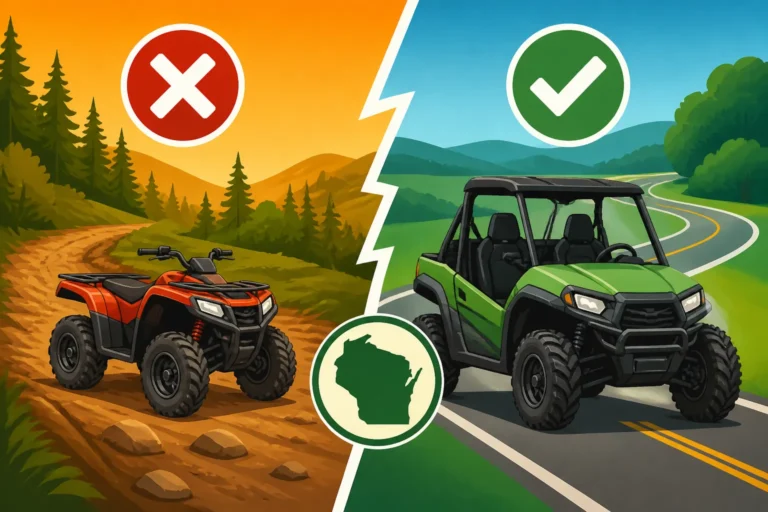
One of the fantastic aspects of riding in Wisconsin is the expanding network of ATV and UTV road routes. Many towns and counties have opened their roads to off-highway vehicles, creating seamless connections between trails, gas stations, restaurants, and lodging. However, riding on these routes comes with specific rules that differ from trail riding and are often more akin to operating a motor vehicle.
Route Signage and Local Ordinances
The absolute golden rule for riding on Wisconsin road routes is to pay close attention to the signage. Every town or county that opens roads to ATVs/UTVs will have specific signs indicating where the routes begin and end, and what restrictions apply. These routes are usually marked with yellow signs featuring an ATV/UTV symbol and arrows. Just because one road in a town is open doesn't mean all of them are.
Additionally, local municipalities can impose their own ordinances that go beyond state law. This means that speed limits, hours of operation, and even specific requirements like insurance can vary from one town to the next. It's your responsibility to know the local rules for the area you're riding in. Many trail clubs and county websites provide maps and ordinance information, and it's always a good idea to check these resources before you head out. These local variations can be frustrating, but they exist, and knowing them prevents trouble. The topic [Municipal Ordinances Wisconsin Riders Must Read] delves deeper into these local rules.
Speed Limits and Passenger Rules on Routes
When you're on a designated road route, you are no longer just on a trail; you are sharing the road with other vehicles, even if it's a quiet backroad. This means adhering to posted speed limits, which are often the same as for cars and trucks. While the thrill of speed is part of off-roading for some, routes are not the place for it. Ride responsibly and respect the local community you're passing through.
Passenger rules also tend to be stricter on road routes. Generally, ATVs are designed for one operator, unless specifically manufactured and designated for two riders (often called 2-up ATVs). UTVs, with their side-by-side seating, are permitted to carry as many passengers as there are manufacturer-installed seats and seatbelts. It's critical to ensure all passengers are properly seated and belted, and that you're not exceeding the machine's capacity. Safety is paramount, especially when sharing paved or gravel roads.
Alcohol and Operating an ATV/UTV
This cannot be stressed enough: operating an ATV or UTV under the influence of alcohol or drugs is illegal, extremely dangerous, and carries severe penalties in Wisconsin. The legal limit for blood alcohol concentration (BAC) is the same for ATV/UTV operators as it is for motor vehicle drivers: 0.08%. This applies to all public lands, including trails, frozen lakes, and road routes.
The consequences of an OWI (Operating While Intoxicated) on an ATV or UTV are serious, including significant fines, loss of riding privileges, and even jail time. It's simply not worth the risk. If you're going to enjoy adult beverages, do so responsibly after your ride is done for the day, or ensure you have a designated sober operator. Don't let a fun day turn into a life-altering mistake. Understanding [Wisconsin Alcohol Limits for ATV Operators] is critical for every rider.
Important Distinctions: ATV vs. UTV for Older Riders
While the general term "off-highway vehicle" often covers both ATVs and UTVs, Wisconsin law sometimes makes specific distinctions, especially concerning age and passenger capacity. For riders 16 and over, these differences are important to understand.
Age for UTV Operation
This is a key distinction that can surprise some riders. While a 12-year-old can operate an ATV on designated trails under certain conditions (with supervision and certification), the minimum age for operating a UTV on public lands in Wisconsin is 16 years old. This means that even if you're a certified ATV rider at 14, you cannot legally operate a UTV on a public trail or route until your 16th birthday.
This rule exists due to the different characteristics of UTVs – their size, weight, and multi-passenger design – which can present different handling challenges compared to ATVs. If you're 16 or over, this rule might not directly impact your ability to drive either, but it's important context for understanding why the rules are structured the way they are for all riders.
Passenger Seating and Safety Belts
UTVs are fundamentally designed for multiple passengers, featuring bucket seats or bench seats and, crucially, seat belts. When operating a UTV, everyone must be properly secured in a factory-installed seat, with their seatbelt fastened. You cannot carry more passengers than there are designated seats and seatbelts. This isn't just a recommendation; it's a legal requirement designed to protect occupants in the event of a roll-over or sudden stop.
ATVs, on the other hand, are typically designed for a single operator. While some ATVs are specifically manufactured as "2-up" models with an extended seat and footpegs for a passenger, a standard ATV is not meant to carry a passenger. Trying to squeeze two people onto a single-rider ATV, even if they're small, is not only illegal but incredibly dangerous, significantly affecting the machine's balance and handling. Always check your machine's manufacturer guidelines and Wisconsin law regarding passenger limits for your specific type of ATV or UTV.
Common Pitfalls and How to Avoid Them
Even experienced riders can sometimes fall into common traps regarding ATV/UTV rules. Knowing these pitfalls ahead of time can help you stay compliant and avoid unnecessary headaches.
Assuming Rules Are Universal
One of the biggest mistakes riders make, especially when traveling through different parts of Wisconsin, is assuming that the rules in one county or town are the same everywhere else. As mentioned earlier, local ordinances play a significant role on road routes. A route that's open until 10 PM in one town might close at sunset in another. A county might require a driver's license for route use, while the state does not on trails.
Always check local regulations for the specific area you plan to ride. Many counties and towns have their ATV/UTV ordinances published online. A quick search before your trip can save you from a citation or, worse, a preventable accident. This variable nature of rules is a common frustration, but it's a reality we all have to contend with.
Riding Unregistered or Uncertified
The temptation to just "slip out for a quick ride" on an unregistered machine, or without the required safety certificate (if you're born after 1988), can be strong, especially if you're only going a short distance. However, Wisconsin wardens are active and vigilant, and the penalties for these infractions can be substantial. [Fines for Riding Wisconsin Unregistered] can quickly add up, easily exceeding the cost of registration or a safety course.
It's simply not worth the risk. Take the time to get your machine properly registered and complete any necessary safety training. These are foundational requirements for a reason, designed to promote safety and ensure funds are available for trail maintenance. Don't cut corners on the basics, as it will almost certainly cost you more in the long run.
Failing to Display Proper Identification
Your registration decals and any required non-resident trail passes are your machine's form of identification on the trails and routes. Failing to display them correctly, or letting them become so faded or caked in mud that they're unreadable, is akin to driving a car without a visible license plate. Wardens need to be able to quickly identify your machine and verify its compliance.
Make it a habit to check your decals before each ride. Ensure they are securely affixed and clean enough to read clearly. If a decal has come off or is no longer legible, you can order replacements through the Wisconsin DNR. This small act of diligence can prevent an unnecessary stop or conversation with a warden, letting you focus on the joy of the ride. You can also refer to [What a Wisconsin Warden Asks a Rider For] to understand what officials are looking for.
Summary of Wisconsin ATV/UTV Rules for Riders 16 and Over
To help keep track of the main points, here's a handy overview of the key rules for riders aged 16 and above in Wisconsin:
| Rule Category | ATV (16+) | UTV (16+) | Notes |
|---|---|---|---|
| Registration | Required for public lands (Public Use) | Required for public lands (Public Use) | Private Use only if never leaving private land |
| Safety Certificate | Required if born on or after Jan 1, 1988 | Required if born on or after Jan 1, 1988 | Exemption for those born before Jan 1, 1988 |
| Helmet Use | Optional if 18+, required if 16-17 | Optional if 18+, required if 16-17 | Always recommended for safety, regardless of age |
| Non-Resident Trail Pass | Required if machine not WI-registered | Required if machine not WI-registered | Not needed if machine has WI Public Use Registration |
| Decal Placement | Both sides of forward half, clearly visible | Both sides of forward half, clearly visible | Must be legible and securely affixed |
| Headlights/Taillights | Required during limited visibility | Required during limited visibility | Must meet visibility standards |
| Muffler/Spark Arrester | Required, 96-decibel limit | Required, 96-decibel limit | USFS-approved spark arrester to prevent wildfires |
| Passengers (Trails) | One operator unless 2-up model | As many as manufacturer seats/seatbelts | All passengers must be in factory seats, seatbelted |
| Passengers (Routes) | One operator unless 2-up model | As many as manufacturer seats/seatbelts | Stricter enforcement on road routes |
| Alcohol Limit | 0.08% BAC (same as vehicles) | 0.08% BAC (same as vehicles) | Severe penalties for OWI |
| Local Ordinances | Varies by town/county on road routes | Varies by town/county on road routes | Check local rules for hours, speed, etc. |
Staying informed about these rules is the best way to ensure you have a safe, legal, and enjoyable experience on Wisconsin's incredible ATV and UTV trails and routes.
Disclaimer
This article is for general informational purposes only and does not constitute professional advice. Laws, prices and regulations vary by location and change over time. Consult a qualified professional for guidance on your specific situation.