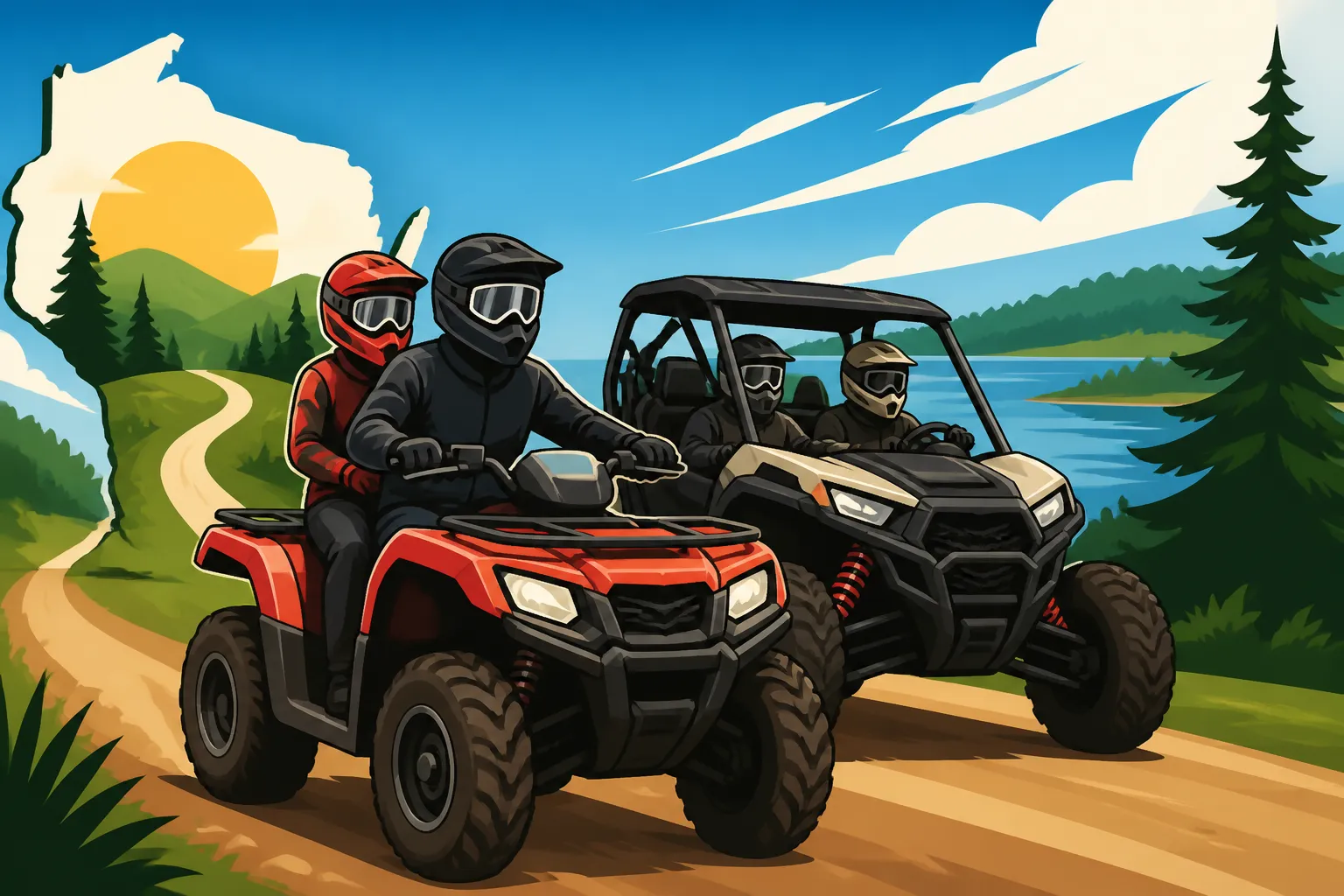
Passengers on a Wisconsin Road Route
Riding the open roads of Wisconsin on your ATV or UTV can be an exhilarating experience, especially when you want to share it with family or friends. However, throwing an extra helmet on the rack and inviting someone along isn't always as simple as it sounds. Wisconsin has very specific, and sometimes confusing, rules about carrying passengers on these machines, especially when you venture onto designated road routes. This guide is here to walk you through the nuances, ensuring you understand not just the letter of the law but also the spirit of safety, so your shared rides are memorable for all the right reasons.
Understanding Wisconsin's Basic Passenger Rules for ATVs and UTVs
Before you even think about hitting a road route, it’s absolutely essential to grasp the fundamental rules Wisconsin has in place for carrying passengers on your off-highway machine. These aren't just suggestions; they are the bedrock of safe and legal riding, and wardens take them very seriously. The biggest differentiator here is whether you're on a traditional ATV or a modern UTV, as the rules, and the design of the machines themselves, vary significantly.
The Crucial Distinction: Manufacturer's Design
The golden rule in Wisconsin, when it comes to carrying passengers on any ATV or UTV, boils down to how the machine was originally designed and manufactured. This isn't about what you think your machine can handle, or what kind of custom seat you bolted on. It’s about the original equipment manufacturer's (OEM) intent, as indicated by the machine's design and decals.
For a traditional ATV, this means looking for a seat explicitly designed for a passenger. These are often longer, saddle-style seats with dedicated footrests and grab handles for the second rider. If your ATV came from the factory with only one seat, then it’s legally a single-rider machine, regardless of how much space seems to be behind you. Attempting to carry a passenger on a single-seat ATV is a direct violation of Wisconsin law and incredibly dangerous. These machines are balanced and engineered for a single operator’s weight distribution, and adding a second person dramatically alters handling, especially in turns or over bumps. It's a quick way to lose control and potentially cause a serious accident. Even if you're just riding [Riding a Friend's Land by Permission in Wisconsin] and think no one will notice, the safety implications are paramount.
UTVs, or side-by-sides, are generally built with multiple seats from the get-go. Most popular models, whether they are two-seat sport machines or four-seat utility rigs, come with designated seating, seatbelts, and often nets or doors for all occupants. The key here is that each seat must be an original, factory-installed seat. If your UTV has a bench seat, the manufacturer specifies how many people that bench is designed to hold (e.g., three across). You can't squeeze a fourth person onto a bench designed for three, just as you can't add a lawn chair to the bed of a utility UTV and call it a passenger seat. The design and safety features are integrated for a reason, and bypassing them puts everyone at risk.
Age and Passenger Limitations on ATVs
For ATVs, the rules concerning passengers are quite strict due to the inherent design and dynamics of these machines. If your ATV is designed for two people—meaning it has a clearly separate, dedicated passenger seat, footrests, and grab handles as installed by the manufacturer—then you can carry a passenger.
However, even with a two-up ATV, there are age considerations for the operator. In Wisconsin, operators of ATVs must be at least 12 years old to operate on public trails and routes, and if they were born on or after January 1, 1988, they need an ATV safety certificate. While there isn't a specific minimum age for a passenger on a two-up ATV, the operator must be competent enough to safely handle the machine with the added weight and dynamics of another person. Think about it: a 12-year-old rider, even a certified one, might struggle significantly with the altered balance and braking required when carrying an adult passenger. It's about common sense and ensuring the operator has the skill and strength to manage the machine effectively with two people aboard. The law focuses on the machine's design first and foremost; if it's a single-rider ATV, no passenger is allowed, period.
UTVs: More Capacity, But Still Rules
UTVs, by their very nature, are designed for multiple occupants, making them a popular choice for families and groups wanting to explore Wisconsin's vast trail and road route systems together. However, this doesn't mean it's a free-for-all. Every passenger in a UTV must occupy a seat designed and provided by the manufacturer. This means no riding in the cargo bed, no perching on fenders, and no standing in the vehicle.
Each occupant must also be secured by a seatbelt if the UTV is equipped with them, which nearly all modern UTVs are. For children, this often means ensuring they are old enough and large enough to properly fit the vehicle's seatbelt system, or utilizing appropriate booster seats or child restraints if they are legally required for on-road vehicles of that type, depending on local ordinances. While Wisconsin's off-road specific laws might not detail child restraint systems in the same way as highway vehicle laws, many road routes adopt aspects of highway traffic laws. For example, [Wisconsin Helmet Rules for Riders Under 18] are critical, but also consider proper seating. It's always best practice to ensure younger passengers are as secure as possible, just as you would in your family car. The number of passengers is strictly limited to the number of factory-installed seats with corresponding seatbelts. If your UTV has a capacity for four, you can only have four people in it—no more.
Specific Challenges on Wisconsin Road Routes
Taking your ATV or UTV onto a designated road route in Wisconsin opens up a whole new layer of regulations, particularly when it comes to passengers. While state law provides a baseline, local municipalities have the authority to add their own rules, creating a complex patchwork of ordinances that riders must navigate. This means a perfectly legal setup in one town might get you a citation just across the county line.
Local Ordinances and Added Restrictions
This is where riding can get tricky in Wisconsin. While the state generally allows ATVs and UTVs on designated road routes, the individual towns, villages, and cities that open these routes often impose additional restrictions. These local ordinances can cover everything from hours of operation to speed limits, and yes, sometimes even more specific rules about passengers. You might find a town that, for instance, prohibits passengers under a certain age on its road routes, even if the state law doesn't explicitly do so for UTVs. Or perhaps a town might specifically require helmets for all passengers, regardless of age, on their routes, going beyond the state's requirement for those under 18.
It’s an immense frustration for riders who travel through multiple jurisdictions, trying to keep up with the varying rules. Before embarking on a multi-town ride, it is absolutely critical to check the local ordinances for every municipality you plan to pass through. Many trail clubs and county DNR offices provide this information, and many towns now post their ATV/UTV ordinances online. Ignoring these local rules, even if you’re complying with state law, can still lead to fines or a ruined day of riding. This constant need to check and re-check local rules is why platforms like onX Offroad are becoming indispensable tools for planning routes and staying compliant, helping you avoid an unexpected interaction with a local warden. Be aware that what applies to [Speed Limits on a Wisconsin Route] might also have companion rules for passengers.
Helmet Requirements for Younger Passengers
Wisconsin state law mandates that anyone operating or riding as a passenger on an ATV or UTV who is under the age of 18 must wear a DOT-compliant helmet. This rule applies uniformly across all trails, routes, and private property (unless that private property is owned by an immediate family member and the riding is for agricultural purposes). This isn't just a suggestion; it's a non-negotiable legal requirement designed to protect younger, more vulnerable riders.
When you're on a road route, this rule is enforced just as strictly, if not more so, as you're sharing space with other vehicles and potentially traveling at higher speeds. As the operator, you are responsible for ensuring your underage passengers are properly helmeted. A bicycle helmet or an uncertified helmet simply won't cut it; it needs to be a helmet approved by the Department of Transportation (DOT). Failing to equip your underage passenger with the correct helmet can result in a citation for the operator, and more importantly, exposes your passenger to significant risk in the event of an accident. Always ensure the helmet fits snugly, is fastened correctly, and provides the maximum protection possible.
Seatbelts and Enclosures in UTVs
For UTVs, the presence and proper use of seatbelts are critical, especially on road routes. If your UTV is equipped with seatbelts—and virtually all modern UTVs are—then every occupant must wear one whenever the vehicle is in motion. This isn't just for compliance; it's a fundamental safety measure that can prevent serious injury or ejection during sudden stops, turns, or rollovers. The law is clear: if it has a belt, use it.
Beyond seatbelts, many UTVs come with side nets, doors, or even full cab enclosures. While these may not always be legally mandated on road routes in the same way seatbelts are, they offer significant protection for passengers. Nets and doors help keep limbs inside the vehicle and prevent ejection in a roll. Cab enclosures, often outfitted with windshields and roofs (perhaps an aftermarket windshield from a brand like SuperATV), provide protection from the elements, flying debris, and enhance overall comfort, making the ride much more enjoyable for passengers, especially on longer road route excursions. Always check that these enclosures are properly secured and maintained. [Belts and Nets in a Wisconsin Side-by-Side] are there for a reason and should always be utilized.
Safety Considerations Beyond the Law
While legal compliance is a must, safety on Wisconsin road routes, especially with passengers, extends far beyond simply ticking off legal requirements. A truly responsible rider understands that rules are a minimum standard, and taking proactive steps to enhance safety can make all the difference in preventing accidents and ensuring a pleasant experience for everyone.
Equipment Checks Before Every Ride
Before you load up your passengers and head out, a thorough equipment check is non-negotiable. This becomes even more critical when you're carrying additional weight, as it stresses your machine's components differently. Start with your tires: check the pressure, looking for any signs of damage or excessive wear. Underinflated tires can affect handling, while overinflated ones can lead to a harsh ride and reduced traction. Inspect your brakes—front and rear—to ensure they are fully functional and not spongy. The added weight of passengers will increase your stopping distance, so reliable brakes are paramount.
Next, examine your suspension components. Are there any obvious leaks from shocks? Is the suspension sagging excessively with the added load? Adjusting your shocks, if your machine allows for it, can help maintain proper ride height and handling with passengers. Check all lights, including headlights, taillights, and brake lights, as road routes mean sharing the road with other vehicles, and visibility is key. Finally, make sure all seatbelts (for UTVs) and grab handles are securely attached and in good working order. Don't forget to check the condition of any aftermarket accessories, like a SuperATV windshield or roof, to ensure they aren't loose or damaged, which could become a hazard on the road. A quick pre-ride inspection can prevent a roadside breakdown or, worse, an accident.
Communicating With Your Passenger
Taking someone along for the ride, particularly a new rider or a child, means you need to be their guide and advocate for safety. Open and clear communication is vital from the moment they step onto or into your machine. Before you even start the engine, explain the basic safety rules: where to put their feet, how to hold on (for ATVs), and the importance of keeping their arms and legs inside the vehicle (for UTVs). Emphasize that they should never try to operate any controls.
Throughout the ride, maintain communication. This is especially true on bumpy trails or when approaching turns. A simple "hold on tight" or "we're going over a big bump" can make a huge difference in their comfort and ability to brace themselves. Pay attention to their signals, too. If they look uncomfortable, are gripping too tightly, or seem anxious, pull over and check in. They might be cold, tired, or simply need a break. Remember, you're in control, and their safety and enjoyment are your responsibility. Setting expectations before you leave, and checking in regularly, will lead to a much better experience for everyone.
Adapting Your Riding Style
With passengers aboard, especially on road routes where conditions can change quickly, you absolutely must adapt your riding style. This isn't the time for aggressive cornering, high-speed jumps, or pushing the limits of your machine. Your focus shifts from your own thrill to the comfort and safety of your passengers. This means riding more smoothly, anticipating bumps and turns, and reducing your speed.
Braking and acceleration should be gradual and controlled. Sudden movements can throw passengers off balance or make them feel insecure. Take turns wider and slower, mindful of how centrifugal force affects your passenger. If you’re on an ATV, remember that your passenger's weight significantly changes the machine's center of gravity. You'll need to be more deliberate with your body positioning and counter-steering. For UTVs, the added weight means a longer stopping distance and different handling characteristics in corners. Always maintain a safe following distance from other vehicles, particularly on road routes, to give yourself ample time to react. Your goal is a smooth, predictable ride that instills confidence in your passenger, making them want to come back for more adventures.
Common Misconceptions and What Wardens Look For
Even with the best intentions, riders sometimes make assumptions or misunderstand specific aspects of Wisconsin's ATV and UTV passenger laws, especially on road routes. These misconceptions can lead to uncomfortable encounters with wardens, fines, and potentially dangerous situations. Understanding what officers are trained to look for can help you stay compliant and avoid unnecessary hassles.
The "Just Riding to Camp" Trap
One of the most common pitfalls riders fall into is the "just riding to camp" or "just going down the road to the tavern" mentality. Many believe that if they're only traveling a short distance on a road route, perhaps from their cabin to a nearby trail system or to grab a bite to eat in a [Riding Into a Wisconsin Trail Town], the rules are somehow relaxed. This is a dangerous misconception.
Wisconsin law, and the local ordinances governing road routes, do not have a "short distance" or "low speed" exemption for passenger rules. If you are operating on a designated road route, all applicable state laws and local ordinances regarding passengers, helmets, and machine design apply, regardless of how far or how fast you're going. A warden observing an ATV with an unauthorized passenger, or a UTV with more occupants than factory seats, will likely issue a citation, even if your destination is just a few hundred yards away. The law is the law, and "just a little ways" is no excuse. Always plan your short trips with the same level of compliance as your longest excursions.
Proving Compliance to an Officer
If you are stopped by a Wisconsin warden or local law enforcement officer while carrying passengers on a road route, they will be looking for specific indicators of compliance. First and foremost, they will check the machine itself. For ATVs, they'll verify if it's a factory-designed two-up model. This usually involves checking the length of the seat, the presence of dedicated passenger footrests, and any manufacturer decals indicating its capacity. For UTVs, they'll count occupants and compare that to the number of factory-installed seats and seatbelts. They'll likely also look for signs of modifications that might make the machine unsafe for passengers.
Beyond the machine, officers will assess your passengers. Are all occupants under 18 wearing DOT-compliant helmets? Are all UTV occupants wearing their seatbelts? They may also ask for your [What a Wisconsin Warden Asks a Rider For] like registration, safety certificate (if applicable), and potentially proof of insurance if required by local ordinance. Being prepared with all your documentation and ensuring your machine and passengers meet all legal requirements will make any interaction with law enforcement smooth and brief. Honesty and cooperation go a long way.
Penalties for Non-Compliance
Operating an ATV or UTV on a Wisconsin road route with passengers in violation of state law or local ordinances can result in significant penalties. These aren't minor slaps on the wrist. Fines can range from moderate to substantial, depending on the specific violation and whether it's a first offense or a repeat. For instance, carrying an unauthorized passenger on a single-seat ATV, or failing to ensure an underage passenger wears a helmet, can lead to direct citations for the operator.
Beyond monetary fines, repeated violations or particularly egregious acts of reckless riding with passengers can even lead to suspension of riding privileges in Wisconsin. More importantly, riding with unauthorized or improperly secured passengers vastly increases the risk of serious injury or fatality in an accident. If an accident occurs and you are found to be in violation of passenger laws, you could face civil liability claims in addition to criminal penalties. It's a heavy price to pay for what might seem like a minor infraction. Understanding [Wisconsin Penalties for Reckless Riding] also gives insight into how seriously violations are taken. The best approach is always to err on the side of caution and ensure everyone aboard is safe and legal.
Preparing for a Multi-Passenger Adventure
Embarking on a multi-passenger ATV or UTV adventure on Wisconsin’s road routes requires more than just knowing the rules; it demands thoughtful preparation. From equipping your passengers to planning your route with their comfort in mind, every detail contributes to a safer, more enjoyable experience for everyone involved.
Gear for All Occupants
Just as you wouldn’t hit the trails without your own riding gear, your passengers need proper attire and protection too. For all passengers, especially on road routes where debris can be kicked up by other vehicles, eye protection is crucial. Goggles or a full-face helmet visor will shield eyes from dust, insects, and small stones. Sturdy footwear that covers the ankles is important, as are long pants and sleeves to protect against scrapes and sun exposure. Even on warm days, having layers is a good idea, as temperatures can drop quickly, especially in the Northwoods.
For any passenger under 18, a DOT-compliant helmet is a legal requirement in Wisconsin, but it’s a smart idea for all passengers, regardless of age. If your UTV has doors or nets, ensure they are securely fastened. Consider adding aftermarket accessories that enhance passenger comfort and safety, such as upgraded grab handles or better footrests. Some riders even invest in communication systems, allowing riders and passengers to talk easily over engine noise and wind, which can be particularly useful for navigating or pointing out sights. If you’re riding in cooler weather, heated grips or heated seats (if your machine has them) can make a huge difference in passenger comfort.
Planning Your Route With Passenger Comfort in Mind
When you have passengers, especially children or those less accustomed to off-road riding, your route planning needs to shift gears. What might be a thrilling, technical trail for a solo rider could be terrifying or uncomfortable for a passenger. On road routes, look for sections that are well-maintained, smooth, and offer scenic views, perhaps leading to a picturesque lake or a charming small town. Avoid excessively bumpy or rough sections if possible, as continuous jarring can quickly lead to passenger fatigue and discomfort.
Consider the length of your ride and plan for regular stops. Passengers, particularly children, will need breaks for stretching, snacks, and bathroom visits. Research potential stopping points along your chosen route, such as parks, trailheads, or local businesses that welcome ATV/UTV riders. If you're planning on [Riding to Supper in a Wisconsin Trail Town], choose routes that are known to be family-friendly and well-traveled. Pace yourself and be flexible; the goal is enjoyment, not setting a speed record. Always have a map, whether paper or digital (like onX Offroad), and be aware of potential bail-out points or alternative routes if a section becomes too challenging or uncomfortable for your passengers.
Maintaining Your Machine for Added Weight
Carrying passengers means added weight and strain on your ATV or UTV, so proper machine maintenance becomes even more critical. Before any multi-passenger trip, ensure your tires are correctly inflated for the increased load; consult your owner's manual for recommended pressures for loaded conditions. Check your suspension; some machines allow for easy adjustment of preload to better handle extra weight, preventing bottoming out and maintaining proper handling. If your machine's suspension isn't adjustable, be extra mindful of large bumps and compressions.
Brakes will work harder with a heavier load, so inspect pads and fluid levels to ensure maximum stopping power. Your engine and drivetrain will also be under more stress, so ensure your oil and other fluids are at proper levels and that all belts (especially the CVT belt on UTVs) are in good condition. An overloaded machine is not only a safety risk due to compromised handling and braking but can also lead to premature wear and tear on expensive components. Regularly cleaning and lubricating moving parts after dusty or muddy rides will extend the life of your machine, even more so when it’s consistently carrying a full load. Brands like SuperATV offer heavy-duty components that some riders opt for if they frequently carry heavy loads or passengers in challenging terrain.
ATV vs. UTV Passenger Rules in Wisconsin
| Feature/Rule | ATV (All-Terrain Vehicle) | UTV (Utility Terrain Vehicle / Side-by-Side) |
|---|---|---|
| Passenger Seats | Must be factory-designed two-up seating with footrests. Single-seat ATVs are strictly one-rider. | All passengers must occupy a factory-installed seat. Capacity equals number of seats. |
| Operator Age | Minimum 12 years old on public trails/routes. If born on/after 1/1/88, must have safety certificate. | Minimum 16 years old to operate on routes. If born on/after 1/1/88, must have safety certificate. |
| Passenger Age | No specific minimum age, but operator must be competent to safely manage machine with added weight. | No specific minimum age, but all must use seatbelts and fit safely. |
| Helmet Rule | Mandatory for all operators and passengers under 18 years old. DOT-compliant only. | Mandatory for all operators and passengers under 18 years old. DOT-compliant only. |
| Seatbelts | Not applicable (ATVs do not have seatbelts). | Mandatory for all occupants if machine is equipped (virtually all are). |
| Enclosures/Nets | Not applicable. | Doors or nets (if equipped) should be closed for safety. |
| Road Routes | All state and local rules apply regardless of distance. | All state and local rules apply, including specific municipal ordinances. |
Disclaimer
This article is for general informational purposes only and does not constitute professional advice. Laws, prices and regulations vary by location and change over time. Consult a qualified professional for guidance on your specific situation.