Michigan Riders Coming to Wisconsin Trails
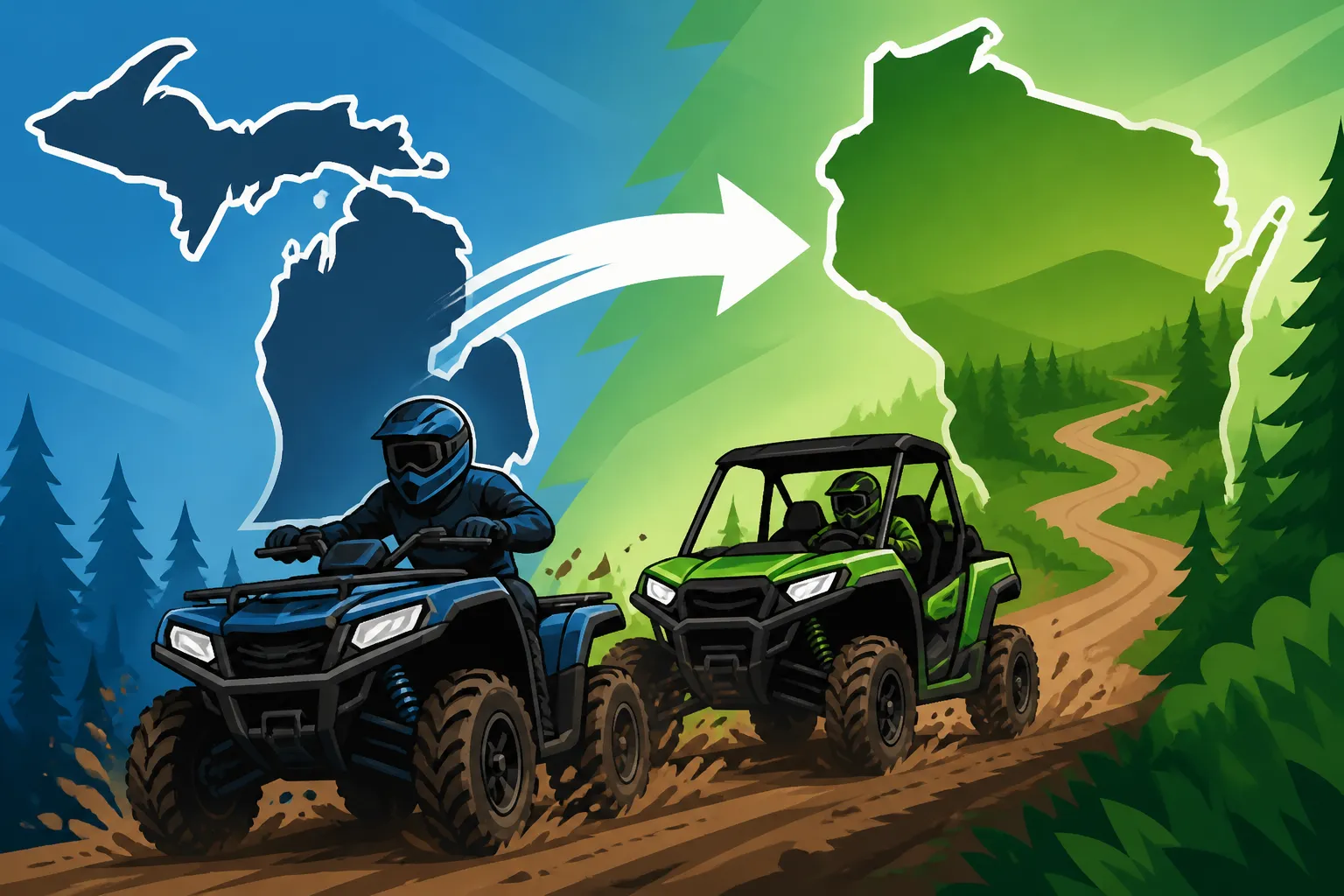
Michigan riders planning a Wisconsin trail trip often assume a home-state registration or permit will cover them across the border. The key point is that Wisconsin has its own requirements for public ATV trails. Here’s how to sort out the pass, paperwork, safety rules and route access before you unload.
What Michigan riders need for Wisconsin trails
A Michigan registration or ORV credential does not automatically serve as a Wisconsin trail pass. If your machine is registered outside Wisconsin and you plan to ride Wisconsin’s public ATV trails, you will generally need a Wisconsin nonresident trail pass for that machine. The pass is separate from your Michigan paperwork, so keep both available.
Wisconsin’s pass requirement is about where you ride, not just where your machine is registered. Public ATV trails are the main concern. A legal connection on a town road, a private trail or a route open to ATVs can have different requirements. A pass does not give you permission to ride every road, trail or piece of public land.
| Situation | What to check before riding |
|---|---|
| Michigan-registered machine on a Wisconsin public ATV trail | Obtain and display the Wisconsin nonresident trail pass, and carry proof of Michigan registration |
| Machine registered in Wisconsin | Check that its Wisconsin registration is current; a Wisconsin-registered machine generally does not use the nonresident pass |
| Riding a road route rather than a public ATV trail | Confirm the road is officially open to ATV or UTV use and meet applicable route rules |
| Riding private land | Get the landowner’s permission and check whether any public-trail requirements apply to the planned ride |
| Unsure whether a place is a trail or route | Check the official map and local rules before setting out |
The nonresident pass applies to the machine, not simply to the person carrying the paperwork. If you bring two ATVs or UTVs, check the requirement for each one rather than assuming a single pass covers the trailer or group. For details on how Wisconsin defines the pass and who needs it, see Wisconsin’s Non-Resident Trail Pass and What Wisconsin Charges an Out-of-State Rider.
A Michigan trail permit, ORV license or registration remains important as proof that your machine is properly documented at home. But it does not replace Wisconsin’s pass when Wisconsin requires one for a public trail. If your machine is not registered or otherwise authorized for use in Michigan, do not assume a Wisconsin pass alone fixes that problem. Confirm the correct registration path for your situation before traveling.
Rules and costs can change, so check current pass instructions and fees through the Wisconsin DNR or an authorized seller. You can also review Which Wisconsin Trails Require a Pass to distinguish trail access from other types of riding.
Get the pass and paperwork ready before you leave
Getting the pass arranged before the trip reduces the chance of reaching a trailhead and discovering that a machine is not ready to ride. Use the official purchasing instructions, follow the display directions that come with the pass and keep the supporting documents where you can reach them.
A practical preparation sequence
- List every machine you plan to ride. Record each machine’s make, model and identification details. The pass is associated with a machine, so do not plan around one pass covering several vehicles.
- Check Michigan paperwork. Carry current proof that the machine is registered or otherwise properly authorized in Michigan. Make sure the identifying information on the paperwork matches the machine.
- Buy the Wisconsin pass through an approved channel. Wisconsin offers online purchase options and authorized agents. Start with Buying a Wisconsin Trail Pass Online or check Wisconsin Agents Near the Northwoods Trails if you prefer to handle the purchase locally.
- Follow the display directions. Attach the pass as instructed and make sure it can be seen. Do not tuck it under a cover, place it where cargo blocks it or rely only on a digital receipt if the rules require a physical display. See Displaying a Wisconsin Trail Pass.
- Keep proof of purchase and registration together. Store the documents securely on the machine or with the operator, in a way that protects them from water and mud while leaving them accessible if requested.
- Check route and trail status. Confirm that the trail system is open on your travel dates and that the planned roads or connectors are open to your type of machine.
Do not wait until the morning of the ride to find out whether a pass can be issued or displayed immediately. Processing and delivery details can vary by purchase method. Check the current instructions so you know whether you will receive a physical decal, what to show if it has not arrived, and whether a receipt is enough in your particular situation.
The same applies to registration. A bill of sale is useful when you have recently bought a machine, but it is not necessarily a substitute for valid registration. If the paperwork is incomplete, mismatched or still being transferred, contact the relevant registration authority before heading to Wisconsin. For a broader overview of the rules visitors should check, see Wisconsin Rules for First-Time Visitors.
Keep the pass on the machine it was issued for and do not move it between vehicles. If it is damaged, lost or peels off, follow the replacement or display instructions rather than improvising with a photocopy or an altered decal. Inspect it during the trip, especially after washing the machine or riding in wet conditions.
Trail passes do not authorize every kind of riding
A Wisconsin nonresident pass gives access only where its rules apply. It does not turn a closed trail into an open one, allow riding outside a marked corridor or make a road legal for ATVs. Before choosing a destination, identify whether each planned segment is a public ATV trail, an ATV route on a road, private land or another kind of motorized area.
Trail and route designations can be easy to confuse on a map. A route may use public roads that a town has opened to ATVs; a trail is a designated off-road riding corridor. A pass requirement for a public trail should not be treated as a blanket permission for the road links between trails. Road access, operating hours, equipment rules and local restrictions may vary by municipality.
Use an official map and confirm the rules with the local land manager or municipality when the map is unclear. Do not rely on a line shown in a phone app alone to establish that riding is allowed. For route-specific questions, What a Wisconsin ATV Route Actually Is explains the distinction, and Finding a Wisconsin Town’s ATV Ordinance can help when a trip includes local roads.
Check the whole trip, not only the destination
A trail day may involve a ride from a staging area, a public trail, a short road connection and a stop in a nearby town. Each part can have its own rules. Before departing, check:
- Whether the trail system is open on the day you plan to ride.
- Whether the connector roads are open to ATVs or UTVs.
- Whether local ordinances set operating hours or add equipment requirements.
- Whether your machine’s width is allowed on the trail.
- Where parking, unloading and trailhead access are permitted.
- Whether the route passes through land with separate restrictions.
Seasonal closures are particularly important in Wisconsin. Trails may close during spring thaw or after conditions cause damage, and the status can differ between counties or trail systems. A trail that was open on a previous visit may not be open now. Check Checking Wisconsin Trail Status Before You Drive and consult the local trail authority for last-minute notices.
Private land requires permission from the owner. A public trail pass does not grant access across private property, even if the crossing seems like the most direct way to reach a trail. Stay on marked routes and trails, obey signs and turn around when a route is closed or access is uncertain.
Other rules Michigan visitors should confirm
The pass is only one part of trip preparation. Wisconsin also has requirements that may apply to the operator, machine and location. These can include safety certification, age-related rules, helmets, eye protection, equipment standards and local route restrictions. Requirements differ according to the rider’s age, the machine and whether the ride is on a public trail, road route or private property.
Safety certification and rider age
Wisconsin requires safety certification for some ATV and UTV operators using public riding areas. The rules depend on the operator’s age and other circumstances. Do not assume that a Michigan course card is either automatically accepted or automatically rejected: check Wisconsin’s current criteria and bring proof of any certification that may qualify. Start with Wisconsin’s ATV Safety Certificate Requirement and Out-of-State Certificates Wisconsin Accepts.
Parents and group leaders should check the rules for each younger rider separately. An adult supervising a young operator does not necessarily remove every certification, age or supervision requirement. A passenger’s age can also matter, especially if the machine is not designed to carry a passenger or local rules impose additional limits.
Machine and local requirements
Before the trip, check that the machine is suitable for the trail and that required safety equipment is in place. A UTV and a single-rider ATV may be subject to different rules, and a route that allows one type may not allow another. Follow posted width restrictions and use the machine only in the configuration permitted for that area.
Road routes can bring additional requirements. A route’s local ordinance may set operating hours or require equipment or insurance beyond general trail rules. An ATV pass does not replace those requirements, and a machine that is acceptable on an off-road trail may not be ready for a particular public road. Check the town’s ordinance where you intend to ride rather than relying on another town’s rules.
Keep your Michigan registration documents, Wisconsin pass and relevant safety certificate proof together. It is easier to answer a question during a ride when the paperwork is legible and readily available. If your name, machine identification number or registration details do not match, resolve the discrepancy before traveling.
A final pre-trip checklist
Before loading the machines, confirm that:
- Each machine has the correct Michigan registration or other required home-state authorization.
- Each machine that needs one has its own Wisconsin nonresident trail pass.
- The pass is displayed exactly as instructed.
- Riders have checked Wisconsin safety certification and age requirements.
- The route map shows the trail and road sections you intend to use.
- Trail status and local ordinances have been checked close to departure.
- You have permission for any private-land access.
- You know where to park and unload without blocking public access.
These checks help avoid a common mistake: treating a border crossing as simple reciprocity, when Wisconsin’s pass and local access rules still apply. A Michigan machine can be ready for the trip, but the rider must still match Wisconsin’s requirements to the places they plan to ride.
Disclaimer
This article is for general informational purposes only and does not constitute professional advice. Laws, prices and regulations vary by location and change over time. Consult a qualified professional for guidance on your specific situation.