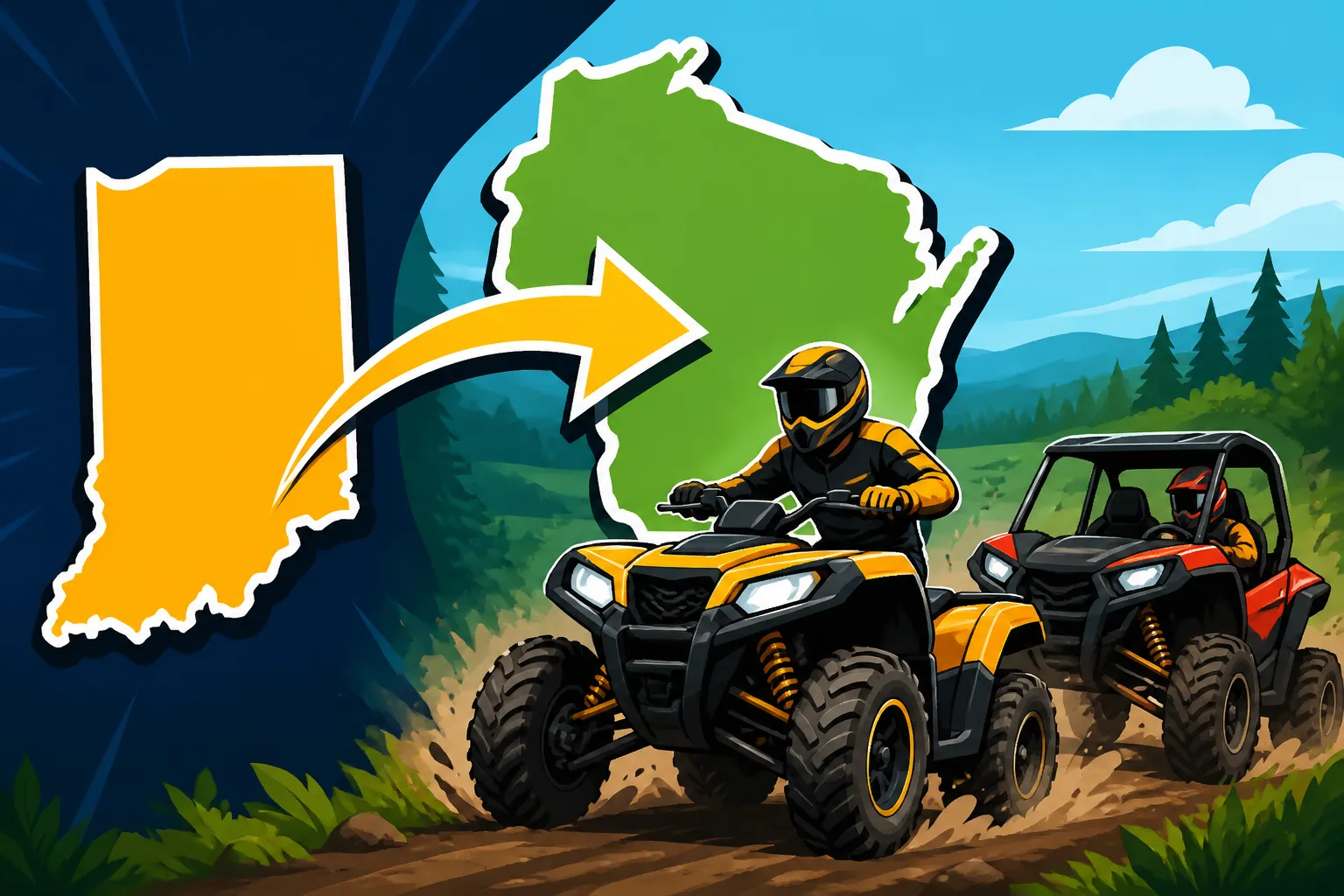
Indiana Riders Heading to Wisconsin
An Indiana registration does not automatically give an ATV or UTV access to Wisconsin’s public trails. Before loading up, check whether your machine needs a Wisconsin trail pass, what rider rules apply, and whether your planned route is open to your type of machine. A little preparation helps prevent an out-of-state paperwork issue from ending a ride early.
What Indiana riders need before using Wisconsin trails
For a machine registered outside Wisconsin, the main question is whether you will ride on a public ATV trail. Wisconsin generally requires an out-of-state machine to display a Wisconsin nonresident trail pass when it is operated on a public trail system where that pass is required. Your Indiana registration is important, but it does not necessarily replace the Wisconsin pass.
The pass is tied to the machine, not simply to the person riding. If you bring more than one ATV or UTV, check the requirements for each machine rather than assuming one pass covers the group. Also confirm the current purchase process, validity period, and display instructions before departure. Rules and administrative details can change, so use the Wisconsin DNR’s current information when you buy.
Start with Wisconsin’s Non-Resident Trail Pass and Passes for a Machine Registered Out of State to understand the basic permit question. What Wisconsin Riders Need Before They Ride is also useful if you are sorting out registration, a pass, safety certification, and other requirements together.
A trail pass is not an all-purpose license to ride anywhere. It does not turn a closed trail into an open one, authorize travel across private property, or automatically allow your machine on a public road. A Wisconsin route is different from an off-road trail: road access depends on the road’s designation and applicable local rules. Before planning a town-to-town ride, read Which Wisconsin Trails Require a Pass and confirm the route rules with the relevant county or town.
| Where you plan to ride | What an Indiana rider should check |
|---|---|
| Public ATV trail | Whether the machine needs a Wisconsin nonresident trail pass and whether that specific trail is open to its type and width |
| Wisconsin road route | Whether the road is officially open to ATVs or UTVs, and any local operating conditions |
| Private property | Permission from the landowner and any applicable rules; a trail pass does not grant access |
| Frozen lake or other special area | The site-specific rules and whether motorized use is allowed |
| County forest or other public land | The managing authority’s map, closures, machine restrictions, and pass requirements |
The distinction between a trail and a road route matters. Trail maps may show public off-road corridors, while road routes are opened under local authority and can have their own conditions. A route that connects two trail segments may still be subject to posted hours, speed limits, equipment requirements, or restrictions for a particular machine. Don’t rely on an app’s line on a map as proof that every segment is open.
For trip planning, check the official trail map and status information close to your departure date. Spring closures, weather damage, maintenance, and local decisions can change access. Checking Wisconsin Trail Status Before You Drive and Finding a Wisconsin County Trail Map can help you build a plan around current conditions rather than last season’s information.
Registration, passes, and where each rule applies
It helps to treat registration and the nonresident trail pass as separate questions. Registration identifies the machine under the rules that apply to it. The Wisconsin pass addresses access to certain public trail systems for machines registered outside the state. Neither one should be assumed to replace the other.
Bring the Indiana registration documents that apply to your machine, and make sure the vehicle identification number and ownership details are easy to verify. Keep the paperwork accessible, but protect it from rain, mud, and damage. A secure waterproof document pouch is a practical option; if you shop on Amazon or elsewhere, choose one that closes reliably and fits the papers without folding them into unreadable condition.
Before leaving Indiana, compare the machine’s registration status with Wisconsin’s requirements for visitors. If the Indiana paperwork is incomplete, expired, or does not clearly identify the machine, resolve that with the appropriate Indiana authority before travel. For state-specific considerations, see Wisconsin Registration for an Out-of-State Machine. Do not assume that a purchase receipt alone proves every fact an officer or trail manager may need to confirm.
A Wisconsin trail pass also has limits. It does not register a machine for every use, waive road-route requirements, or grant permission to ride on private land. Likewise, a machine’s Indiana registration does not mean it may be driven on any Wisconsin town road. The correct paperwork depends on where and how you ride.
Keep the pass displayed as instructed by the Wisconsin DNR. A pass that is in a glove compartment but not properly displayed may not satisfy the display rule. Check that the decal or other proof is placed where it can be seen, remains attached, and is not obscured by accessories, mud, or a windshield. If you have questions about display, use the current instructions rather than relying on advice from another rider’s machine.
If the machine is borrowed or rented, confirm who is responsible for the pass and whether it is already valid for that specific vehicle. A pass associated with one machine should not be treated as transferable to another. Ask the owner or rental provider for the machine’s registration information and confirm the pass status before you arrive at a trailhead. The same check applies when several people share machines during a weekend.
It is also worth confirming that the machine fits the trail. Public systems can differ in width limits and permitted vehicle types. A UTV that is too wide for a particular trail does not become eligible because it has the right pass. Look for restrictions on maps and signs, and contact the local trail authority when the machine’s width or classification is unclear. This matters especially when the group includes both ATVs and side-by-sides.
Rider age, safety certification, and route rules
Indiana riders need to follow Wisconsin’s operating rules while riding in Wisconsin. Your home-state license, safety course, or riding habits do not automatically answer every Wisconsin requirement. Age, machine type, where you ride, and whether an adult is supervising can all affect what is allowed.
Wisconsin has age-related rules for ATV and UTV operation, as well as safety certification requirements that apply to certain riders. These rules are not identical for every machine or setting. Before the trip, check Wisconsin’s ATV Safety Certificate Requirement and Wisconsin ATV Age Rules. If a young rider is coming along, confirm the minimum age, required supervision, and certificate requirements for that rider’s exact age and the type of machine.
Do not rely on a broad statement such as “the child can ride because the machine is on a trail” or “the adult is nearby.” Supervision rules can specify who must accompany a young operator and where that person must be positioned. They may also distinguish between riding an ATV and operating a UTV. If you cannot confirm that a youth rider meets the current requirements, arrange an age-appropriate alternative rather than trying to interpret the rule at the trailhead.
Safety certification is another issue to resolve early. Check whether the rider’s existing certificate is accepted in Wisconsin and whether the rider needs to carry proof. If a certificate is required, complete the course and confirm that the documentation is available before the trip. A parent’s certification does not substitute for a young rider’s own required qualification.
Road routes have additional conditions beyond public-trail access. A town or county may open certain roads to ATV and UTV traffic, but that does not mean all roads in the area are open. Local ordinances may set operating hours, insurance requirements, speed rules, or additional equipment conditions. Read signs at intersections and route entrances, and do not assume that a road remains open after leaving one municipality.
A safe route plan should identify:
- Which trails and roads are actually open to your machine.
- Whether the machine meets any width or equipment limits.
- The pass and registration requirements for each machine.
- Any applicable rider age, supervision, or certification rules.
- Local route conditions, operating hours, and closures.
If you plan to ride from a trail into a town for fuel or food, check the connection carefully. The last trail marker does not establish permission to continue on a nearby road. A short gap on the map may involve a road that is not open, a private driveway, or a route with a local restriction.
A practical pre-trip checklist for Indiana visitors
A good pre-trip check takes less time than sorting out a paperwork or access problem at the staging area. Confirm each machine and rider separately, especially if your group includes different vehicle types, young riders, borrowed machines, or a mix of registrations.
Use this checklist several days before departure:
- Confirm the machine’s registration. Check that the Indiana documents are current and match the machine’s identifying information.
- Check the Wisconsin pass requirement. Determine whether the machine needs a nonresident trail pass for the places you intend to ride, and follow the current purchase and display instructions.
- Match the machine to the trail. Verify vehicle type, width, and other restrictions on the trail map or with the managing authority.
- Check rider eligibility. Review Wisconsin age, supervision, and safety certificate rules for each operator.
- Verify every route segment. Distinguish off-road trails from public road routes, and check local conditions where the trip enters a town or county road.
- Check for closures. Look for current notices, particularly after heavy rain, during seasonal openings, and around maintenance periods.
- Prepare the documents. Carry registration and any required proof in a protected, accessible place.
- Confirm borrowed or rented machines. Ask who handles the pass and whether it applies to the exact machine you will use.
When you arrive, follow posted signs even if your map or GPS suggests a different route. Trail status and permitted use can change, and a device may show a route that is closed or restricted. If the signage is unclear, stop and verify rather than continuing onto an uncertain segment.
Keep a backup plan. Trail closures, weather, or a machine-width restriction can make a planned loop unusable. Choose an alternate trail system or a shorter route that you have already checked. For riders coming from Indiana, this is particularly useful when the trip depends on several connecting roads or trail segments.
The key point is to treat Wisconsin access as a combination of machine paperwork, a possible nonresident trail pass, rider qualifications, and local access rules. Indiana registration is only one part of that picture. Confirm the current requirements with Wisconsin’s official resources and the relevant local trail authority before you haul your machine north.
Disclaimer
This article is for general informational purposes only and does not constitute professional advice. Laws, prices and regulations vary by location and change over time. Consult a qualified professional for guidance on your specific situation.