Buying Your First Side-by-Side in Wisconsin
Buying a first side-by-side is not just a choice between models. You need to match the machine to your riding, passengers, storage, budget and Wisconsin’s rules. This guide explains what to check before you buy, how to think through registration and trail access, and which costs to include beyond the dealer’s quote.
Start with the kind of riding you actually plan to do
A side-by-side, also called a utility-terrain vehicle or UTV, can be a practical choice if you want a steering wheel, side-by-side seating and a place for passengers or gear. But the right machine depends less on its feature list than on where and how you expect to use it.
Start by describing a typical ride in plain terms. Are you mainly crossing your own property, doing farm or property work, riding public trails, or traveling between towns on approved routes? Will you carry passengers regularly? Do you need a cargo bed, or would a smaller recreational model suit you better? These answers shape which features matter and which will just add cost, bulk or maintenance.
Match the machine to its main job
A UTV intended for trail riding may not be the best fit for frequent hauling or plowing. A work-focused model may have the cargo capacity and accessories you want, but its size and setup may be less convenient on narrower trails. If winter work is part of the plan, think through where the machine will be stored, how you will manage snow and ice, and whether you need accessories such as a plow or cab enclosure.
A clear priority list helps keep a sales conversation focused. Sort your needs into three groups:
- Must-haves: features that make the machine usable for your planned riding, such as enough seating, seat belts and a suitable cargo area.
- Useful extras: features that would make a task easier but are not necessary for the machine to do its main job.
- Nice-to-haves: options that sound appealing but you may rarely use.
If trail access is your main reason for buying, begin with the trail system and route rules rather than a particular model. A machine that works well around your property may not be an ideal fit for every trail or route you want to ride. Read Where to Ride an ATV in Wisconsin and Wisconsin Trail Difficulty Ratings to start planning around the terrain and riding experience you want.
Decide whether a UTV is the right type of machine
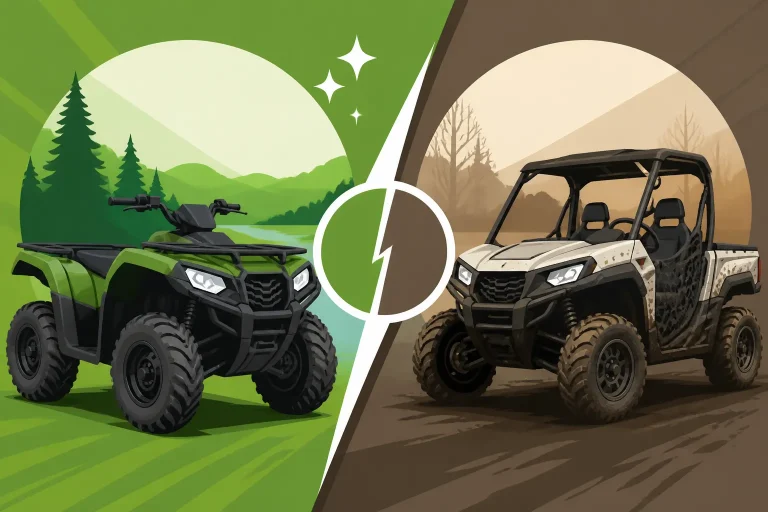
A UTV and an ATV are not interchangeable terms in Wisconsin law. The Wisconsin Department of Natural Resources defines a UTV as a device designed for off-highway use with a width of not more than 65 inches. It also describes UTV equipment such as a steering wheel, headlights, tail lights, brake lights, seat belts and a roll bar or similar occupant-protection structure. Check the DNR’s current definition and the specific vehicle’s classification before buying; marketing language alone does not establish how Wisconsin will treat a machine.
For comparison, the Wisconsin DNR defines an ATV as a commercially designed, motor-driven device with a net weight of 900 pounds or less and a width of 50 inches or less. Its seat is designed to be straddled by the operator. If you are choosing between a quad and a side-by-side, the difference in seating, passenger protection, size and intended use matters as much as the name on the listing.
Do not assume that a machine can use every public road because it has lights, mirrors or a license-style plate. Wisconsin road access depends on the specific roadway and local rules. A road must be designated and signed as a route where required, and state-highway operation has additional conditions. See What a Wisconsin ATV Route Actually Is and Municipal Ordinances That Wisconsin Riders Must Read before treating road access as part of a machine’s value.
Choose a size and configuration you can use confidently
A side-by-side that looks manageable on a dealer’s open lot can feel different on a narrow trail, in a crowded trailer or while maneuvering around a shed. Consider the places where you will drive, park, load, store and maintain it—not just the open space where it feels easiest to operate.
Check width and physical fit
Wisconsin’s UTV definition includes a maximum width of 65 inches, according to the Wisconsin DNR. Before purchase, confirm the manufacturer’s specification and ask how the vehicle’s width is measured for the relevant classification. Do not rely solely on a seller’s shorthand description such as “trail width.” Accessories or modifications may affect the machine’s overall dimensions, and a fit that works for one trail or storage area may not work for another.
Measure your trailer, garage or storage space, gates, ramps and the tightest places on your usual riding area. Leave room to load and unload safely, tie the machine down and reach it for maintenance. A machine that technically fits can still be awkward if there is no space to open doors, move around it or handle equipment.
If you expect to ride trails with specific width limitations, verify the trail’s current requirements with the trail manager before buying. Trail status and permitted machine types can differ by location. A wider machine may be suitable for many rides and still rule out a route that matters to you. Check Wisconsin Trails That Suit a 50-Inch Machine if you are comparing trail constraints, and verify current local information rather than assuming all systems use the same limits.
Think about passengers and protection
A side-by-side can make group outings more practical, but passenger capacity is not just a matter of having an extra seat. Confirm that the seating position, seat belt and occupant-protection equipment are intended for the people who will ride in the machine. The Wisconsin DNR’s UTV description includes seat belts or similar restraints for occupants and a roll bar or similar structure designed to protect occupants during a rollover.
Make it a habit for everyone to buckle up. WisDOT reminds UTV users to wear seat belts and notes that they reduce the risk of being ejected. A belt only helps when it is used and fits properly, so inspect buckles, webbing and anchor points during a used-machine inspection.
If children will ride, consider whether they can sit properly, reach the belt and follow instructions. Do not treat a child’s ability to ride as permission to operate a UTV on public areas. The Wisconsin DNR says UTV operators born on or after January 1, 1988, must meet the applicable age and safety-certification requirements for public riding areas; its stated minimum age for a UTV operator on public trails and areas after completing a safety course is 16. Read Wisconsin Age Rules for ATVs and UTVs and Wisconsin’s ATV Safety Certificate Requirement for the details that apply to a young rider.
Consider cargo, accessories and maintenance access
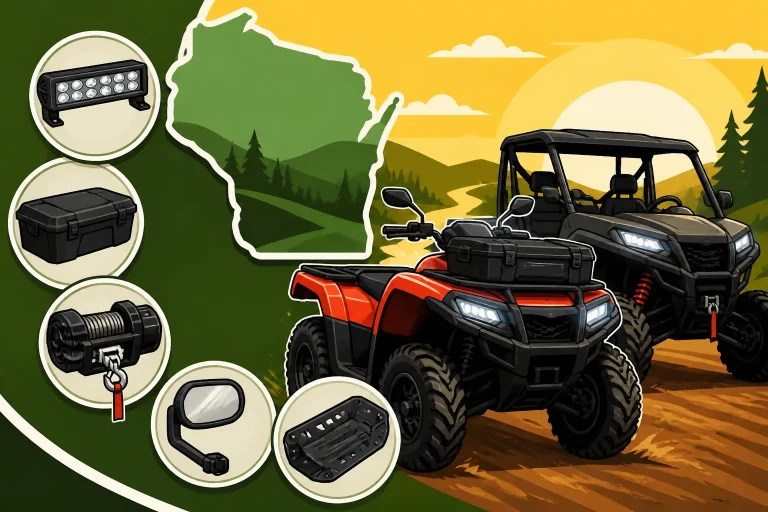
A cargo bed can be useful for property work, but compare how much of your typical load it can handle and whether it suits the work you actually do. A winch, plow, roof, windshield, doors, heater or storage system can change how the machine functions and what it costs to own. Ask which items are included in the written quote and which are add-ons.
Accessories can also affect the way the machine fits through tight spaces or onto your trailer. Before ordering, check compatibility with the exact model and year, including mounting points and electrical connections. If buying basic equipment online, Amazon may be one place to compare options such as tie-down straps, but confirm the working load, length and compatibility rather than choosing by appearance alone. Follow the machine and trailer manufacturers’ instructions when securing a vehicle.
Also look at where routine service can be done. Check access to the battery, filters, drain points and belt inspection area, and ask what scheduled maintenance the manufacturer recommends. A machine with a low purchase quote may still be inconvenient if servicing it requires special transport or a long trip to a shop.
Set a realistic budget before you visit a dealer
The sticker price is only one part of the purchase. Build a written estimate that includes the machine, setup, registration or trail access as applicable, insurance, safety gear, hauling and the equipment you need for your first planned ride. Ask the dealer to identify each line item rather than accepting a single total that is hard to compare.
Compare written out-the-door quotes
Request a written quote for the exact vehicle and configuration you are considering. Ask the dealer to separate the machine price from destination or delivery charges, setup, accessories, required paperwork and any optional products. For a named manufacturer or dealer, costs and terms can change, so confirm current figures directly with the seller. Do not assume an accessory is included because it appears in a photograph or was mentioned in a conversation.
Wisconsin sales tax and dealer charges can affect your total. Get the applicable amount and explanation from the seller, and review Wisconsin Sales Tax and Dealer Fees on a Machine before comparing offers. When you compare quotes, make sure they describe the same model, equipment, warranty arrangements and delivery condition. A lower total may reflect a different configuration rather than a better deal.
| Budget item | What to confirm before committing |
|---|---|
| Vehicle and setup | Exact model, installed equipment, delivery condition and any separate preparation charge |
| Tax and dealer charges | What is included in the quote, how tax is calculated and which charges are optional |
| Registration | Which registration category fits your intended use and whether the dealer will submit the application |
| Trail access | Whether the machine needs a Wisconsin registration, a nonresident pass or a short-term trail receipt |
| Insurance | Coverage available for your use, passengers, storage and accessories |
| Gear and transport | Helmet and other riding gear, trailer needs, loading equipment and tie-downs |
| Upkeep and storage | Routine service, tires, battery care, winter storage and repairs |
Plan for ongoing ownership costs
Before buying, set aside room in your budget for fuel, routine maintenance, tires, brakes, belts, battery care, repairs and storage. Costs will vary with the machine, how hard it is used and how it is maintained. Ask the dealer what service intervals apply to the specific vehicle, what maintenance is owner-manageable and which work requires a shop.
If you plan to use the machine for winter chores, include the cost of a plow or other equipment in the comparison, along with the work of maintaining the machine through winter. A plow setup can be a useful tool, but it may not be a priority if most of your riding is recreational. Review Yearly Cost of Owning an ATV in Wisconsin and Winter Storage Costs for Wisconsin Owners as planning references, while treating any estimates as dependent on your own machine and use.
Insurance is another cost to investigate before you buy. Ask an insurer what coverage is available for your intended use, whether passengers are covered, how accessories are handled and what proof you may need when riding. Coverage can differ by policy and use, so confirm it directly rather than assuming a homeowners or auto policy will protect the machine. Wisconsin ATV Insurance Cost can help you frame the questions to ask.
Registration fees depend on the registration type. The Wisconsin DNR’s public-use fee is $30 for a first registration and $30 for a two-year renewal, plus a $1 renewal issuing fee. The Wisconsin DNR’s private-use agricultural and private-use non-agricultural registration fees are each $15, with the private registrations valid until ownership is transferred; the non-agricultural category is limited to private land owned by the applicant or an immediate family member. These are not interchangeable options: choose based on where you will ride and how you will use the machine.
The fee figures in this section are Wisconsin DNR figures as of November 2026. The Wisconsin DNR also says public-use registrations are valid for up to two years, start April 1 and expire March 31. If you renew a public-use registration after its decal expires, the DNR charges a $5 late fee. Check current information before budgeting, especially if you are purchasing close to a renewal period.
A registration cost is not the same thing as permission to ride everywhere. Trail access, municipal route ordinances, safety requirements and local closures still matter. Build those checks into your purchase decision before you decide that one registration type or one model will cover all of your plans.
Inspect a new or used machine with the same care
A new machine offers a clear starting point for condition, but you still need to confirm what is included, how it is classified and what paperwork the seller will file. A used machine may offer more features for your budget, but its condition and ownership history need closer attention.
What to verify on a new machine
Confirm the exact model name and configuration on the purchase documents. Ask the dealer to show you the manufacturer’s specifications for width, seating and safety equipment, and confirm that the machine is represented as a UTV that can be registered for your intended use in Wisconsin. If a dealer says the machine is suitable for a particular trail, route or special use, ask what supports that claim and verify local requirements yourself.
Inspect the seat belts, latches, lights, brakes, tires, steering and protective structure before taking delivery. Make sure the equipment shown in the quote is installed and working. Read the operating and maintenance information before your first ride, and ask the dealer how to handle a breakdown, warranty issue or required service.
Get the registration process in writing. Wisconsin ATV and UTV dealers must submit registration applications to the DNR within five days after the sale, according to the Wisconsin DNR. Ask whether the dealer is filing the application, what information you need to provide and what proof you will receive while the paperwork is processed. What a Wisconsin Dealer Files for You covers this part of the transaction.
What to inspect on a used machine
For a used UTV, inspect the vehicle in person and, if possible, arrange for a qualified shop to look it over before money changes hands. A clean exterior does not establish that the drivetrain, brakes, frame or electronics are sound. Ask for service records and a clear explanation of any repairs, modifications or warning lights.
Pay particular attention to:
- Frame and protective structure: Look for visible damage, cracks, poorly repaired areas or signs that the machine has rolled.
- Belts and restraints: Check belt condition, buckle function and attachment points for all passenger positions.
- Steering and suspension: Note looseness, unusual sounds, uneven tire wear or parts that appear recently replaced.
- Brakes and lights: Confirm that the brake pedal feels consistent and that the headlights, tail lights and brake lights work.
- Drivetrain and tires: Ask about unusual vibration, shifting problems, leaks or recent work. Check tire condition and whether the tires suit your intended terrain.
- Cargo area and accessories: Look for damage, improvised wiring or equipment that does not appear to be properly mounted.
- Identification and paperwork: Compare the vehicle identification number on the machine with the available documents and registration record.
Ask the seller whether the machine has been used for plowing, heavy hauling, deep mud, frequent water crossings or other demanding work. Those uses do not automatically make a machine a bad purchase, but they help you understand what to inspect and what service may be due. If the seller cannot explain the machine’s history, treat that uncertainty as part of the risk rather than filling in the gaps with assumptions.
Read Buying a Used Machine in Wisconsin, Inspecting a Used Machine in Wisconsin and Wisconsin Records and a Machine’s Ownership History before paying. If ownership paperwork is missing or inconsistent, pause the sale and clarify what is required to register and transfer the vehicle. A low price does not resolve a paperwork problem.
Understand registration and trail access before delivery
It is easy to confuse registration with trail permission. They are separate questions: the machine may need registration, and the place where you want to ride may have its own access rules. Work through both before you buy.
Choose registration for the way you will use the machine
The Wisconsin DNR offers public-use and private-use registration categories, among others. Public-use registration is generally the relevant category to investigate if you plan to ride in places where public registration is required. The DNR says private-use non-agricultural registration applies exclusively to private lands owned by the applicant or an immediate family member. Private-use agricultural registration is another category; do not select it simply because the UTV sometimes does farm or property work.
For more detail on the distinction, read Public Use Versus Private Use in Wisconsin. If the machine will stay on private property, still check whether the registration rules and any exception fit the actual vehicle and use. Do not assume that permission to ride on private land automatically answers the registration question.
A Wisconsin public-use registration requires a rear plate, according to the Wisconsin DNR. The plate must be at least 4 inches high and 7 1/2 inches wide, with a white background and black lettering at least 1 1/2 inches high. The registration number on the rear plate must use black letters at least 1 1/2 inches high with a stroke at least 3/16 inch wide, according to the DNR. Follow the current DNR requirements for where and how the plate is displayed.
If you register online, the Wisconsin DNR provides a temporary operating receipt valid for 21 days. That temporary receipt helps bridge the wait for registration materials; it does not replace the need to understand the rules for the place where you ride.
Know what a nonresident purchase involves
If you live outside Wisconsin and plan to bring the machine in for riding, ask whether you need a nonresident trail pass or a short-term trail use receipt. The Wisconsin DNR says the annual nonresident ATV and UTV trail pass costs $35 and expires March 31, while the five-day receipt costs $20 and covers five consecutive days. A temporary operating receipt printed on plain white paper is issued upon ordering an annual pass, and the physical decal arrives by mail in approximately two weeks, according to the DNR.
Those pass options do not mean every road, trail or property is open. The Wisconsin DNR says nonresidents with a pass or five-day receipt may operate on designated corridors and frozen waterways. It also says nonresidents who keep an ATV or UTV in Wisconsin must register the vehicle in the state. If you are moving to Wisconsin or keeping the machine here seasonally, read Wisconsin Registration for an Out-of-State Machine and confirm which requirement applies to your situation.
Verify routes and local access
Do not buy a side-by-side on the assumption that you can drive it from your property to a restaurant, gas station or trailhead. Wisconsin road access depends on legal designation and local rules. According to WisDOT, a roadway is not an ATV route until the required ordinance is enacted and the roadway is signed and posted. State highways have additional limits, and local approval does not automatically make every state highway available.
WisDOT also says ATVs are not allowed on interstate highways. The rules about routes and highway crossings are technical, so check the rules for the specific route and machine rather than relying on a general statement from a seller or another rider. Start with Riding an ATV on a Wisconsin Road Route and Finding a Wisconsin Town’s ATV Ordinance. Because the supplied highway rules distinguish ATVs and UTVs in places, do not assume an ATV route designation authorizes a UTV unless the applicable rules expressly allow it.
Complete the purchase and transfer carefully
Good paperwork protects both sides of a sale and makes registration easier. Before you hand over payment, make sure the seller, machine and documents agree.
At a private sale
Ask to see the seller’s registration card and compare the identification number on the vehicle with the record. Confirm the seller has the authority to transfer the machine and that there are no unresolved ownership or lien issues. Put the agreed terms in writing, including the machine’s identifying information, sale date, payment arrangement and any accessories included.
The Wisconsin DNR says a buyer must complete an application for transfer within 10 days after the ownership transfer. The DNR lists the ownership transfer fee as $5, with registration an additional cost. The seller should provide the paperwork needed for the transfer; if the registration card is missing, ask how the record can be resolved before completing the transaction.
Use Buying an ATV From a Seller With No Paperwork, What a Wisconsin ATV Bill of Sale Should Carry and Transferring a Wisconsin Registration Within Ten Days to prepare. Do not treat a handwritten receipt alone as proof that the machine can be registered in your name if the registration record or ownership details do not line up.
At a dealership
Ask the dealer to state who submits the registration application and when. Wisconsin ATV and UTV dealers must send applications to the DNR within five days after the sale, according to the Wisconsin DNR. Keep the purchase agreement, payment records and any temporary receipt or registration documents together until you receive the final materials.
Make sure the paperwork reflects the person or people who will own the machine. If you want two names on the record, ask how that will be handled before the application is filed. A local DNR license agent can renew a registration for its registered owner but cannot change ownership names, according to the Wisconsin DNR. That is a good reason to settle the ownership arrangement at the point of purchase rather than later.
Keep records after delivery
Store the bill of sale, registration materials, service records, warranty documents and receipts for accessories where you can find them. Keep digital copies as a backup, but follow official requirements about what must be carried or displayed while riding. If you move, sell the machine or change the way you use it, check whether the registration record or access requirements need updating.
If you buy the UTV in another state, do not assume the other state’s paperwork settles Wisconsin registration. Review Moving to Wisconsin With an Out-of-State Quad or Registering a Machine Bought in July where relevant, and confirm the current process with the Wisconsin DNR before relying on an out-of-state record.
Prepare for the first ride, not just the first drive
A successful purchase includes a plan for safe operation, legal access and practical logistics. Before unloading at a trailhead, make sure the route is open, your machine is properly registered or covered by the applicable pass, and each person knows how to ride safely.
Check certification and passenger rules
The Wisconsin DNR says operators born on or after January 1, 1988, must complete a safety certification course to operate on public riding areas if they meet the minimum age requirement. Its stated minimum age for UTV operators on public trails and areas after completing a safety course is 16. Operators must carry their safety certification card and show it to law enforcement when requested, according to the DNR.
A course requirement is separate from the machine’s registration. Confirm the requirements for every operator, including anyone who may drive while the usual owner is a passenger. Read Wisconsin Rules for Riders Sixteen and Over and Wisconsin Safety Courses Online and In Person before planning a family ride. The Wisconsin DNR also advises riders to operate within their abilities, wear a helmet and ride sober.
Plan hauling, staging and storage
If you need a trailer, make sure it is suitable for the UTV and the way you will load it. Check the trailer’s capacity and dimensions, use appropriate ramps, and secure the machine according to the trailer and vehicle manufacturers’ instructions. Think about where you can park and unload before choosing a destination. Wisconsin Trailhead Parking and Staging can help you plan the logistics.
At home, choose a storage location that keeps the machine protected and accessible for inspection and maintenance. Consider ventilation, weather exposure, battery care and where fuel or maintenance products will be kept. A cover can help protect a stored machine, but it is not a substitute for appropriate winter preparation or a secure place to keep the vehicle.
Confirm conditions every time you ride
Trail status, local ordinances and route access can change. Check current local information before setting out, especially after poor weather or during seasonal closures. Carry the documents and equipment that apply to your ride, and make sure passengers know how to use seat belts and stay seated.
Do not assume that a route is open because it appears on an old map or because another vehicle has used it. The Wisconsin DNR advises operators to familiarize themselves with relevant laws and regulations before riding. WisDOT provides information about ATV and UTV operation on state highways, while the DNR provides registration and safety information. Check the relevant official guidance for the exact area and machine you plan to use.
Frequently Asked Questions
Is a side-by-side the same as a UTV in Wisconsin?
“Side-by-side” is a common name for a UTV, but confirm the vehicle’s legal classification before buying. The Wisconsin DNR defines a UTV by its off-highway design and statutory characteristics, including a width not greater than 65 inches.
Can I use a private registration for public trails?
Do not assume so. The Wisconsin DNR limits private-use non-agricultural registration to private lands owned by the applicant or an immediate family member. Check the registration type and trail-access rules that fit your planned use.
Does a Wisconsin registration let me ride on any road?
No. Road access depends on the road’s designation, local ordinances, signage and other applicable rules. Verify the specific route, and do not assume that a route for one vehicle type automatically permits another.
What should I do if I buy a used UTV without complete paperwork?
Pause the transaction until you understand how ownership and registration can be established. Compare the vehicle identification number with the available documents and contact the Wisconsin DNR about the record before paying.
Does the dealer handle registration when I buy new?
Wisconsin ATV and UTV dealers must submit registration applications to the DNR within five days after the sale, according to the Wisconsin DNR. Ask the dealer whether it is filing your application and keep your purchase documents and temporary paperwork.
Sources
- Wisconsin Department of Natural Resources — All-terrain vehicle (ATV) and utility-terrain vehicle (UTV) registration | | Wisconsin DNR (checked November 3, 2026)
- Wisconsin DNR — Nonresident ATV and UTV Trail Passes | | Wisconsin DNR (checked November 3, 2026)
- Wisconsin Department of Natural Resources — ATV | Wisconsin DNR (checked November 3, 2026)
- Wisconsin DNR — Safety Education | Sign up for a safety education course | Wisconsin DNR (checked November 3, 2026)
- Wisconsin Department of Transportation — Wisconsin Department of Transportation All-Terrain Vehicles and Utility Terrain Vehicles on state highways (checked November 3, 2026)
- Wisconsin Department of Natural Resources — ATV_flier.pdf (checked November 3, 2026)
- Department of Natural Resources — UTV_flier.pdf (checked November 3, 2026)
- Wisconsin Department of Natural Resources — How to renew your ATV or UTV registration | | Wisconsin DNR (checked November 3, 2026)
- Wisconsin Department of Natural Resources — Fatality Summary, Annual Reports and Incident Reporting | ATV riding in Wisconsin | Wisconsin DNR (checked November 3, 2026)
- Wisconsin Department of Natural Resources — All Terrain Vehicle (ATV) Enforcement Patrol Grant | ATV riding in Wisconsin | Wisconsin DNR (checked November 3, 2026)
- Wisconsin Department of Transportation — Wisconsin Department of Transportation All-Terrain Vehicles and Utility Terrain Vehicles (checked November 3, 2026)
Disclaimer
This article is for general informational purposes only and does not constitute professional advice. Laws, prices and regulations vary by location and change over time. Consult a qualified professional for guidance on your specific situation.