Wisconsin Rules for a Machine at a Hunting Lease
A hunting lease can look like private land, but that does not automatically settle which ATV or UTV rules apply. The answer depends on where you ride, how you reach the lease, your machine’s registration and who controls the property. Here’s how to check the key requirements before bringing a machine onto leased hunting ground in Wisconsin.
Start with permission and the lease terms
A lease gives you only the access and uses its agreement allows. Before unloading a machine, check the written lease and ask the landowner or lease manager about ATV and UTV use. Permission to hunt does not necessarily include permission to drive, park, maintain trails or bring guests in on machines.
Ask specific questions rather than relying on a general “machines are okay” answer:
- Which trails, lanes and access points may you use?
- Are there limits on machine type, size, noise or hours?
- Can you ride to a stand, retrieve game or haul supplies?
- Are passengers or visiting hunters allowed?
- Where can you park or store a trailer?
- Are there seasonal closures or restrictions during wet conditions?
- Does the lease cross land owned or controlled by someone else?
A route that appears to lead directly to your lease may cross another private parcel, a county forest, a public trail or a road. Permission from one landowner does not grant permission to cross other property. Ask who controls each segment and get permission where needed. Written instructions or a marked map can help prevent misunderstandings, especially when the lease covers a large area or several parcels.
Also distinguish the lease boundary from the riding area. A machine may be allowed on a private lane but not in a crop field, wetland, timber stand or other sensitive area. Stay on routes the lease manager has approved. Avoid riding around gates or barriers, and do not treat a hunting trail as a motorized trail unless you have confirmation that machine use is allowed.
Landowner permission is separate from registration, trail-pass and safety requirements. It does not make a public trail private, authorize travel on a road route, or waive rules that apply where you ride. For more on land access, see Riding a Friend’s Land by Permission in Wisconsin and Wisconsin Permit Rules on Leased Hunting Ground.
Match registration and pass requirements to the places you ride
The most important practical question is not simply whether the machine is at a hunting lease. It is whether the machine will be used only on private land or also on a public trail, road route or other public riding area.
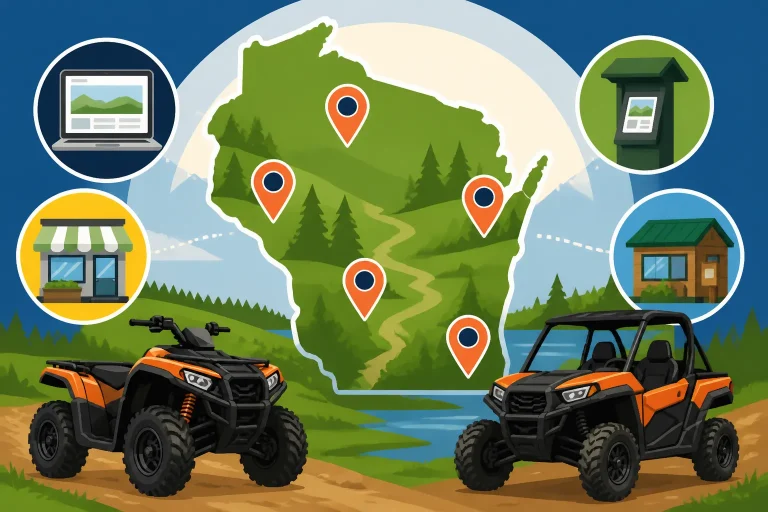
A private lease may let you ride on approved private lanes, but it does not change the rules once you leave the property. If you use a public trail to reach the lease, for example, check whether the machine needs Wisconsin registration or a nonresident trail pass. If you use a road route, check the applicable registration and local route requirements. A trip that includes several kinds of access may involve more than one set of rules.
| Where you plan to ride | What to confirm before the trip |
|---|---|
| Only on the leased parcel | Landowner permission, lease restrictions and whether any registration exemption applies |
| On a public ATV or UTV trail | Registration or trail-pass requirements for the machine, plus trail rules |
| On a town or county road route | Whether the route is open to your machine and the rules set by the local jurisdiction |
| Across another private parcel | Permission from the person or entity controlling that parcel |
| On county, state or other public land | Whether motorized use is allowed there and any site-specific requirements |
For Wisconsin machines, understand the difference between public-use and private-use registration. A registration category that fits private-property use should not be treated as permission to ride public trails. If your machine is registered in another state, check Wisconsin’s rules for visitors rather than assuming the home-state registration covers every Wisconsin riding area. The distinctions are explained in Public Use Versus Private Use in Wisconsin, Wisconsin’s Public Use ATV Registration and Wisconsin’s Non-Resident Trail Pass.
If the machine is registered in Wisconsin, do not assume that its registration resolves every access question. Registration, a trail pass, landowner permission and road-route authorization are separate issues. Likewise, a trail pass does not give you permission to ride across private land or open a road that is not designated for ATV or UTV use.
Before leaving home, write down the full route: trailer parking, the road to the lease, any trail connections and the sections you will ride on the property. Check the current status and requirements for each public segment. For help with out-of-state machines, see Wisconsin Registration for an Out-of-State Machine and Passes for a Machine Registered Out of State.
Check rider, machine and hunting-season requirements
A lease does not create a blanket exception to rules that apply to the rider or machine. Check age, safety-certification and equipment requirements for the type of riding planned, particularly if young riders will be traveling on public trails or road routes. Wisconsin requirements can depend on the rider’s age, birth date, machine type and location. Confirm the current requirements with the appropriate official source before the ride. Wisconsin Age Rules for ATVs and UTVs and Wisconsin ATV Safety Certificate Requirements explain the main questions to check.
For road routes, confirm that the route is officially open and read the local ordinance. Towns may set operating conditions, and requirements can differ from one route to the next. Do not assume that a road is open because other machines use it, because it is near the lease, or because it appears on a map. The rules for road routes are different from permission to use a private logging road or lane. See Riding an ATV on a Wisconsin Road Route and Finding a Wisconsin Town’s ATV Ordinance.
Also inspect the machine before a hunting trip. A machine used for short trips around a lease still needs to be in safe operating condition. Check tires, brakes, lights, steering, belts and any required safety equipment. If hauling equipment or game, stay within the machine’s capacity and secure the load so it cannot shift or block the operator’s view. A passenger should ride only where the machine is designed to carry one.
During hunting season, coordinate machine use with the lease manager and other hunters. Agree on travel routes and times so riders do not surprise people on foot or interfere with hunting activity. Keep speeds low near camps, parking areas, stands and other people. Follow rules for hunting equipment and firearms, and do not handle a firearm in a way that distracts the operator or compromises control of the machine. If you are unsure how a firearm may be carried or transported, check the current hunting rules rather than relying on another rider’s custom.
Weather and ground conditions matter, too. A route that is passable in dry weather can become deeply rutted or damage soil when wet. Use only approved lanes, avoid cutting across fields or wetlands, and stop if the ground is breaking down under the tires. The landowner may close a route even when no public trail closure applies.
Use a pre-ride checklist and keep documents handy
A short check before the trip can catch access problems before they become citations, lease disputes or damage to the property. Keep the answers in writing when possible, and share them with anyone who will ride.
- Confirm the lease allows machine use. Check the written terms and get the manager’s approval for the planned routes, parking and activities.
- Map every part of the trip. Identify the lease boundary, public trails, road routes and any other parcels you may cross.
- Verify each access segment. Confirm the required registration, trail pass or local route authorization for the machine and where it will operate.
- Check rider requirements. Confirm applicable age and safety-certificate rules for each rider and each type of riding.
- Review equipment and local rules. Check the machine’s condition and any route-specific operating requirements.
- Agree on hunting-season practices. Set boundaries, travel times, speed expectations and procedures for sharing lanes with hunters on foot.
- Carry useful records. Keep registration information and proof of permission accessible. A signed lease or manager’s contact details can help explain why you are on the property, but they do not replace any required registration or pass.
Do not rely on a seller, neighboring hunter or online map as the final authority for access. A machine may be legal to own and still be ineligible for a particular route, while a route may be open only under conditions that your trip does not meet. Check with the relevant land manager, local authority or Wisconsin agency for the specific places and machine involved. For related registration questions, see Wisconsin DNR ATV Registration Explained and What a Visiting Hunter Needs to Ride Wisconsin Trails.
The safest assumption is that a hunting lease and a public riding area are different places with different permissions. Get clear approval for the private ground, then verify every public connection separately. That small amount of planning helps protect the lease, avoids surprises at trail or route boundaries and keeps the trip focused on hunting rather than paperwork.
Disclaimer
This article is for general informational purposes only and does not constitute professional advice. Laws, prices and regulations vary by location and change over time. Consult a qualified professional for guidance on your specific situation.