Reporting Trail Damage in Wisconsin
A washed-out culvert, a newly fallen tree, or deep ruts after a wet weekend can turn a familiar Wisconsin ATV trail into a hazard. Reporting the problem to the right land manager helps protect riders, nearby property, and the trail itself. The key is identifying who maintains that stretch, describing what you found clearly, and avoiding the temptation to ride around the damage.
How to report ATV trail damage in Wisconsin
Identify who manages the trail
Wisconsin trails can cross county forest, state forest, town, private, or other public land. The land manager may change along a route, so a problem on one stretch might need to go to a county forestry office while damage farther along belongs to a town or another agency. A trail map, posted signs, or a local trail organization can help you identify the right contact.
Start with the trailhead kiosk or signs near the damaged area. Look for a county forestry department, town contact, park office, or trail-system information. If you are riding in a county forest near Rhinelander, for example, the relevant contact may be different from the one responsible for a town route near Eagle River. Don’t assume that the county where you live or parked is automatically responsible for the section you’re on.
If the manager is not obvious, contact the county or municipality where the damage occurred and ask who handles that trail. Local ATV clubs can sometimes point riders toward the appropriate office, especially on systems they help maintain. Wisconsin ATV Clubs and the Trails They Keep offers more context on the role clubs play, while County Forestry Offices and Trail Maps is a useful place to start when you’re trying to identify a county-managed trail.
Make the report specific and useful
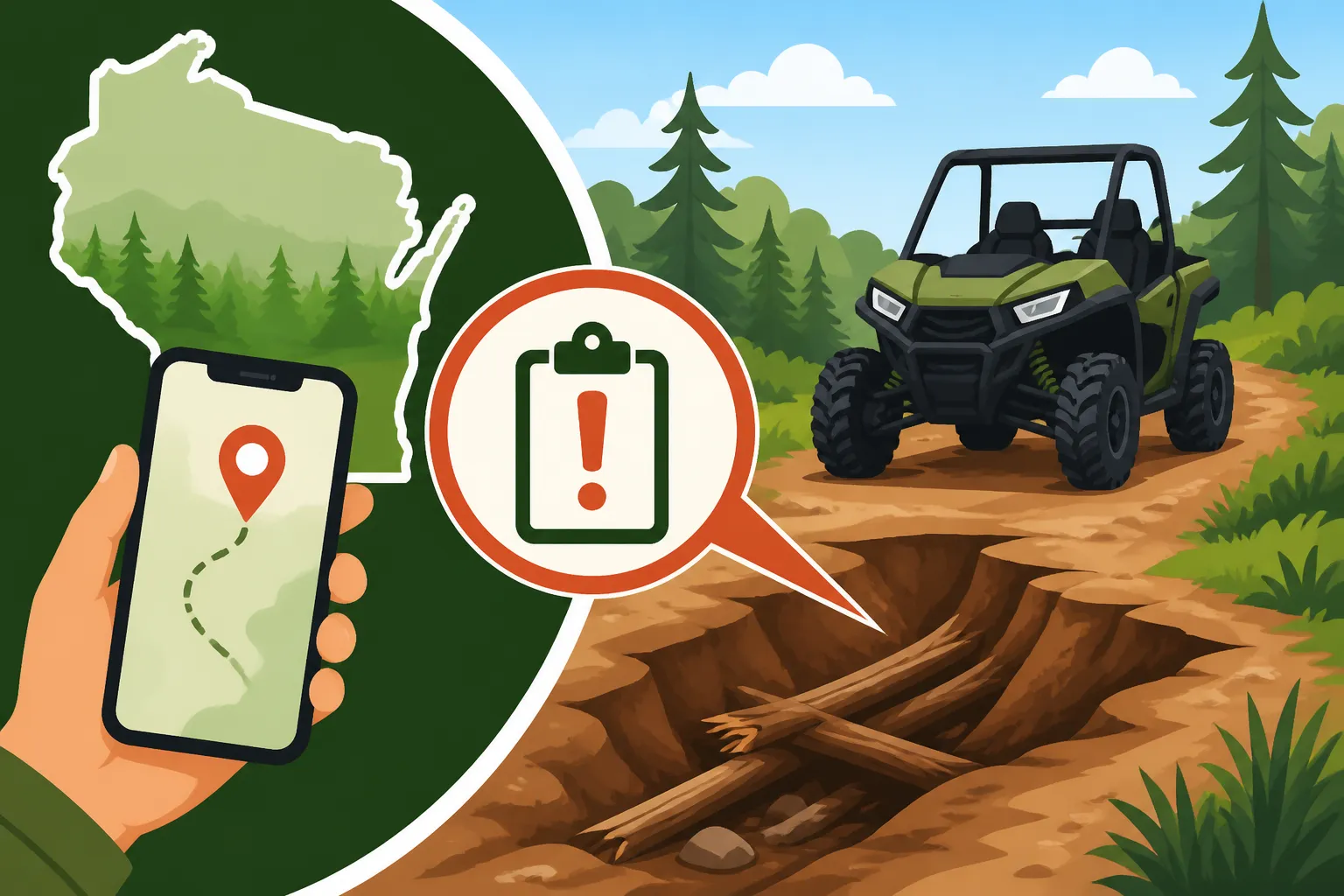
A report such as “the trail is wrecked near the river” is understandable, but it may not give a maintenance crew enough information to find the exact spot. Include the trail system or route name, the nearest trail marker or intersection, and a location pin or GPS coordinates if you can safely obtain them. Mention the direction you were traveling and how far the problem is from a recognizable landmark.
Describe what you saw without guessing at the cause. For example: “A tree is blocking the westbound trail just past the marked junction” is more useful than “the windstorm must have taken out the trail.” For washouts, standing water, damaged signs, exposed culverts, or deep ruts, state whether the issue blocks the route, leaves only a narrow passage, or appears passable with caution.
A concise report can include:
- The trail system, road, or route name.
- The closest marker, intersection, or landmark.
- A map pin or coordinates, if available.
- The type and approximate size of the damage.
- Whether the route is blocked or still passable.
- The date and time you observed it.
- A photo taken from a safe, legal location, if practical.
Mapping tools can help you record where you are, but they do not replace contacting the trail manager. You might use onX Offroad to orient yourself, identify nearby trail intersections, or save a location pin, then include that information in a direct report to the responsible agency or organization. Make sure the pin corresponds to the actual problem rather than a nearby trailhead or parking area.
What to do when you find damage
Put rider safety ahead of the report
Do not ride into a flooded section, cross an unstable bridge, or squeeze past a fallen tree if doing so could put you or another rider at risk. Turn around where it is safe, warn approaching riders if you can do so without blocking the trail, and follow any closure signs or directions from officials. A shortcut around a washout can widen the damaged area and create new ruts, disturb vegetation, or lead riders onto land where motorized travel is not allowed.
Water can hide a washed-out trail edge, loose rocks, a damaged culvert, or a sudden drop. A crossing that looks shallow from the seat may have a soft bottom or a current strong enough to move a machine. If the damage is at a creek or wet crossing, treat it cautiously and report what you can observe from solid ground rather than testing it with your ATV. Water Crossings on a County Trail explains why these locations deserve special care.
If you see an immediate threat to a person, call emergency services. Routine trail maintenance concerns—such as a downed tree, a missing marker, or erosion that does not present an immediate emergency—should generally go to the trail manager or local maintenance contact. Keep emergency lines for emergencies, and use the appropriate non-emergency or agency contact for ordinary trail reports.
Document damage without making it worse
Photos can help a manager understand the problem, but only take them when you can stop in a safe spot and remain on the permitted trail. Frame the image so it shows both the damage and enough surrounding detail to help locate it. A close-up of a broken sign may show the problem clearly but give no clue where the sign is; a wider photo can capture the sign, nearby intersection, or marker.
Do not move heavy debris, attempt to repair a bridge, or dig drainage channels unless the land manager has authorized the work. Even a well-intentioned repair can create a hazard or conflict with maintenance plans. A small tree limb may be harmless, while a larger trunk could be under tension and shift unexpectedly when cut or pulled.
If a section appears freshly damaged after heavy rain, stay off the soft ground. Spinning tires can deepen ruts and push water and soil into nearby ditches or wetlands. Reports are especially helpful after a wet spell, when damage may be developing faster than crews can inspect every stretch. See Riding a Wisconsin Trail After a Wet Week for related riding considerations, and check Wisconsin Trail Closures in April for an example of how seasonal conditions can affect access.
What details to include in common reports
Different damage calls for different observations. Keep your description factual and easy to scan. You do not need to diagnose the engineering problem; the maintenance crew can evaluate what repair is needed.
| Problem you find | Useful details to report | What to avoid |
|---|---|---|
| Fallen tree or branches | Approximate size, whether the trail is fully blocked, nearby marker or junction | Trying to cut or drag a large tree without permission |
| Washout or deep rutting | Length and width if easy to estimate, whether water is moving, whether any safe route remains | Riding through soft ground or creating a bypass |
| Damaged bridge or culvert | What appears broken, loose, or exposed; whether riders can pass safely | Testing the structure with a machine |
| Missing or unreadable sign | Sign type, direction it served, nearest intersection or landmark | Guessing that a route is closed unless a manager confirms it |
| Standing water or flooded trail | Approximate location, extent, and visible conditions from a safe spot | Entering water when the bottom or depth is unknown |
| Debris or erosion near a ditch | Where it is, whether it blocks the trail, and any visible risk to riders | Moving soil or changing drainage on your own |
Use the clearest language you can. “The bridge feels unsafe” is a fair reason to turn back, but a report is stronger if it explains what you observed: “The near-side boards are loose and one edge has dropped.” Avoid stating that a trail is officially closed unless you saw a closure notice or received confirmation from the manager.
For a sign issue, include the sign’s location and what information is missing or unreadable. Trail markers and route signs help riders stay on authorized paths, so a missing marker can lead to wrong turns or accidental travel onto private or restricted land. Wisconsin Trail Signs and Markers can help you understand why reporting damaged or unclear signage matters.
Follow up and help prevent repeat damage
Check for closures before returning
After sending a report, do not assume the trail has been repaired—or that it is closed. The manager may need time to inspect the location, arrange equipment, or post a notice. Before planning another ride, check the trail system’s official updates, posted notices, or local land-manager information. Checking Wisconsin Trail Status Before You Drive is a practical next step, and Finding a Wisconsin County Trail Map can help you confirm the correct system and location.
If you use onX Offroad to save or revisit a pin, treat it as a navigation aid rather than an official status source. Trail access can change, and a map view may not reflect a new closure or a maintenance crew’s latest instructions. Confirm conditions with the organization responsible for that section before setting out, especially after storms, flooding, or seasonal thaw.
Where a trail manager provides a case number or asks for more information, keep your reply focused on the specific location and observations. If you have not received a response, a polite follow-up through the same office or organization is usually more useful than sending multiple reports to unrelated agencies. If you are unsure whether your first message reached the right place, ask who maintains that stretch and where future trail issues should be sent.
Support maintenance without doing unauthorized work
Trail upkeep often involves more than removing a branch. Crews may need to assess drainage, stabilize a slope, replace a bridge component, or close a section until conditions improve. Trail Crews and Bridge Repairs describes the maintenance work that can sit behind a seemingly simple trail problem. A report that clearly identifies the location helps crews plan an inspection and choose the right equipment.
Riders can also help by respecting temporary closures, staying on marked routes, and avoiding travel during conditions that quickly damage trails. Do not create a new line around a puddle or blocked area. If the route is not passable, turn back rather than widening the trail into surrounding vegetation. That choice can prevent a temporary obstacle from becoming a larger maintenance issue.
If you belong to a local ATV club, ask whether it coordinates approved volunteer work with the land manager. Don’t assume that a club membership gives you permission to clear trees, repair structures, or alter drainage. The manager can explain what work is appropriate, where volunteers are needed, and whether special tools or safety procedures are required. For more on how trail-related funding and maintenance connect, read Where Wisconsin Trail Pass Money Goes.
Reporting trail damage is most helpful when it is prompt, accurate, and sent to the right person. A clear location, a brief description, and a safe photo can give a land manager a much better starting point than a vague warning shared only among riders. Until the area has been checked, keep your distance from hazards, obey posted restrictions, and choose another authorized route.
Disclaimer
This article is for general informational purposes only and does not constitute professional advice. Laws, prices and regulations vary by location and change over time. Consult a qualified professional for guidance on your specific situation.