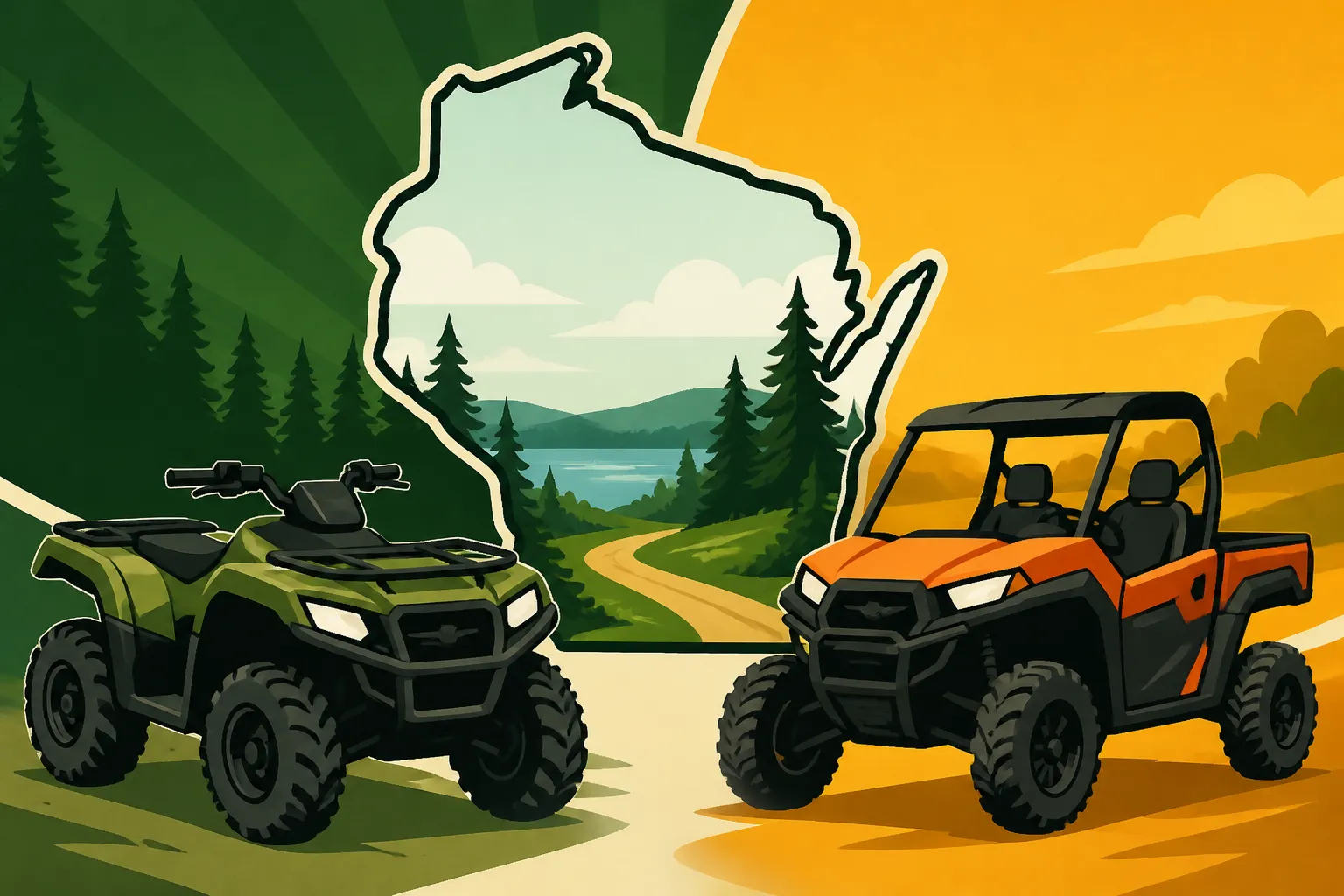
Wisconsin Rules for a Utility Machine
A “utility machine” can mean different things to different owners, but Wisconsin rules depend on how the vehicle is classified and where you plan to ride it. Getting the category wrong can lead to the wrong registration or permit. Here’s how to check whether your machine is a UTV, choose the right registration, and sort out the rules that still apply on trails and roads.
First check whether Wisconsin treats it as a UTV
“Utility machine” is a casual description, not a registration category. Wisconsin distinguishes all-terrain vehicles (ATVs) from utility-terrain vehicles (UTVs), and a machine’s design and specifications matter more than what a seller or owner calls it.
According to the Wisconsin Department of Natural Resources, a UTV is designed for off-highway use, has a weight without fluids of no more than 3,000 pounds, and is no wider than 65 inches. The DNR also describes UTV features such as a steering wheel, lights, restraints for occupants, and a roll bar or similar rollover-protection structure. A four-wheel, seat-straddling machine with handlebars may instead fit the ATV definition, depending on its specifications and design.
For comparison, the Wisconsin Department of Natural Resources defines an ATV as a commercially designed and manufactured motor-driven device with a net weight of 900 pounds or less and a width of 50 inches or less. The definition also covers features such as three or more tires and a seat designed to be straddled by the operator. A homemade machine does not qualify as an ATV under the DNR definition.
The practical point: don’t decide by appearance alone. Check the manufacturer’s specifications and the vehicle’s registration record, especially if the machine is modified, unusually wide, or built from parts. If you’re buying used, have the seller’s paperwork and vehicle identification number ready when you confirm its category. Buying a Used ATV in Wisconsin: The Paperwork and Wisconsin Records and a Machine’s Ownership History cover related checks.
Small or child-sized machines aren’t automatically outside the registration system. According to the Wisconsin Department of Natural Resources, four-wheel child-sized ATVs with an engine certified at no more than 130 cubic centimeters must be registered. The same agency says four-wheel child-sized UTVs with an engine certified at no more than 200 cubic centimeters must be registered.
Choose registration based on how the machine will be used
Once you’ve confirmed the vehicle category, decide whether you need public use or private use registration. The right choice depends on where the machine will operate, not just on whether it is a UTV. If the machine will leave private property for public riding areas, don’t assume a private-land registration will cover that trip.
According to the Wisconsin Department of Natural Resources, public use registration costs $30 for a first registration and $30 for a two-year renewal, plus a $1 renewal issuing fee. Public use registrations are valid for up to two years, beginning April 1 and expiring March 31. A $5 late fee applies when a public use registration is renewed after its decal has expired. See Public Use Versus Private Use in Wisconsin for help comparing the categories.
Private use options are narrower. The Wisconsin Department of Natural Resources lists a $15 fee for private use agricultural registration, which remains valid until ownership is transferred. Private use non-agricultural registration also costs $15, but it is valid exclusively on private land owned by the applicant or an immediate family member, and it ends when ownership is transferred. It is not a general substitute for public use registration. Private Registration That Never Expires explains the limits of the private category.
| Registration situation | What to know |
|---|---|
| Public use | The Wisconsin Department of Natural Resources lists a $30 first registration and a $30 two-year renewal, plus a $1 renewal issuing fee. Public use registration runs from April 1 through March 31, for up to two years. |
| Private use agricultural | The Wisconsin Department of Natural Resources lists a $15 fee; the registration remains valid until ownership transfers. |
| Private use non-agricultural | The Wisconsin Department of Natural Resources lists a $15 fee; use is limited to private land owned by the applicant or an immediate family member, until ownership transfers. |
| Municipal or government use | The Wisconsin Department of Natural Resources lists a $5 first registration and a $5 two-year renewal, plus a $1 renewal issuing fee. |
| Commercial dealer registration | The Wisconsin Department of Natural Resources lists a $90 fee that includes three sets of decals and certificate cards; each additional set costs $30. |
These categories describe registration, not every condition for riding. Public use registration does not by itself mean every trail or road is open to your machine. Check local access rules and route signs before setting out.
All ATVs and UTVs registered for public use must display a rear plate, according to the Wisconsin Department of Natural Resources. The plate must be at least 4 inches high and 7 1/2 inches wide, with black lettering at least 1 1/2 inches high. The DNR specifies a minimum 3/16-inch stroke for the registration number. Keep the plate legible and mounted where it can be seen; don’t rely on the decal alone as proof that the plate requirement is met.
There are limited registration exceptions. According to the Wisconsin Department of Natural Resources, registration is not required when a government agency owns the vehicle and displays its name on the exterior, when the machine displays a registration decal required by a tribe or band, or when it is in Wisconsin for no more than 15 days and used exclusively for manufacturer advertising. Those exceptions are specific; ordinary private ownership or occasional riding does not automatically qualify.
Buying, transferring, or renewing a machine
When ownership changes, the buyer has a deadline to handle the transfer. According to the Wisconsin Department of Natural Resources, the buyer must complete an application for transfer within 10 days after the transfer date. The DNR lists a $5 ownership transfer fee, with registration as an additional cost. A dealer selling an ATV or UTV must submit the registration application to the DNR within five days after the sale.
If the seller has misplaced the registration card, or the names on the paperwork don’t match the situation, sort that out before relying on the machine’s registration history. Transferring a Wisconsin Registration Within Ten Days, Transferring When the Seller Lost the Card, and What a Wisconsin ATV Seller Must Give the Buyer address common sale problems.
For an online renewal, the Wisconsin Department of Natural Resources provides a temporary operating receipt valid for 21 days. A renewal completed through a local sales agent also provides a 21-day receipt, according to the DNR. A license agent can renew for the registered owner but cannot change the ownership names. Mail-in renewal has different practical limits: the DNR requires payment by check or money order, and if the decals have already expired, the owner must wait for the new certificate and decals before operating. Renewing a Wisconsin Registration Online has more on choosing a renewal method.
Nonresident permits are a separate question
A nonresident bringing a UTV to Wisconsin should distinguish vehicle registration from trail access. The pass or receipt described by the Wisconsin Department of Natural Resources is for eligible nonresident trail use; it does not turn private registration into public registration or open every road and trail.
According to the Wisconsin DNR, a nonresident may operate an ATV or UTV on designated corridors and frozen waterways with an annual trail pass or a five-day trail use receipt. The DNR lists the annual pass at $35, expiring March 31, and the five-day receipt at $20 for five consecutive days. The five-day period is consecutive, so plan around the dates you will actually ride. Wisconsin’s Non-Resident Trail Pass and Which Wisconsin Trails Require a Pass can help with trip planning.
When an annual pass is ordered, the Wisconsin DNR issues a temporary operating receipt printed on plain white paper for immediate operation. The physical decal arrives by mail in approximately two weeks, according to the DNR. Keep the receipt available while you wait for the decal, and follow the DNR’s instructions for displaying the pass once it arrives.
There is an important distinction for visitors who leave their machine in Wisconsin. The Wisconsin DNR says nonresidents who keep an ATV or UTV in the state must register the vehicle in Wisconsin. A pass or short-term receipt for a visiting machine is not a way to avoid that requirement. If you’re moving to Wisconsin or storing a machine at a cabin for the season, check the registration rules for your particular circumstances. Wisconsin Registration for an Out-of-State Machine and Seasonal Residents and Wisconsin Registration cover those situations.
Rider requirements and route rules still apply
Registration and a trail pass address different parts of the problem: whether the vehicle is registered and whether a nonresident has the required trail access document. Neither removes rider qualifications, local restrictions, or safe-operation responsibilities.
For safety certification, the Wisconsin Department of Natural Resources says operators born on or after January 1, 1988, who meet the minimum age requirement must complete a safety certification course to operate on public riding areas. The minimum age after completing the course is at least 12 for an ATV and at least 16 for a UTV. The DNR also requires operators to carry their safety certification card and show it to law enforcement when requested. These age and certification rules are not interchangeable: a young ATV rider’s eligibility does not mean that rider can operate a UTV. See Wisconsin ATV Safety Certificate Requirements and Wisconsin Age Rules for ATVs and UTVs.
The Wisconsin Department of Natural Resources says all Wisconsin recreational safety students need a DNR Customer ID Number when registering for a safety education class. If a child under 12 takes an ATV safety class, the certificate does not become valid until the child reaches 12. Check the course details and eligibility before enrolling, especially if the rider will use a different type of machine.
Road access requires a separate check. Wisconsin law allows ATVs and UTVs to operate on state highways only in specific circumstances, according to the Wisconsin Department of Transportation. For ATV routes, WisDOT says a roadway is not a route merely because it connects to a trail: an ordinance must be enacted and the roadway must be signed and posted as required. WisDOT also says ATVs are not allowed on interstate highways. Because route designations and local ordinances determine where highway riding is allowed, confirm the route and signs rather than assuming a nearby road is open.
If you are riding an ATV across a roadway, WisDOT says the operator must stop completely before crossing, yield to pedestrians and vehicles, and cross in the most direct manner possible. Highway-route rules can be technical, and the rules for a specific UTV route may depend on the local authorization. Check the local ordinance and posted signs before taking a utility machine onto a road. What a Wisconsin ATV Route Actually Is and Finding a Wisconsin Town’s ATV Ordinance offer more detail.
Finally, public use registration has a short annual boundary that is easy to overlook: according to the Wisconsin Department of Natural Resources, ATVs and UTVs may operate without registration during the first full weekend in June each year. Treat that as a limited exception, not a replacement for registration throughout the rest of the riding season. Before any trip, verify the machine’s category, registration status, pass needs, rider eligibility, and the rules for the specific trail or road. The DNR advises operators to ride within their means, wear a helmet and seat belt, and ride sober.
Sources
- Wisconsin Department of Natural Resources — All-terrain vehicle (ATV) and utility-terrain vehicle (UTV) registration | | Wisconsin DNR (checked November 3, 2026)
- Wisconsin DNR — Nonresident ATV and UTV Trail Passes | | Wisconsin DNR (checked November 3, 2026)
- Wisconsin Department of Natural Resources — ATV | Wisconsin DNR (checked November 3, 2026)
- Wisconsin DNR — Safety Education | Sign up for a safety education course | Wisconsin DNR (checked November 3, 2026)
- Wisconsin Department of Transportation — Wisconsin Department of Transportation All-Terrain Vehicles and Utility Terrain Vehicles on state highways (checked November 3, 2026)
- Wisconsin Department of Natural Resources — ATV_flier.pdf (checked November 3, 2026)
- Department of Natural Resources — UTV_flier.pdf (checked November 3, 2026)
- Wisconsin Department of Natural Resources — How to renew your ATV or UTV registration | | Wisconsin DNR (checked November 3, 2026)
- Wisconsin Department of Natural Resources — Fatality Summary, Annual Reports and Incident Reporting | ATV riding in Wisconsin | Wisconsin DNR (checked November 3, 2026)
- Wisconsin Department of Natural Resources — All Terrain Vehicle (ATV) Enforcement Patrol Grant | ATV riding in Wisconsin | Wisconsin DNR (checked November 3, 2026)
Disclaimer
This article is for general informational purposes only and does not constitute professional advice. Laws, prices and regulations vary by location and change over time. Consult a qualified professional for guidance on your specific situation.