Wisconsin Registration for a Club-Owned Machine
Picture this: Your Wisconsin ATV or UTV club has finally done it. You’ve pooled your resources, held fundraisers, maybe even landed a generous donation, and now you’re the proud owner of a club machine. This isn’t just any quad or side-by-side; it’s a shared asset, a tool for trail maintenance, or maybe the designated lead machine for group rides. But here's where the rubber meets the trail, and often, the confusion begins: how exactly do you navigate the Wisconsin DNR registration process when the machine isn't owned by a single person, but by an entire club? It's a common question that can leave even the most organized clubs scratching their heads, and this guide is here to untangle the specifics of getting your club-owned machine properly registered in Wisconsin.
Understanding "Ownership" for Club Machines in Wisconsin
When you register an ATV or UTV with the Wisconsin DNR, the concept of "ownership" is pretty central. For an individual, it's straightforward – their name, their machine. But for a club, it gets a bit more nuanced. A club, in itself, isn't always a legal entity that can simply "own" property in the same way an individual can. Understanding how your club is structured legally is the very first step in determining how your machine will be registered.
The Legal Entity of Your Club
Many ATV/UTV clubs in Wisconsin operate with varying degrees of formality. Some are loosely organized groups of friends who ride together, while others are formally incorporated non-profit organizations with official bylaws, a board of directors, and a tax ID number. The way your club is set up dictates whose name, or what entity's name, will appear on the registration paperwork.
If your club is a formally recognized non-profit organization (e.g., a 501(c)(3) or 501(c)(4) entity), then the club itself, as a legal entity, can typically be listed as the owner. This means the name of your organization, as it appears on official documents, is what goes on the registration application. This method provides the clearest line of ownership and responsibility for the machine, attributing it directly to the club's legal identity. It’s important to have documentation like your articles of incorporation and bylaws handy, as these prove the existence and structure of your club.
For less formal clubs, or groups that haven't taken the step to incorporate, the situation is different. Since the "club" isn't a legal person, the registration usually has to be placed in the name of an individual member. This is often a club officer, such as the President, Treasurer, or another designated responsible party. While this person becomes the official registrant in the eyes of the DNR, it's absolutely crucial for the club to have a clear, written internal agreement about the machine's true ownership and usage. This agreement should outline that the machine is club property, even though it's registered in an individual's name. You might find resources like LawDepot helpful for creating formal agreements or bylaws to cover these kinds of arrangements, ensuring everyone is on the same page.
Designated Owner on the Registration
Whether your club is a formal entity or an informal group, there will always be a designated owner or point of contact on the official Wisconsin DNR registration record. For an incorporated club, this means the club's formal name will be listed. For example, "Northwoods Riders ATV Club, Inc." would be the owner. In this scenario, the club's designated representative (e.g., the President or Secretary) would sign the registration application on behalf of the club, often with a title indicating their authority.
For informal groups, where an individual member is listed as the owner, that person's full legal name and address will appear on the registration. This individual is legally responsible for ensuring the machine is properly registered, renewed, and that all rules are followed. It cannot be overstated how important it is for the club to have a rock-solid internal understanding of this arrangement. What happens if that individual leaves the club, moves away, or, in the worst-case scenario, passes away? Without a clear agreement, you could face significant hurdles in transferring or even accessing the machine. Many clubs create a specific line in their bylaws or a separate agreement stating that the individual is holding the registration "in trust" for the benefit of the club.
When considering who should be the designated individual, pick someone with a long-standing commitment to the club and a clear understanding of their responsibilities. Ensure there's a written understanding within the club about the machine's usage, maintenance, and what happens if the designated registrant's circumstances change. This might sound like a lot of paperwork, but it saves immense headaches down the road.
The Wisconsin Registration Process for Club-Owned ATVs/UTVs
Once you've sorted out the "who owns it" question, the actual registration process largely follows the same steps as for an individually owned machine, with a few critical distinctions to keep in mind for clubs. The DNR aims for consistency, but you'll need to pay close attention to how you fill out the forms and what information you provide.
Public Use Versus Private Use Considerations for Clubs
One of the most crucial decisions for any ATV or UTV owner in Wisconsin is whether to register for public use or private use. This distinction becomes even more important for clubs, as their machines often serve multiple purposes.
A public use registration allows your club machine to be ridden on designated public ATV/UTV trails, routes, and areas throughout Wisconsin. This is almost always the choice for clubs that use their machine for organized group rides, participating in community events, or accessing trail systems for maintenance. If your club plans to use the machine on any state, county, or municipal trails, you absolutely need a public use registration. These registrations are identifiable by the distinct color of their decals and typically expire on March 31st each year. Neglecting to renew can lead to [Penalties for an Unregistered ATV in Wisconsin].
A private use registration, on the other hand, is specifically for machines that will only be operated on private land owned by the registrant, or on private property with permission from the landowner. If your club's machine is exclusively used on club-owned land (perhaps a private testing ground or a specific parcel for training) or on land where you have explicit private permission, this option might suffice. These decals are usually a different color and, once purchased, generally do not expire. However, if your club ever decides to take the machine out for a spin on public trails, you would need to upgrade to a public use registration. Given the nature of most ATV/UTV clubs, which thrive on group rides and trail access, [Public Use Versus Private Use in Wisconsin] usually points to a public use registration as the more practical and common choice.
When your club applies, carefully consider the primary intended use. If there’s any chance the machine will touch public trails, err on the side of public use registration. It's much easier to start with public and clarify [What Public Registration Lets You Ride] than to deal with violations for riding a private-use machine on public land.
Required Documentation and Signatures
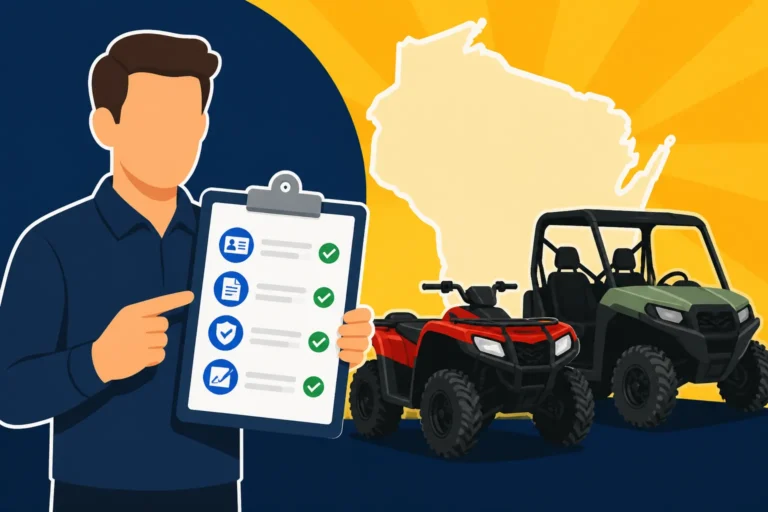
Registering any ATV or UTV in Wisconsin requires specific paperwork, and a club-owned machine is no exception. You'll typically need:
- Application Form: The Wisconsin DNR provides specific forms for ATV/UTV registration. You'll fill this out with the machine's information (VIN, make, model, year) and the owner's information. If your club is incorporated, the "owner" will be the club's legal name and address. If an individual is listed, it will be their name and address. Be precise, as incorrect information, especially the VIN, can cause delays or issues later, making [Correcting a VIN on a Wisconsin Record] necessary.
- Proof of Ownership: This is crucial. For a new machine, you'll have a manufacturer's statement of origin (MSO). For a used machine, you'll need a bill of sale from the previous owner. If the club purchased the machine, the bill of sale should ideally list the club as the purchaser. If an individual club member is registering it, the bill of sale can be in their name, but again, ensure internal documentation clarifies club ownership. Make sure the bill of sale includes key details like the VIN, purchase price, and buyer/seller information – you can find templates for robust bills of sale on platforms like LawDepot to ensure all necessary fields are covered, which helps establish [What a Wisconsin ATV Bill of Sale Should Carry].
- Sales Tax Proof: Wisconsin requires sales tax to be paid on ATV/UTV purchases. If you bought from a dealer, they typically handle this. If it was a private sale, you might need to submit proof of sales tax payment (or pay it at the time of registration).
When it comes to signatures, if the club is the official registrant, an authorized officer (e.g., President, Secretary, Treasurer) will sign on behalf of the club, often adding their title next to their signature. If an individual club member is the registrant, they will sign as the owner. Always double-check that all required fields are filled out completely and accurately to avoid delays. You can submit these documents through a [Wisconsin Registration Agents and Where They Are] or directly to the Wisconsin DNR. [Wisconsin DNR ATV Registration Explained] provides a comprehensive look at the process.
Managing Registration Renewals and Responsibilities
Getting your club machine registered is a great achievement, but it's not a one-and-done deal, especially for public use registrations. Effective club management includes setting up systems to ensure continuous compliance with Wisconsin's registration laws. This involves keeping track of expiration dates, ensuring decals are properly displayed, and having a plan for when club leadership changes.
Ensuring Continuous Registration and Decal Placement
For public use registrations, the clock starts ticking the moment you get those shiny new decals. In Wisconsin, [Wisconsin Public Use Registrations Expire March 31] every single year. This means your club needs a reliable system to remember and process renewals. Many clubs designate a specific officer, like the Treasurer or Secretary, to be responsible for tracking registration dates and initiating the renewal process. It's a good practice to set multiple reminders, perhaps 60 and 30 days before March 31, to avoid any last-minute scramble or, worse, a lapse in registration.
Fortunately, [Renewing a Wisconsin Registration Online] is a straightforward process through the Wisconsin DNR GoWild system. Having a designated club member with access to the account details or having a consistent individual handle the renewals each year can streamline this.
Once renewed, your club will receive new decals. Proper [Sticker Placement on a Wisconsin Machine] is not just a suggestion; it's a requirement. The decals must be visibly affixed to both sides of the machine, typically on the cowl or fender, where they can be easily seen by wardens and other riders. Incorrect placement, or riding with expired decals, can lead to fines. Ensure the decals are applied cleanly to a smooth, dry surface for maximum adhesion, especially important in Wisconsin's varied weather conditions.
Addressing Changes in Club Leadership or Machine Status
Club dynamics can change over time. Leaders rotate out, new members step up, and sometimes, the club might even decide to sell or scrap a machine. It's vital to have a plan for how these changes impact your registration.
If your machine is registered in the name of an individual club member, and that member leaves the club or is no longer able to serve as the designated registrant, you'll need to formally transfer the registration. This usually involves submitting a transfer form to the DNR, often accompanied by a new bill of sale (from the old registrant to the new one, or to the club itself if it incorporates). This can feel a bit cumbersome, but it's essential to maintain accurate records and ensure ongoing legality. This is another area where clear club bylaws or written agreements regarding the machine's ownership and the process for transfer are invaluable.
Should your club decide to sell the machine, the designated registrant (whether the club entity or an individual member) would act as the seller, providing the buyer with the registration card and a bill of sale. Remember, the buyer has a limited window to [Transferring a Wisconsin Registration Within Ten Days] of purchase. If the club machine is ever damaged beyond repair and needs to be scrapped or parted out, it’s a good idea to notify the DNR to remove it from the active registration database. This prevents any future confusion or unwanted renewal notices.
Common Pitfalls and Best Practices for Club Machine Registration
Even with the best intentions, it's easy for clubs to overlook certain details, especially when dealing with a shared asset. Being proactive and establishing clear internal procedures can prevent many common headaches.
Avoiding Lapses and Penalties
One of the most frequent pitfalls for club-owned machines, especially those used publicly, is simply forgetting to renew the registration before the March 31 deadline. A lapse in registration can lead to fines if the machine is caught on public trails with expired decals. Imagine your club organizing a big trail ride or a trail cleanup event, only to have the lead machine pulled over by a warden because the decals are out of date. It's embarrassing and costly.
To avoid this, implement a multi-layered reminder system. Have the club secretary or treasurer put renewal dates on a shared calendar, set up email reminders, and even consider auto-renewal options if available through the DNR system for your specific registration type. Ensure that the contact information on file with the DNR (mailing address and email) is current for the person or entity responsible for renewals, so that official reminders reach the right place.
Another common mistake is misinterpreting the "public versus private use" rules. If your club machine is registered for private use but is ridden, even just once, on a public trail or route, it's considered unregistered for that public use, and the club could face penalties. If there's any ambiguity in how the machine will be used, opt for public use registration. It provides far more flexibility and peace of mind.
Documentation for Shared Use and Liability
For a club-owned machine, liability is a huge concern. While registration itself doesn't directly address liability, robust internal documentation helps manage risk and expectations among members.
Consider creating a formal usage agreement for any member who uses the club machine. This document can outline:
- Who is authorized to operate the machine.
- The conditions under which it can be used (e.g., specific events, trail maintenance only, no personal use).
- Responsibilities for fuel, minor repairs, cleaning, and reporting damage.
- Acknowledgement of safety rules and the requirement for a valid [Wisconsin's ATV Safety Certificate Requirement] if applicable (for riders born on or after January 1, 1988).
- A clear waiver of liability, stating that the member understands the risks of ATV/UTV operation and releases the club from responsibility for accidents or injuries.
Platforms like LawDepot can be invaluable here, offering templates for club bylaws, usage agreements, and liability waivers that can be customized to your club's specific needs. Having these documents formally in place not only protects the club but also sets clear expectations for members, ensuring responsible use of a shared asset. These documents reinforce that even though the machine is registered to an individual or the club, the ultimate responsibility for safe and legal operation falls to the rider.
Additionally, for any club that owns and operates machinery, carrying adequate insurance is a non-negotiable best practice. While Wisconsin state law doesn't universally mandate ATV/UTV insurance for all riding, many municipalities have [Municipal Insurance Requirements in Wisconsin] for riding on their road routes, and any smart club will want to protect its asset and its members from unforeseen circumstances. Talk to an insurance agent specializing in recreational vehicles and non-profit organizations to ensure your club has comprehensive coverage for its machine and its activities.
Disclaimer
This article is for general informational purposes only and does not constitute professional advice. Laws, prices and regulations vary by location and change over time. Consult a qualified professional for guidance on your specific situation.