Speed Limits on a Wisconsin Route
Riding your ATV or UTV on Wisconsin's ever-expanding network of designated road routes is an absolute blast, a fantastic way to link up trails or grab a bite in a charming small town. But here's the kicker: many folks, especially those new to route riding or visiting from out of state, get confused about something crucial – the speed limits. It's not always as straightforward as it seems, and misunderstanding these rules can lead to more than just a ticket; it can put you and others at risk. This guide is here to untangle the complexities of speed limits on Wisconsin's ATV and UTV routes, making sure your ride is both enjoyable and legal.
Understanding the Basics of Wisconsin ATV/UTV Route Speed Limits
When you first pull onto a gravel road or a paved town street designated as an ATV/UTV route, it's natural to wonder, "How fast can I actually go here?" It's not like the open trails where you might have a general understanding of safe speeds. On these routes, you're sharing the road with other traffic, residents, and sometimes even pedestrians. Getting this right is paramount for safety and to avoid an unwelcome interaction with a local law enforcement officer.
Why Speed Limits Matter on Designated Routes
Think about it: these aren't just isolated trails cut through the woods. [Riding an ATV on a Wisconsin Road Route] means you're operating your machine on infrastructure designed for cars, trucks, and sometimes even bicycles. The speed limits aren't arbitrary; they're set with a number of factors in mind, primarily safety. High speeds on a route can kick up excessive dust, reduce your reaction time to unforeseen hazards like a child's stray ball or a deer darting out, and significantly increase the severity of an accident. It also impacts the local community. Imagine living on a quiet town road that suddenly becomes a thoroughfare for off-road machines. Excessive noise and dust from riders going too fast can quickly turn welcoming residents into frustrated ones, potentially leading to routes being closed down. Adhering to the posted limits helps maintain the good standing of ATV and UTV riders within these communities.
Beyond safety, there's the legal aspect. Speed limits are laws, plain and simple. Exceeding them is a violation that can result in fines and points on your driving record, even though you're on an off-road machine. It's about respecting the rules that allow us to have these privileges in the first place. You're representing the entire ATV/UTV riding community every time you roll down a route, so setting a good example with responsible speeds is important for the future of riding opportunities. Many aftermarket accessories, like enhanced lighting from a brand like SuperATV, can improve visibility, but even the best equipment won't save you from the consequences of unsafe speeds.
The General Rule: Default Speed Limits
Wisconsin law has a general default speed limit for ATVs and UTVs operating on designated routes where no other speed is explicitly posted. This is the fallback rule you should always remember. If you're riding down a town road that's been opened as a route and you don't see any speed limit signs specifically for ATVs or UTVs, or any signs for cars, then you should default to 10 miles per hour (mph). Yes, you read that right – 10 mph. This might seem painstakingly slow, especially if you're used to higher speeds on trails, but it's a crucial distinction.
However, it's not always 10 mph. The local municipality (town, village, or city) that designates the route can, and often does, set a higher speed limit. When they do, they are required to post those limits clearly. This is where it gets interesting, because these local ordinances can vary widely. So, while 10 mph is your absolute baseline if no sign is present, always be on the lookout for posted speed limits that could be 25 mph, 35 mph, or even the posted speed limit for cars on that road, provided it's clearly indicated for ATVs and UTVs as well. The key takeaway here is to always be observant and assume the lowest legal speed until you see clear signage indicating otherwise.
Navigating Local Ordinances and Posted Limits
This is where the rubber meets the road, or perhaps more accurately, where your tires meet the various local regulations across Wisconsin. The beauty and challenge of Wisconsin's road route system for ATVs and UTVs lie in its decentralized nature. It's not a uniform state-mandated speed across the board; rather, it's a patchwork of decisions made by hundreds of individual towns, villages, and cities, each with its own unique circumstances and preferences.
How Towns and Counties Set Specific Limits
When a local municipality decides to open a road as an ATV/UTV route, they do so through a local ordinance. This ordinance is essentially a local law that outlines the rules for riding on those specific roads, and speed limits are a major component. [How a Wisconsin Town Votes in a Route] often involves public hearings where residents can voice concerns, and the elected officials then decide on everything from hours of operation to, you guessed it, speed limits. These limits can be influenced by factors like the density of homes along the route, the presence of schools or parks, the type of road surface (paved vs. gravel), and traffic volume.
For instance, a rural town might designate a gravel road that mostly passes by fields with a 35 mph limit, mirroring the car speed limit. But that same town, when opening a route through its residential village center, might impose a much stricter 15 or 20 mph limit to minimize noise and dust for residents. It's a balancing act for local governments, trying to provide recreational access while also preserving the quality of life for their citizens. As riders, our job is to understand and respect these local nuances. Never assume that because one town allows 35 mph, the next town over will have the same rules.
The Importance of Route Signage
Given the variability of local ordinances, signs become your absolute best friend on Wisconsin's ATV/UTV routes. The state law requires municipalities to clearly post the speed limits for ATVs and UTVs on these designated routes. This means you should see signs indicating the specific speed limit that applies to your machine. [Route Signage Standards in Wisconsin] are in place to ensure these signs are uniform and easily understood, helping you know exactly what's expected.
If you come across a route that's posted for 25 mph, that's your limit. If you see a standard vehicle speed limit sign (e.g., 45 mph), but there's no additional sign specifically for ATVs/UTVs, or perhaps a sign that says "ATV/UTV 25 MPH," then the specific ATV/UTV limit takes precedence. If there are no signs at all, neither for vehicles nor specifically for ATVs/UTVs, then you revert to the 10 mph default. This is why vigilance is key. Always scan for signs, particularly when entering or exiting a town or village, or when the road type changes. Sometimes, even accessories that enhance your machine's look, like a new bumper or a light bar from SuperATV, can distract you from important signage if you're not careful. Stay focused on the rules of the road.
| Scenario | Posted Speed Limit | Your ATV/UTV Speed Limit | Notes |
|---|---|---|---|
| No speed signs whatsoever | Not posted | 10 mph | This is the state's default legal limit. Always assume this if no other signage. |
| Standard vehicle speed sign (e.g., 35 mph) | 35 mph | 10 mph | Unless there's a specific ATV/UTV sign. The vehicle speed sign alone does not apply to ATVs/UTVs. |
| Sign specifically for ATV/UTV (e.g., "ATV/UTV 25 MPH") | 25 mph (for ATVs/UTVs) | 25 mph | This sign overrides the default 10 mph. |
| Standard vehicle sign AND ATV/UTV specific sign (e.g., 45 mph for cars, "ATV/UTV 30 MPH") | 45 mph (cars), 30 mph (ATVs/UTVs) | 30 mph | The ATV/UTV specific sign dictates your limit. |
| Entering a residential area on a route | Often lower for all vehicles | Check specific ATV/UTV signage, or default to 10 mph | Local ordinances frequently impose lower speeds in populated areas. |
Special Considerations and Common Misconceptions
Riding on Wisconsin's road routes isn't just about reading signs; it's about understanding the spirit of the rules and being a considerate rider. There are certain situations and common misunderstandings that can trip up even experienced riders. Let's dig into some of those nuances to help ensure you're always riding smart and legally.
Speed Limits in Residential and Congested Areas
This is one of the most critical areas where riders can inadvertently cause issues. Even if a sign says "ATV/UTV 30 MPH," if you're riding through a residential neighborhood, passing driveways, mailboxes, and potentially children playing, that 30 mph might be the legal maximum, but it's not necessarily the safest or most courteous speed. Local ordinances often reflect this, setting lower limits in densely populated areas for good reason. The noise from your exhaust, the dust you kick up, and the sheer presence of an off-road machine can be much more impactful to residents than a passenger car.
Think about it from the perspective of someone living there. They want to maintain the peace and quiet of their home. A sensible rider understands that slowing down to 15-20 mph, even if 30 mph is posted, shows respect for the community. It reduces dust, dampens noise, and gives you more time to react to unexpected situations like a pet running into the road. This courtesy goes a long way in ensuring these routes remain open and welcomed by the communities they pass through. Remember, it's about being a good neighbor on wheels. [Riding Slowly Past a Farmyard on a Route] or through a small town shows the kind of respect that keeps riding opportunities alive.
Distinctions Between ATVs and UTVs on Routes
In Wisconsin, when it comes to speed limits on designated road routes, ATVs (all-terrain vehicles) and UTVs (utility terrain vehicles, often called side-by-sides) are generally treated the same. The speed limits posted for "ATV/UTV" apply equally to both types of machines. You won't typically find separate speed limits for an ATV versus a UTV on the same route section. The rationale is that the concerns—safety, noise, dust, and impact on local residents—are largely consistent regardless of whether it's a quad or a side-by-side.
However, UTVs often have a higher top speed and a more car-like feel, which can sometimes lead riders to push the limits more than they might on an ATV. It's crucial to remember that just because your UTV can go 60 mph doesn't mean you should or can go anywhere near that speed on a designated route. The rules apply to the route, not the machine's capability. So, whether you're on a sporty ATV or a powerful side-by-side, the speed limit signs are your ultimate guide. Even with advanced suspension and comfort features you might add from a company like SuperATV, the legal limits are what dictate your pace on these shared roads.
Encountering Other Vehicles and Pedestrians
Road routes, by their very nature, are shared spaces. This means you will encounter cars, trucks, bicycles, and pedestrians. This is perhaps the most significant difference between riding on a dedicated trail and riding on a road route, and it fundamentally impacts how you should approach speed. On a trail, other users are typically also on off-road machines, and there's a shared understanding of trail etiquette. On a road route, you're sharing with people who may not be accustomed to seeing ATVs or UTVs, or who may not fully understand their capabilities or limitations.
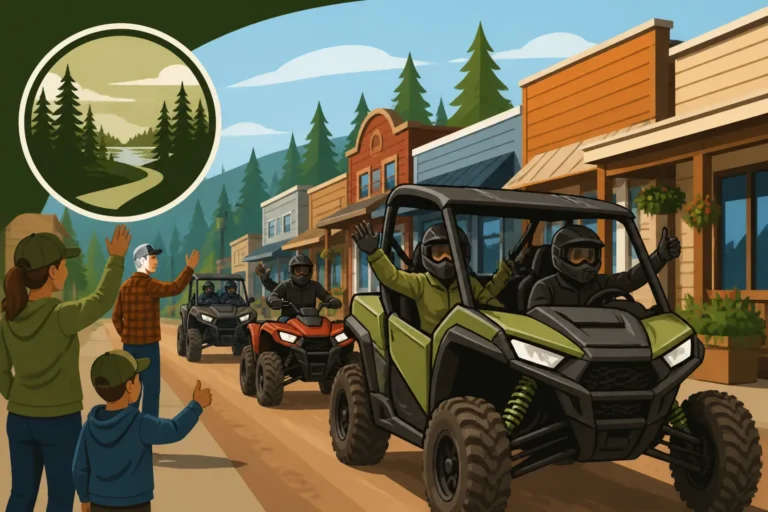
When you approach other vehicles, especially those going slower, or when passing pedestrians or cyclists, always reduce your speed significantly. This isn't just a courtesy; it's a safety imperative. Slowing down minimizes dust for cyclists and pedestrians, reduces the chance of startling them, and gives everyone more time to react. If you're coming around a blind corner or over a hill, assume there's someone on the other side and adjust your speed accordingly. [Group Etiquette Through a Northwoods Town] suggests riding single file and reducing speed to minimize disruption. Being predictable and cautious makes the experience safer and more pleasant for everyone involved.
Consequences of Exceeding Speed Limits
It's easy to think that speeding on an ATV or UTV route might just result in a slap on the wrist, or that you might not even get caught. But the reality is, Wisconsin law enforcement, particularly wardens and local deputies, are actively patrolling these routes. They are well aware of the rules and the impact that irresponsible riding has on local communities. Exceeding speed limits can lead to serious repercussions, both legal and safety-related, that can quickly turn a fun day of riding into a very expensive and regrettable experience.
Penalties and Citations for Speeding
Just like speeding in a car, speeding on an ATV or UTV route can lead to a citation. The penalties can vary depending on how fast you were going over the limit and the specific local ordinance. Generally, you can expect a fine, and in some cases, points could be assessed against your driver's license, even though you were operating an off-road machine. These aren't cheap tickets, and they can quickly add up, especially if you're caught repeatedly. [Wisconsin Fines for Illegal Road Riding] can be substantial, making that extra burst of speed quite costly.
Beyond the immediate financial penalty, there are other potential legal ramifications. Repeated offenses, or particularly egregious speeding, could lead to your riding privileges being suspended or even your machine being impounded. While rare for a first-time minor speeding offense, it's a possibility if behavior doesn't change. Furthermore, if you are involved in an accident while speeding, your insurance company might deny coverage, or your liability could be significantly increased. This makes the stakes much higher than simply paying a small fine. Always remember that [What a Wisconsin Warden Asks a Rider For] includes proof of your adherence to local laws, and a speeding ticket certainly doesn't help your case.
Safety Risks and Accident Prevention
Beyond the legal penalties, the most critical consequence of exceeding speed limits on ATV/UTV routes is the increased risk of accidents and injuries. Speed directly impacts several key factors in an accident:
- Reaction Time: The faster you go, the less time you have to perceive a hazard, process the information, and react appropriately. A sudden turn by a car, a child on a bike, or an animal darting out leaves you with precious few milliseconds to respond.
- Braking Distance: Kinetic energy increases exponentially with speed. This means that doubling your speed doesn't just double your braking distance; it roughly quadruples it. At higher speeds, you need a much longer distance to come to a complete stop, which can be critical on shared roads.
- Severity of Impact: Higher speeds mean more energy in a collision. Even a minor accident at 10 mph can become a serious injury-causing event at 30 mph. This applies whether you're hitting another vehicle, a fixed object, or even just losing control and rolling your machine. Helmets are always recommended, and legally required for riders under 18. [Wisconsin Helmet Rules for Riders Under 18] exist for a reason, as head injuries are a major concern in ATV/UTV accidents.
- Loss of Control: ATVs and UTVs are designed for off-road conditions, but they handle differently on paved or gravel roads compared to how a car would. High speeds on a loose gravel surface or a slippery paved road can easily lead to a loss of control, especially when braking or turning. Even if you've upgraded your machine with high-performance tires or suspension components from SuperATV, physics still applies, and an unexpected patch of sand or loose rock can send you sliding.
Preventing accidents really comes down to a few core principles: always obey the posted speed limits (and consider going slower in congested areas), ride defensively, maintain a safe following distance from other vehicles, and be acutely aware of your surroundings. Anticipate potential hazards, especially around blind curves, driveways, and any area where pedestrians or other vehicles might be present. Your safety, and the safety of everyone else on the route, depends on your responsible choices. Remember, the goal is to enjoy the ride and get home safely, not to set any land speed records on a town road.
Disclaimer
This article is for general informational purposes only and does not constitute professional advice. Laws, prices and regulations vary by location and change over time. Consult a qualified professional for guidance on your specific situation.