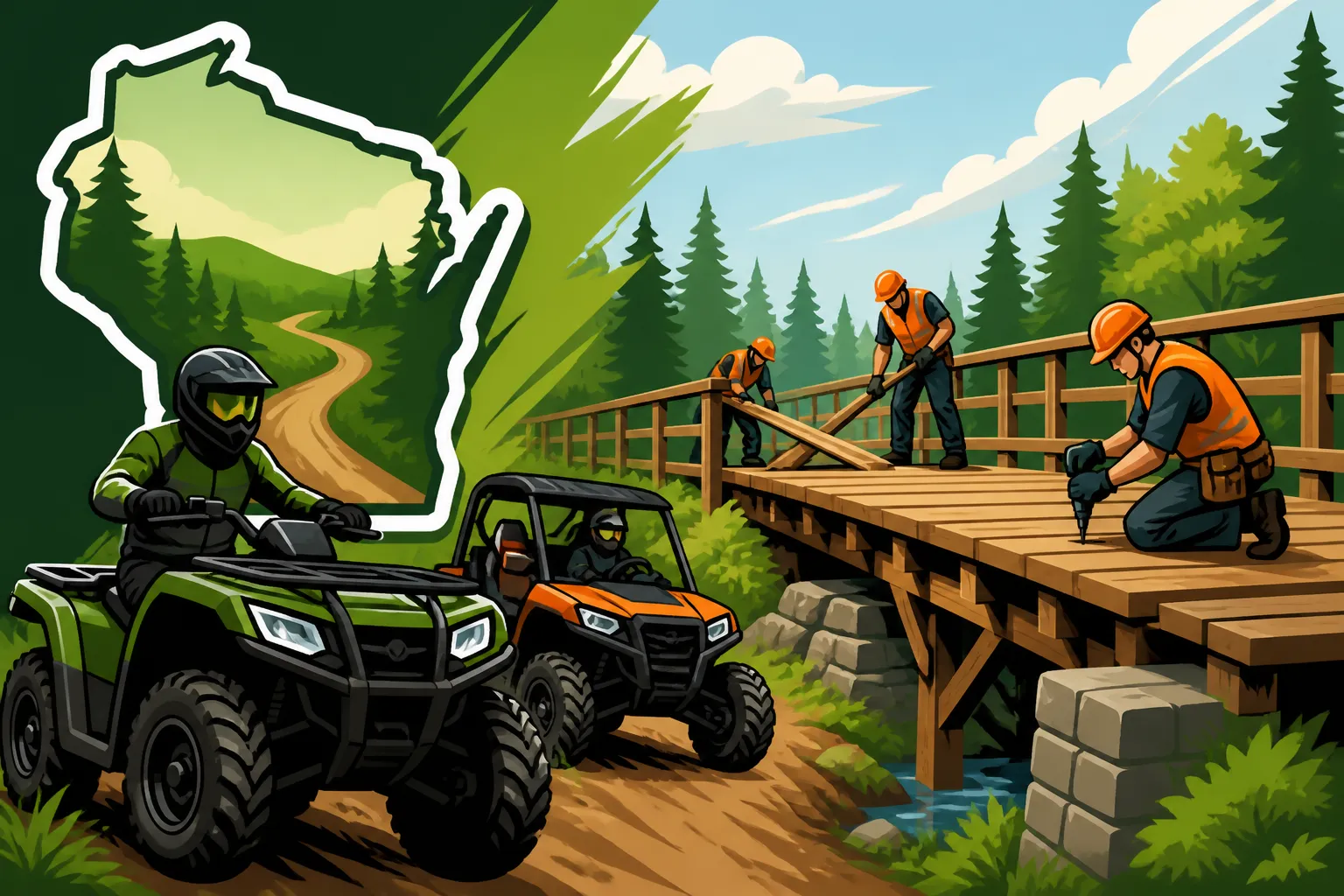
Trail Crews and Bridge Repairs
A washed-out bridge or freshly closed trail can derail a Wisconsin riding weekend, especially when the route is far from town and cell service is spotty. Understanding who maintains trails, how bridge repairs happen, and where to check for closures helps you plan around the work, protect the trail, and avoid putting yourself or a crew in a dangerous spot.
Who maintains Wisconsin ATV trails
The work is shared across local partners
Trail maintenance in Wisconsin can involve county forestry departments, towns, land managers, ATV clubs, and volunteers. Who is responsible depends on the trail and the land it crosses. A county forest route may be managed differently from a trail on other public or private land, so there is no single crew or contact for every route.
The work is broader than clearing a fallen branch. Crews may maintain signs, repair erosion, remove debris, improve drainage, and inspect bridges and culverts. They may also need to coordinate access, equipment, materials, and permission to work on the land. That coordination can make a repair take longer than a rider expects, even when the damaged section looks small.
ATV clubs are often important partners. Members may help with trail checks, brush clearing, sign upkeep, and organized work days, while land managers or local authorities oversee access and determine what repairs are appropriate. If you are interested in helping, start by finding a local club or contacting the land manager rather than doing work on your own. Joining a Wisconsin ATV Club offers a useful starting point for learning how clubs support riding areas.
Why a repair may take longer than it looks
A bridge problem is not always just a loose board. A crew may need to assess the bridge structure, the condition of its supports, the stream or drainage beneath it, and whether heavy equipment can reach the site without damaging the trail. Even a small crossing may need materials transported in from a staging area, which can be difficult on a narrow or wet route.
Weather and seasonal conditions matter, too. Heavy rain can change water levels and wash out approaches. Spring thaw can leave trails too soft for vehicles or repair equipment. In some places, crews may need to wait for safer or drier conditions before moving materials. A temporary closure can be frustrating, but riding around a repair site can widen the trail, damage fragile ground, or put riders close to machinery and workers.
Trail systems differ in their maintenance schedules and closure decisions. Before heading out, check the managing county or land agency’s information for the particular route you plan to ride. Wisconsin County Forest Trail Systems explains why it is worth identifying the system and land manager rather than assuming nearby routes share the same rules.
How bridge repairs affect a ride
What crews may need to repair
A trail bridge can have several parts that require attention: the deck riders travel over, the supports beneath it, the approaches on either side, and drainage around the crossing. Water, freeze-thaw cycles, fallen trees, and repeated use can all contribute to wear. Sometimes the bridge itself remains sound, but the trail leading to it has become muddy or unstable enough to need work.
The repair can involve more than replacing boards. A crew may need to stabilize an approach, improve drainage, clear debris, or restrict access while materials are moved. If the crossing is over a creek or wet area, the surrounding ground can be especially sensitive. Riding around the bridge or through a bypass that has not been designated can cause erosion and create a second repair problem.
Water crossings deserve particular care. Do not assume that a shallow-looking area is an authorized alternative to a bridge, and never ride through a closed work zone. Follow posted directions and use the route shown by the land manager. For a broader look at the challenges these crossings present, see Water Crossings on a County Trail.
Closures are part of keeping trails usable
A closure may be temporary while crews inspect damage, complete repairs, or let a wet area recover. It can also apply only to one segment rather than an entire trail system. Read the closure notice closely: the location, dates, allowed access, and any detour instructions may be specific to that section.
A practical pre-ride check is to confirm both the overall trail status and any local notices. A trail map can show the route, but a map alone may not show a newly posted closure or a temporary work area. Check the managing authority’s updates before leaving, especially after heavy rain, during spring thaw, or when a bridge or culvert has recently been reported damaged. Checking Wisconsin Trail Status Before You Drive and Where Wisconsin Closure Notices Are Posted can help you build that check into your planning.
| What you encounter | What to do | Why it matters |
|---|---|---|
| A posted closure or barrier | Turn around and follow the official detour, if one is posted | The closed area may be unsafe or vulnerable to damage |
| A crew working near the trail | Slow down, follow directions, and give workers and equipment room | Crews may be handling tools or moving materials |
| A damaged bridge or crossing | Do not test it or create a bypass; report the location | A crossing can look passable while its supports or approaches are compromised |
| A blocked trail with no clear notice | Stop before the obstruction and check for safe, lawful options | Going around can damage vegetation or lead onto private land |
| A newly repaired section | Ride gently and stay on the marked route | Fresh repairs may need time to settle or recover |
How riders can help without creating more damage
Report a problem with useful details
A clear report helps the responsible land manager decide what needs attention and where to send a crew. Include the trail system, the nearest sign or intersection, the direction you were traveling, and a description of the issue. If you can safely record a location or GPS pin, that can be more useful than a vague description such as “the bridge up north.”
Photos can help explain whether the issue is a downed tree, a damaged deck, standing water, or an eroded approach. Take them from a safe place, without entering a closed area or standing near unstable structures. Do not move barriers, remove signs, or attempt a repair unless you are authorized and properly equipped.
Use the land manager’s preferred reporting channel where possible. A club may also be able to direct a report to the right person, but it should not be treated as a substitute for notifying the organization responsible for that trail. Reporting Trail Damage in Wisconsin covers the kind of information that can make a report easier to act on.
If you use a mapping app such as onX Offroad, a saved route or location pin may help you describe where you found a problem. It is still important to verify closures and access rules with the trail’s managing authority; a mapped line does not necessarily confirm that a route is open today. Keeping an offline map available can also be useful when cell service drops, but it should support, not replace, current local notices.
Respect signs, barriers, and work zones
A barrier is not an invitation to squeeze past. Crews may have exposed tools, unstable ground, equipment in motion, or materials placed where a rider cannot see them from the approach. Follow instructions from workers and posted signs, and give crews enough room to work without pressure from passing traffic.
Do not create a side path around a muddy spot, a downed tree, or a closed bridge. Repeated detours can widen into ruts, damage vegetation, and cause erosion that eventually requires more work. When no official detour is provided, turn back and choose another open route rather than improvising one.
Keep your machine on the marked trail, including when you stop to check a map or take a photo. Park in a safe, permitted location and avoid blocking access for work vehicles or other riders. Trailhead and staging information can help you plan where to stop before the ride begins; see Wisconsin Trailhead Parking and Staging.
Planning around maintenance and repair work
Check conditions before leaving home
Build trail status into the same routine as checking fuel, weather, and your machine. Look for notices from the county, town, land manager, or trail organization responsible for the specific route. A closure in one area does not always mean an entire county system is closed, and a nearby trail may be managed by a different authority.
Seasonal timing deserves particular attention. During thaw periods, soft trails can be damaged by even a small number of vehicles. Some systems may close sections while conditions recover or repairs take place. Do not rely on what was open last weekend; check again before you travel. Wisconsin Trail Closures in April explains why spring closures are a recurring part of trail planning, while Wisconsin Trails Open in May is a helpful related topic when you are looking ahead to early-season rides.
Use more than one source when the ride depends on a particular bridge or connector. A county map can help you understand the route, a local notice can clarify a closure, and a club or land manager may have additional context. onX Offroad can help riders organize routes and identify locations, but local authorities’ notices should determine whether a section is open and available for riding.
Have a flexible route plan
A good ride plan includes an alternative in case a bridge repair or closure changes your route. Choose a nearby open trail system or a shorter loop that does not depend on the affected crossing. Let someone know where you intend to ride, especially if you will be traveling in a remote area where cell reception may be unreliable.
Before heading north toward places such as Eagle River, the Chequamegon-Nicolet National Forest, or the Black River State Forest, confirm the status of the exact trail network you plan to use. A closure on one connector can change the distance, fuel needs, or time required for a loop. Carry enough supplies to handle a longer return, and avoid planning a route that depends on crossing a bridge whose condition or access status is uncertain.
If a crew is working when you arrive, treat the day’s plan as flexible. Turn around, follow an official detour, or switch to a different open route. It may feel like a wasted trip after hauling your machine and trailer, but respecting the closure protects both the repair work and the next rider’s chance to use that trail safely.
Trail maintenance is easy to notice only when something goes wrong: a blocked route, a washed-out approach, or a bridge that is no longer safe to cross. Checking local updates, reporting problems clearly, and staying out of closed work areas all help keep Wisconsin trails in better shape. A little flexibility before and during a ride can save time, prevent damage, and make the work of local crews and volunteers more effective.
Disclaimer
This article is for general informational purposes only and does not constitute professional advice. Laws, prices and regulations vary by location and change over time. Consult a qualified professional for guidance on your specific situation.