Wisconsin Single Track for Dirt Bikes
Finding Wisconsin single track can take more digging than finding an ATV route: a trail marked for off-highway motorcycles is not automatically open to every dirt bike, and many popular routes are built for wider machines. This guide explains how to identify legitimate single-track riding, check access and conditions, and plan a ride without arriving at a closed gate or the wrong kind of trail.
What Wisconsin Single Track Means for Dirt Bike Riders
Single track is not the same as an ATV trail
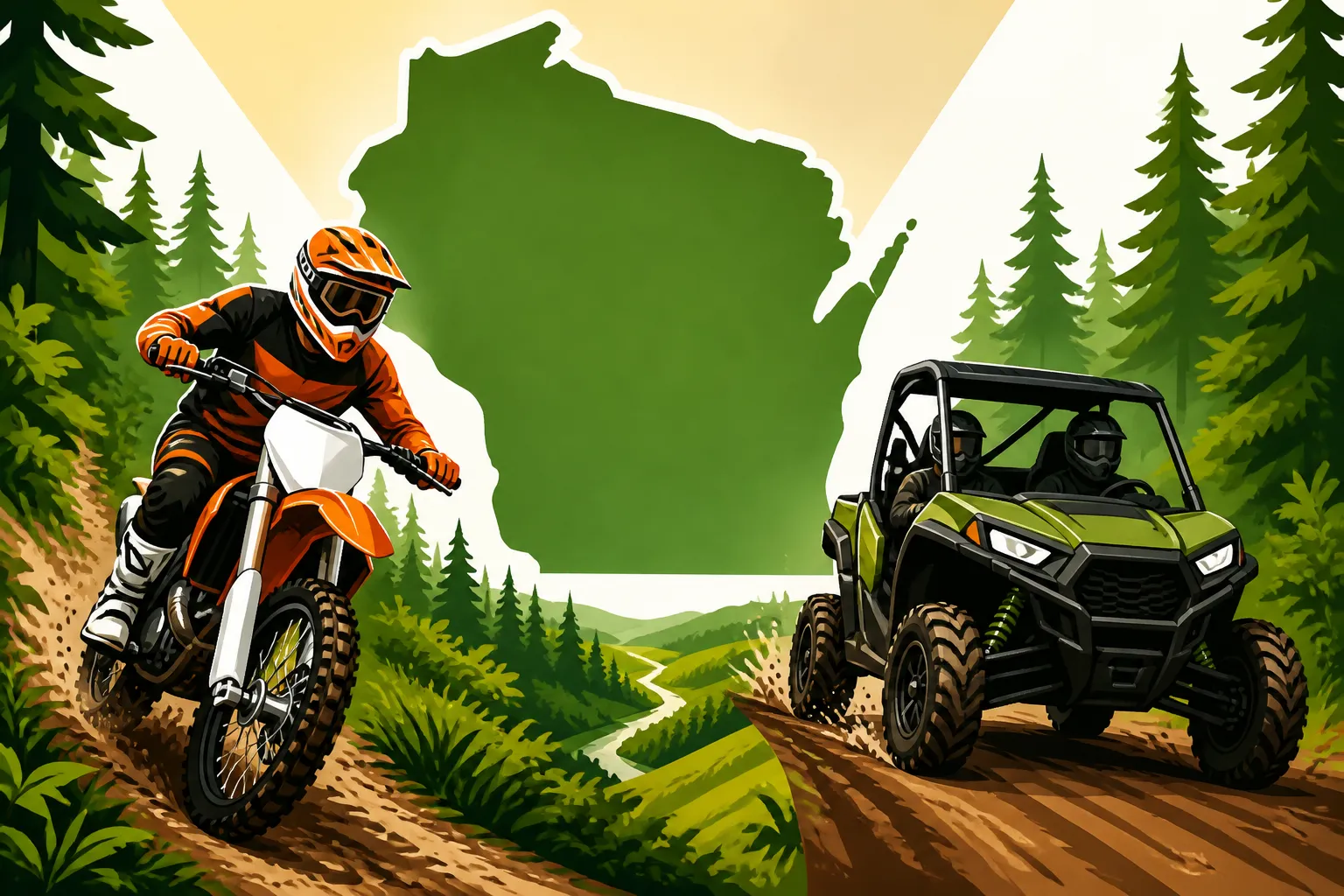
Single track is a narrow trail, usually wide enough for one motorcycle. It may wind through woods, climb over roots and rocks, or include tight turns that are awkward or impossible for a wider ATV or side-by-side. That narrowness is part of the fun for dirt bike riders, but it also makes the trail’s vehicle designation important.
An ATV trail, UTV route, road route, and off-highway motorcycle trail are not interchangeable labels. A map line may look rideable, but the legal access rules can depend on the trail system, land manager, and vehicle type. Before you unload, confirm that the specific trail is open to off-highway motorcycles—not merely that it is open to motorized recreation.
This distinction matters especially in Wisconsin’s Northwoods, where a weekend plan might combine county forest roads, marked ATV trails, and a dedicated motorcycle loop. A route that works for the wider machines in your group may not be suitable or authorized for dirt bikes, and the reverse can be true for a narrow single-track trail.
Wisconsin opportunities can be scattered
Wisconsin has a large network of ATV routes and trails, but that does not mean every riding area contains dedicated single track. Motorcycle-specific trails may be limited, located in separate areas, or managed under rules that differ from those applying to nearby ATV trails. Riders should treat a destination name as a starting point for research rather than proof that a particular trail is open.
Two places riders may come across while researching off-highway motorcycle riding are the Tigerton area and Knobby Ridge. Check with the relevant land manager before making either one your destination: confirm the current trail designation, permitted vehicle types, open dates, access conditions, and any registration or pass requirements. Trail names and online map symbols can be easy to misread, especially when multiple trail types share a broader recreation area.
If you are comparing destinations, start with [Wisconsin Single Track for Dirt Bikes] as a topic to explore alongside official trail information, then verify details directly with the agency or property manager responsible for the land. For a broader look at the difference between kinds of riding terrain, [Wisconsin Trail Difficulty Ratings] can help you think beyond distance alone.
Match the machine and rider to the trail
A narrow, rocky single track may suit an experienced rider on a dirt bike but be a poor choice for a beginner who is still learning clutch control, braking, or how to handle a steep downhill. Even a relatively short loop can feel demanding if it has tight corners, deep ruts, roots, loose gravel, or repeated elevation changes.
Before committing to a route, consider the motorcycle’s size and condition, the rider’s experience, and whether the group can comfortably manage the most difficult section. A newer rider might prefer a shorter, less technical outing with an easy place to stop and regroup. A rider who is comfortable on narrow terrain may still want to avoid a trail that is wet, freshly rutted, or beyond the motorcycle’s capabilities.
Do not assume that a trail described as “easy” will feel easy to everyone. Surface conditions, recent rain, visibility, fatigue, and traffic can change the experience. If the ride includes mixed experience levels, choose the route for the least experienced rider rather than setting a pace around the most confident person in the group.
How to Confirm a Trail Is Open to Dirt Bikes
Check the land manager’s current information
Begin with the agency or organization responsible for the land. Depending on the destination, that may be a state agency, county forestry office, municipal authority, private recreation property, or trail operator. Look for information that specifically identifies off-highway motorcycles or motorcycle trails. A general statement that an area is open to motorized use may not answer whether dirt bikes can use a particular path.
Confirm more than the overall area name. Ask whether the exact segment you plan to ride is designated for motorcycles, whether there are seasonal closures, and whether access is limited to certain days or conditions. Some networks include different trail types close together, so a parking area serving several routes does not mean every route has the same rules.
It can also help to call the land manager when online information is vague. Ask a direct question such as, “Is this marked trail open to off-highway motorcycles today, and are there any restrictions on the loop from this trailhead?” That is more useful than relying on a broad map label or a post from someone who rode there under different conditions.
Read the map carefully, then verify it
Online maps and navigation apps can make planning easier, but they are not a substitute for current local rules. onX Offroad can help you review a route, locate trailheads, and keep track of your position, but use it alongside the trail manager’s information. A line shown on a map may be a road, an ATV trail, a snowmobile route, or a path with access restrictions that are not obvious from the screen.
Before leaving home, check the map’s legend and look for the specific designation of each segment. If a proposed ride connects a motorcycle trail to a road or another trail system, confirm that dirt bikes are allowed on every part of the connection. Do not assume a short connecting road is legal just because it appears to offer the most convenient way back to the truck.
For a practical planning routine, check [Checking Wisconsin Trail Status Before You Drive] before the trip and review [Wisconsin Trail Signs and Markers] so you know what to look for once you arrive. Save or download the information you need before entering an area with weak mobile reception. A map app can be a useful backup, but it should not be your only source of guidance.
| Planning question | What to confirm | Why it matters |
|---|---|---|
| Is the trail open to dirt bikes? | The exact vehicle designation for the trail segment | Nearby ATV or UTV access does not automatically establish motorcycle access |
| Is the area open today? | Seasonal closures, temporary closures, and operating conditions | A trail can be closed even when a map still shows it |
| Are permits or registration required? | Requirements for your machine and residency status | Rules may differ for motorcycles and ATVs |
| Can your group use the whole route? | Access on connectors, roads, and adjacent trails | A legal trail can lead to an unauthorized connection |
| Is the trail suitable for the group? | Difficulty, surface, distance, and rider experience | A short route can still be physically or technically demanding |
| Can you reach the trailhead? | Parking, access-road conditions, and staging rules | A suitable trail is not useful if your truck and trailer cannot stage there |
Understand registration and pass rules
Motorcycle-specific access rules may differ from the requirements for an ATV or UTV. Before riding, check the Wisconsin requirements that apply to your off-highway motorcycle, including any registration, trail pass, safety, equipment, or age-related rules. Do not assume that an ATV sticker, an out-of-state plate, or a permit for a different vehicle type covers your dirt bike.
The relevant rules can depend on the machine, where it is registered, where you plan to ride, and whether the land is public or private. The Wisconsin DNR’s information and the land manager’s rules are the best places to confirm what you need for the specific ride. If your plans involve more than one property, check each property separately.
The reference topic [Wisconsin Passes for an Off-Highway Motorcycle] is a useful starting point for understanding that motorcycle requirements are distinct from other machine categories. If you are riding in a group, check every motorcycle individually rather than assuming one rider’s paperwork or pass covers the rest.
Planning a Single-Track Ride in Wisconsin
Choose a route around the group, not just the mileage
A route’s total distance tells you only part of the story. A short loop with frequent roots, rocks, tight switchbacks, or steep sections can take longer and demand more concentration than a longer, smoother route. When you are new to an area, plan conservatively and leave time for breaks, navigation checks, and changes in trail conditions.
For example, imagine a group with one experienced rider and two people who have recently started riding. The experienced rider may be eager to cover more ground, but the new riders could be working hard just to stay relaxed on narrow turns. A shorter loop with an easy exit or a nearby staging point gives everyone room to learn without feeling pressured to keep up.
Pay attention to trail width, surface, and machine restrictions as well as difficulty labels. Advice for a wide ATV route may not tell you much about a tight dirt-bike trail. [Wisconsin Trails Suited to Beginners] can help you think through beginner-friendly options, but confirm that any trail you choose is actually open to motorcycles.
Build a realistic day plan
Before setting out, note the trailhead, parking arrangement, intended route, expected return point, and a backup option. Tell someone who is not riding where you are going and when you expect to be back. This is especially sensible in wooded areas where phone service can be unreliable and a small mechanical problem can turn into a long delay.
Carry the basic items that match your route and motorcycle: water, food, a charged phone, navigation, first-aid supplies, and tools or repair items appropriate for common problems on your machine. For remote riding, consider how your group will communicate if riders become separated or one motorcycle has to stop. Agree in advance on where to wait and what to do if someone leaves the trail.
Plan fuel and daylight around the slowest likely pace, not the most optimistic one. A rider who is learning may need frequent breaks, and muddy or damaged sections can slow everyone down. For additional staging advice, see [Wisconsin Trailhead Parking and Staging]. If you expect limited reception, [Cell Dead Zones in Northern Wisconsin] is another useful planning topic.
Account for weather and seasonal closures
Wisconsin trail conditions can change quickly. Rain can leave roots slick, soften soil, and create ruts; dry stretches may bring dust and reduce visibility. Spring thaw is a particularly important time to check for closures because riding on saturated trails can damage the surface and lead to longer-term restrictions.
Do not treat a trail as open simply because it was rideable on your last visit. Check the latest notice before driving, then pay attention to signs at the entrance and along the route. If a closure is posted, respect it even when the trail appears firm or other riders are entering. Local conditions can differ from one part of a county or forest to another.
Seasonal planning is also useful for avoiding wasted travel. [Wisconsin Trail Closures in April] explains why spring restrictions matter, while [When Wisconsin Trails Open After Thaw] offers a related topic to check when planning an early-season trip. When conditions are uncertain, call the land manager rather than guessing from a weather forecast or a distant camera view.
Riding Single Track Responsibly and Safely
Ride at a pace that preserves control
On narrow trails, speed can build quickly between turns, and the next obstacle may be hidden by brush or a change in elevation. Keep enough space to react to another rider, a downed branch, an animal, or a sudden rut. The goal is to arrive at each corner with enough control to choose a safe line—not to brake at the last moment.
Leave room between motorcycles, especially where dust, foliage, or uneven terrain limits visibility. If the rider ahead stops unexpectedly, close spacing can turn a minor pause into a collision. Agree on a manageable pace before the ride, and let the group know that it is fine to slow down or stop when a section feels uncomfortable.
When passing is difficult, use a safe, visible place and communicate clearly. Do not pressure a slower rider to move onto a soft shoulder or unstable slope. On a narrow trail, waiting a moment for a suitable passing point is usually safer than trying to squeeze by where the ground is loose or the sightline is poor.
Protect the trail and surrounding land
Stay on the designated route. Cutting corners, riding around a wet section, or creating a new line through vegetation can widen a trail and damage soil. If a section appears muddy or blocked, do not assume that going around it is acceptable. Check posted instructions, turn back if needed, and report damage or a hazard to the land manager.
Be considerate of other trail users and nearby residents. Reduce speed near trailheads, crossings, and places where people may be walking or working. Keep noise in mind, particularly near homes, campgrounds, and quiet recreation areas. Good trail behavior helps preserve access and makes it easier for land managers to support continued riding.
Respecting boundaries matters even when a neighboring path looks like a natural continuation. A trail may cross private land or connect to a route that has different restrictions. Read signs at intersections, stop when you are unsure, and do not follow tracks off the designated trail simply because they look well used.
Prepare for a problem far from the trailhead
A flat tire, stalled motorcycle, or minor injury can become stressful when the group is several miles into a wooded trail system. Before riding, make sure at least one person knows the route and can use the map. Carry supplies suited to the motorcycle and terrain, and avoid assuming that another rider will have the exact tool or part you need.
Set a regrouping plan. For instance, agree that riders will stop at signed intersections and wait if the group becomes separated, rather than continuing to the next junction independently. If someone has to leave the trail, make sure the rest of the group understands where they are going and how they will reconnect.
For a remote outing, think through what happens if the motorcycle cannot be ridden back to the trailhead. Know whether the land manager allows recovery vehicles, where a truck can legally access the area, and how to contact help if phone service fails. A little planning before the ride is far easier than trying to solve those questions after dark.
Making the Most of Wisconsin Dirt-Bike Trails
Use local knowledge without treating it as official permission
Local riders, clubs, shops, and community groups can offer practical details that are hard to see on a map: where riders usually stage, which stretches are rocky, or whether a trail has been rough after recent rain. Those tips are valuable, especially when you are visiting an unfamiliar area, but they do not replace confirmation from the land manager.
A social-media post may describe a ride from a previous season or refer to a trail that is now closed, rerouted, or limited to a different vehicle type. Ask when the person rode and which exact trail they mean. Then compare that information with current official notices and signs at the site.
onX Offroad can be helpful for reviewing a planned route and keeping your location visible while riding, especially when cell service is poor. Still, use it as a navigation aid rather than a legal ruling. Check the map against official information before the trip, and stop to reassess if the trail markings on the ground do not match what you expected.
Make a backup plan for a closed or unsuitable trail
A backup plan keeps a disappointing discovery from turning into a rushed decision. Identify another legal riding area or an alternative activity before leaving home. If the intended trail is closed, too difficult for the group, or not open to motorcycles, do not improvise by entering a nearby ATV route or unmarked path.
If the area has several designated systems, ask whether any of them permit dirt bikes and whether the group’s motorcycles meet the requirements. If there is no suitable alternative, consider changing the day’s plan rather than risking a citation, damaging the trail, or putting a less experienced rider into terrain they are not ready to handle.
This is also where a saved map and a printed or offline copy of key information can help. onX Offroad may make it easier to compare your planned route with nearby options, but confirm each option with the authority responsible for it. Reliable backup planning means knowing not only where else you could ride, but whether that ride is actually allowed.
Keep the experience sustainable for the next visit
Single track is a small-footprint way to enjoy wooded riding, but narrow trails are especially vulnerable to damage when riders leave the established line. Staying on route, following closures, and slowing down around others all help protect the riding opportunity. A responsible day also means being willing to turn around when conditions are unsafe or access is unclear.
After the ride, note what worked: the trailhead, parking setup, fuel plan, trail difficulty, and any confusing junctions. If you found a hazard or a damaged section, report it through the appropriate land manager or trail organization. Clear, useful information can help the next rider plan well and can help maintainers address problems before they worsen.
Wisconsin offers varied motorized recreation, but a good dirt-bike trip starts by identifying a trail that is specifically suitable and authorized for the machine. Confirm the designation, rules, conditions, and route before unloading. That simple habit can save a long drive, prevent an unpleasant surprise, and leave you more time to enjoy the ride.
Disclaimer
This article is for general informational purposes only and does not constitute professional advice. Laws, prices and regulations vary by location and change over time. Consult a qualified professional for guidance on your specific situation.