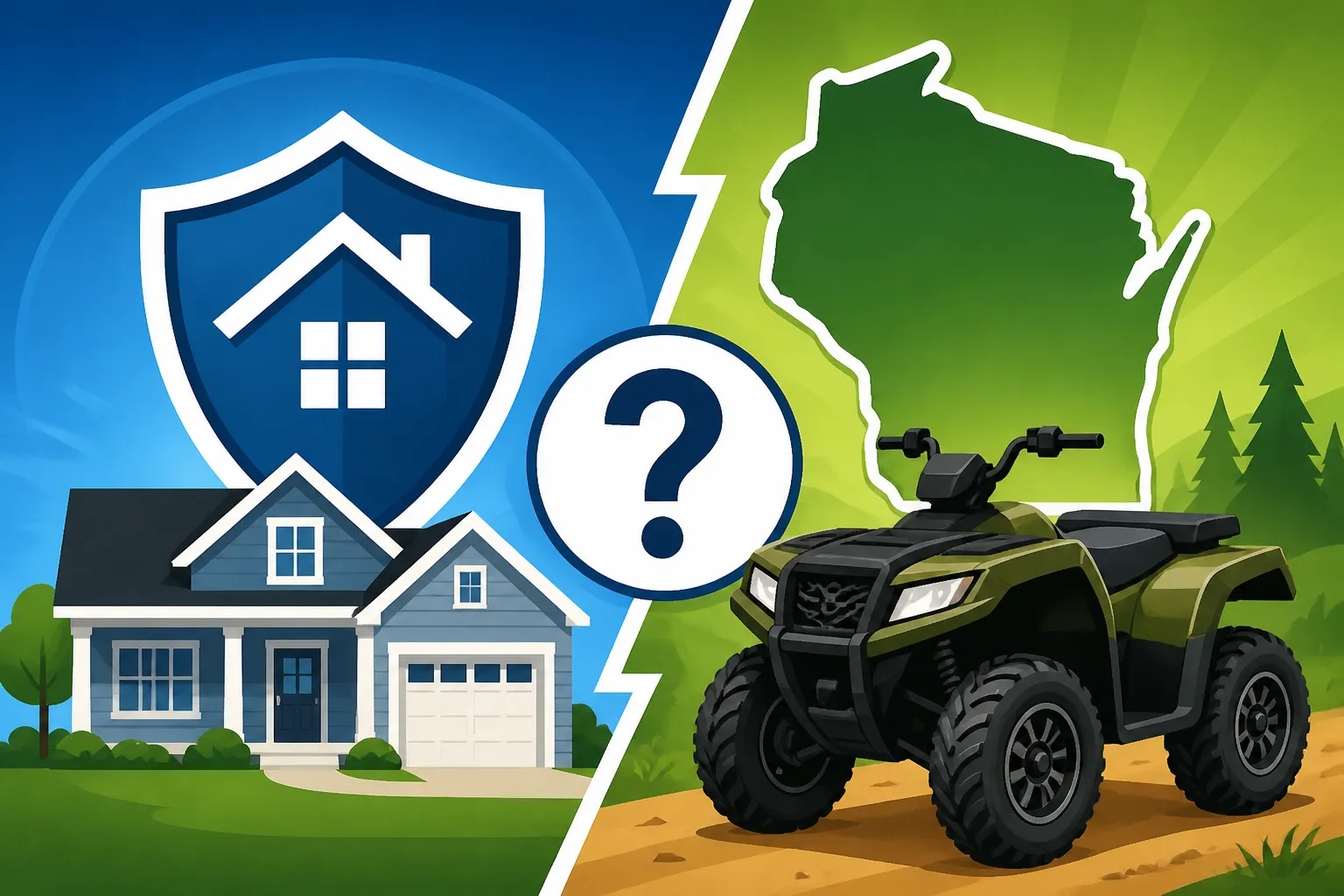
Does a Homeowners Policy Cover a Wisconsin Quad?
It’s a common scenario, isn’t it? You’ve just brought home that shiny new (or new-to-you) ATV or UTV, dreaming of hitting the trails up north, plowing snow from your Wisconsin driveway, or maybe just cruising around your own property. And then, a little nagging thought surfaces: "Is my homeowners insurance going to cover this if something goes wrong?" For many Wisconsin quad owners, the assumption is often "yes," but unfortunately, that assumption can lead to a rude awakening. This guide is here to clarify exactly what your standard homeowners policy might cover, where it absolutely falls short, and why dedicated ATV/UTV insurance is almost always your best bet to protect your investment and your peace of mind.
The Misconception: Why Homeowners Insurance Falls Short for Your Wisconsin Quad
Let’s be honest, we all love the idea of one policy covering everything, a kind of magical blanket protection for all our belongings and potential mishaps. When it comes to your home, that’s largely true – it covers the structure, your personal property inside, and liability for accidents that happen on your property. But here’s the rub, and it’s a big one for motorized vehicles like ATVs and UTVs: standard homeowners insurance policies are generally not designed to cover the risks associated with operating an off-road vehicle. They're built for residential risks, not vehicle risks.
The core reason for this gap lies in the nature of an ATV or UTV itself. These are powerful, motorized machines, capable of speed and causing significant damage or injury, both to property and to people. Insurance companies typically categorize them more akin to cars, motorcycles, or boats, all of which require their own specialized policies. Your homeowners policy has specific exclusions for "motorized vehicles" – a phrase that almost certainly includes your quad or side-by-side. These exclusions are often broad, stating that coverage doesn't apply to losses or liabilities arising from the ownership, maintenance, use, loading, or unloading of any motor vehicle. It doesn't matter if you're on your own land or out on the trails; the vehicle's inherent risk profile is simply outside the scope of a standard home policy.
Imagine a scenario: your teen rider, excited about their new machine, accidentally backs into your neighbor's fence while on your property. While it happened on your land, the damage was caused by a motorized vehicle. Your homeowners policy is highly likely to deny the claim under the motorized vehicle exclusion. Or, even more tragically, what if a friend or family member is injured while riding your ATV on your property? The liability protection of your homeowners policy, which might cover someone slipping on your icy porch, will almost certainly not extend to an injury sustained while operating a powerful, off-road vehicle. This is where the frustration really hits home, realizing that the coverage you thought you had simply isn't there when you need it most.
What Your Homeowners Policy Might Cover And Its Limits
Now, before you completely despair, there are extremely narrow circumstances where a homeowners policy might offer a sliver of coverage for your ATV or UTV, but these are often so limited they hardly offer true protection. It's like trying to put out a bonfire with a squirt gun – technically water, but largely ineffective.
One of the most frequently asked questions revolves around theft. If your ATV or UTV is stolen from your locked garage, shed, or even from the property itself, your personal property coverage within your homeowners policy might kick in. However, and this is a huge "however," there are often very specific limitations. Many policies will have a sub-limit for motorized vehicles, meaning they might only pay out a fraction of your ATV's actual value, often a paltry sum like $1,000 or $2,500, regardless of what your machine is actually worth. If your shiny new side-by-side cost you well over $10,000, that sub-limit won't even scratch the surface of replacing it. Always check your policy's declarations page for specific sub-limits on "recreational vehicles" or "motorized vehicles." Even then, some policies might exclude theft if the machine wasn't stored in a fully enclosed, locked structure. It's a real maze to navigate, and the fine print usually leaves you vulnerable.
When it comes to liability, the situation is even grimmer. As discussed, the general exclusion for motorized vehicles means that if someone is injured because of the operation of your ATV, your homeowners policy is unlikely to cover medical bills, lost wages, or legal defense costs. There's a rare, theoretical exception where if the ATV is somehow involved in a "non-vehicle" incident—say, it catches fire while parked and that fire spreads to your house—the damage to your house might be covered by the fire portion of your policy, but not the damage to the ATV itself or any liability arising from its operation. These scenarios are so convoluted and infrequent that they offer no real peace of mind for typical ATV use.
Furthermore, if you're using your ATV for specific purposes like plowing snow for commercial gain, or if it's explicitly titled and registered for road use (which is a different beast entirely for ATVs in Wisconsin), any slight chance of homeowners coverage completely vanishes. The policy's intent is residential, not commercial or public road vehicle use. It's essential to understand that while a document prepared with a service like LawDepot might help clarify ownership during a sale or transfer, it has no bearing on whether your homeowners policy provides coverage for accidents or theft. That's entirely up to the insurance contract itself.
Here's a quick look at the stark differences:
| Feature | Homeowners Policy (Typical) | Dedicated ATV/UTV Policy (Typical) |
|---|---|---|
| Property Damage (Own ATV) | Very limited; often sub-limits for theft (e.g., $1-2.5k) | Covers collision, comprehensive (theft, fire, vandalism) |
| Liability (Injuries/Damage to others) | Generally excluded for motorized vehicle operation | Covers bodily injury and property damage liability |
| Medical Payments (Yourself/Passengers) | Excluded for vehicle-related incidents | Covers medical expenses for injuries regardless of fault |
| Uninsured/Underinsured Motorist | Not applicable | Covers injuries/damages if hit by an uninsured rider |
| Road Use Coverage | Excluded | Available for designated road routes, if applicable in WI |
| Coverage Off Your Property | Generally excluded | Designed specifically for use on trails, routes, and private land |
When You Absolutely Need Separate ATV/UTV Insurance in Wisconsin
Let's cut right to it: if you plan on riding your ATV or UTV anywhere beyond a strictly controlled, completely private, and uninhabited parcel of land where you bear absolutely zero risk of causing harm or damage to anyone or anything else, you need separate, dedicated ATV/UTV insurance in Wisconsin. The reality for most riders is that dedicated coverage isn't just a good idea; it's a necessity.
Any time your tires leave your private property, you're entering a realm where specialized insurance becomes critical. Think about Wisconsin's amazing trail systems – the [Chequamegon-Nicolet National Forest Trails], the county forest networks in places like [Riding Oneida and Vilas County in Wisconsin] or [Marinette County Year-Round Riding]. Riding these public lands opens you up to a whole host of potential liabilities. What if you accidentally collide with another rider, damaging their machine and causing injury? Or what if you veer off a marked trail and damage private property adjacent to the trail system? Your homeowners policy simply won't have your back in these scenarios. [Wisconsin ATV Insurance Cost] is a small price to pay for this protection.
Even if you're just riding on a friend's land, or crossing a designated [Wisconsin Road Route] in a small town to get to a gas station or supper, you're exposed. Many municipal ordinances for ATV routes actually require proof of insurance, and a homeowners policy won't satisfy that requirement. If you’re ever asked by a Wisconsin warden to show proof of insurance, a homeowners declaration page usually won't cut it. This is why it’s so important to have the right kind of coverage.
Furthermore, if you've financed your ATV or UTV, the lender will almost certainly require you to carry full coverage insurance – collision and comprehensive – to protect their investment. Without it, you could be in breach of your loan agreement. This isn't just about protecting yourself; it's about protecting your financial obligations.
Consider the physical damage to your own machine. Let's say you misjudge a corner on a rocky trail in Bayfield County and roll your UTV. Or perhaps your quad is stolen from a roadside pull-off while you're grabbing a bite to eat in a [Riding to Supper in a Wisconsin Trail Town]. Without dedicated collision and comprehensive coverage, you'd be footing the entire bill for repairs or replacement. These machines are significant investments, and leaving them uninsured for physical damage is a huge financial gamble. While a properly documented [What a Wisconsin ATV Bill of Sale Should Carry], perhaps created through a service like LawDepot, can prove ownership after a theft, it won't help you replace the machine itself without the right insurance policy in place.
Navigating Your Options: Getting the Right Coverage for Your Wisconsin Quad
So, you've realized your homeowners policy isn't going to cut it – which is a completely valid and common realization for many Wisconsin quad owners. Now what? The good news is that getting dedicated ATV/UTV insurance is straightforward, and it offers comprehensive protection specifically tailored to the unique risks of off-road riding.
When you're looking for an ATV/UTV insurance policy, you'll want to consider several key components:
- Bodily Injury Liability: This covers costs if you injure someone else while operating your machine, including medical expenses, lost wages, and legal fees. This is absolutely critical for peace of mind when riding on public trails or routes.
- Property Damage Liability: This covers costs if you damage someone else's property, like a fence, another vehicle, or even a mailbox. Again, a must-have for riding anywhere off your own land.
- Collision Coverage: This protects your machine itself, covering repair or replacement costs if it's damaged in a collision, regardless of who is at fault. If you have a loan on your machine, your lender will almost certainly require this.
- Comprehensive Coverage: This covers your ATV or UTV for losses other than collision, such as theft, vandalism, fire, natural disasters, or hitting an animal. Given the potential for theft or unexpected incidents, this is highly recommended.
- Uninsured/Underinsured Motorist Coverage: This protects you if you're involved in an accident with another rider who doesn't have insurance or whose insurance isn't enough to cover your damages.
- Medical Payments Coverage: This helps pay for medical expenses for you or your passengers if injured in an accident, regardless of who caused it.
Many insurance providers offer specific ATV/UTV policies. It's often worth checking with your current auto or home insurance provider first, as they might offer multi-policy discounts when you bundle your ATV insurance with your existing coverage. Don't be afraid to shop around and get quotes from a few different companies. Explain exactly how and where you plan to use your machine – whether it's solely on your private land, on public trails, or occasionally on designated [Wisconsin Road Rules Riders Get Wrong] routes. This will help them tailor the policy to your actual risk.
When you purchase a used machine, say a [Buying a Used ATV in Wisconsin: The Paperwork] often includes a bill of sale. While this document is vital for establishing legal ownership, especially if you used a service like LawDepot to draft it, it doesn't transfer or create insurance. You need to secure your own policy before you hit the trails. Make sure to ask your insurance agent plenty of questions: What are the deductibles? Are there any specific exclusions for certain types of riding or modifications? What are the coverage limits? Having a clear understanding of your policy will empower you and ensure you're truly protected. The peace of mind that comes from knowing you're fully covered, no matter where your Wisconsin adventures take you, is truly priceless.
Disclaimer
This article is for general informational purposes only and does not constitute professional advice. Laws, prices and regulations vary by location and change over time. Consult a qualified professional for guidance on your specific situation.