Wisconsin Trails That Suit a 50-Inch Machine
A 50-inch ATV or UTV can open up narrower trail options, but the number stamped in a model name does not guarantee that every route is suitable. Wisconsin trail systems mix narrow trails, wider paths, road connectors, and seasonal closures. This guide explains how to check width rules, choose a riding area, prepare your machine, and avoid arriving at a trailhead only to find your ride does not fit.
What a 50-Inch Trail Means in Wisconsin
Understand the trail designation before you ride
A trail marked for machines 50 inches wide or less is intended for narrower off-highway vehicles. The limit matters because a narrow trail may have tight turns, trees close to the trail edge, or limited room for vehicles to pass. A machine that is only a little wider than the posted limit can be a poor fit even if it seems manageable on an open road.
Wisconsin riding areas can include more than one kind of access. A trail system might have narrow trail segments alongside wider trails, town roads, county roads, or other connectors with different rules. A 50-inch designation on one segment does not mean every connected route has the same width allowance. Follow local signs and maps rather than assuming a route continues to suit your machine.
Width limits can also be easy to misread when you are shopping or planning. A model name, advertised class, or owner’s manual specification may not match the machine’s actual widest point after tires, wheel spacers, guards, or other accessories are fitted. Check the specification for your exact configuration and compare it with the limit stated for the specific trail.
Measure the machine you actually plan to ride
Before loading up, check your owner’s manual for the machine’s overall width and look for any changes made since it left the factory. Wider tires and wheel spacers can push the machine beyond its original dimensions. Even accessories that seem minor can affect clearance, so take a careful measurement at the widest point rather than relying on the model name or a retailer listing.
If the machine is close to 50 inches, do not treat “close enough” as a safe assumption. A narrow trail can pinch between trees, pass through a tight gate, or make a sharp turn where a few extra inches matter. If you cannot confirm that your setup fits the posted restriction, contact the relevant trail or land manager before travelling.
This check is especially useful when riding with a group. A narrow machine may be allowed on a segment where a companion’s wider side-by-side is not. Agree on a route that works for every vehicle, and identify any places where the group may need to split up or take a wider alternative. For background on the differences between trail and road access, see [What a Wisconsin ATV Route Actually Is].
How to Find Wisconsin Riding Areas That Fit
Start with the trail manager’s map and signs
Wisconsin riding opportunities are spread across different jurisdictions, including county forests, state forest areas, and local trail networks. A general map can help you choose a region, but the detailed map from the authority managing the area is the one to check for current route designations, access points, closures, and restrictions. A trail map may show a route’s general shape without showing every detail that affects a 50-inch machine.
Before leaving home, check the official map and any posted notices for the trail system you plan to visit. Then confirm the signs at the trailhead and at junctions as you ride. Conditions and access can change with weather, maintenance, construction, or seasonal restrictions. A route shown on an older paper map may no longer be open or may have a different limitation.
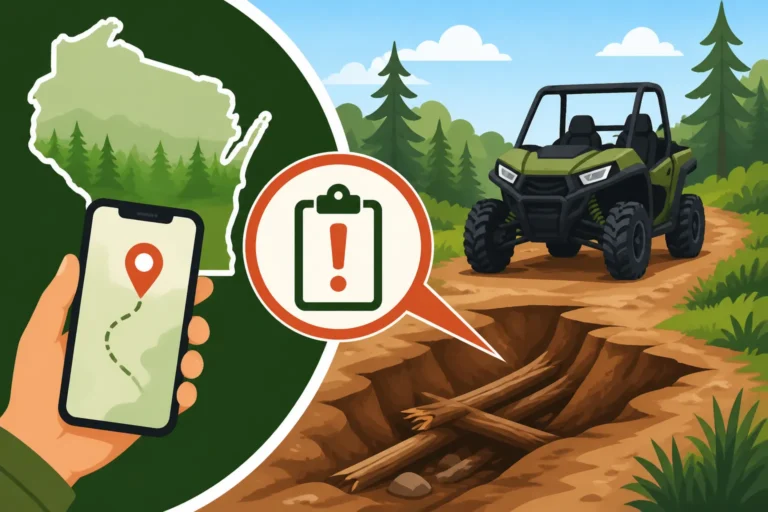
Digital mapping can help with trip planning, but it should complement—not replace—official information. onX Offroad can be useful for reviewing an area and keeping track of a planned route, particularly when you are unfamiliar with a trail network. Compare what you see in the app with the land manager’s map and local signs, especially if the distinction between a narrow trail and a wider connector will determine whether your machine is allowed.
Compare regions without assuming every trail is narrow
Northern and central Wisconsin offer many well-known riding areas, but a county or forest name alone does not tell you whether a particular segment suits a 50-inch machine. For example, riders may look at Oneida County, Vilas County, Clark County, Jackson County, or the Black River State Forest when planning a trip. Within any broad area, the trail experience can vary by route, connection, and local rules.
Use regional guides as a starting point, then verify the specific segment you intend to ride. [Wisconsin County Forest Trail Systems] is a useful place to begin thinking about county-managed riding, while [Black River State Forest ATV Riding] and [Riding Oneida and Vilas County in Wisconsin] can help you explore regional options. Before committing to a route, confirm current width restrictions and closures with the responsible authority.
A practical comparison can help you narrow the search:
| Planning factor | What to check | Why it matters for a 50-inch machine |
|---|---|---|
| Posted width limit | Whether the segment is limited to machines 50 inches wide or less | A wider machine may not be permitted, even if the trail looks passable |
| Route type | Narrow trail, wider trail, road route, or connector | Different segments may have different access rules |
| Trailhead access | Parking, staging area, and vehicle access | A suitable trail is not helpful if your trailer cannot be staged conveniently |
| Current status | Closures, maintenance notices, and seasonal conditions | A mapped route may be temporarily unavailable |
| Surface and terrain | Sand, gravel, rocks, mud, or roots | The surface affects handling and how much clearance you need |
| Group vehicles | Width and access limits for every machine | One oversized vehicle can make a planned group route unsuitable |
Keep notes as you compare areas. A route that looks short on a map may include a long road connector or a narrow section that requires extra care. onX Offroad may help you review the shape of a planned ride, but confirm the allowed machine size with official sources before treating a mapped line as permission to ride.
Choosing a Route for Your Machine and Riding Style
Match the trail to the machine, not just the trip
A 50-inch machine may be designed for narrower trails, but that does not mean every trail at the maximum width will feel comfortable. A newer rider may prefer a route with gentler turns, clear sight lines, and fewer steep or uneven sections. Someone experienced with tight woods trails may be comfortable with a more technical ride, provided the machine is allowed and the trail is open.
Think about what your machine is carrying, too. A passenger, cargo, rack extensions, or added protection can affect handling and clearance. A fully loaded machine may respond differently in sand or mud than it does on a short, empty test ride. If your route includes rough terrain, allow extra room to maneuver and avoid assuming that a machine’s narrow body makes every obstacle easy.
For a family outing, look beyond width alone. Check the route’s difficulty, the presence of road crossings, available stopping points, and how far the planned ride is from the staging area. A modest loop can be a better choice than a long route that looks appealing on the map but leaves fewer options if a child becomes tired or the weather turns. [Family-Friendly Wisconsin ATV Trails] can help you think through the broader needs of a family ride.
Plan around connectors, crossings, and changing conditions
A trail ride may include transitions between different surfaces and access types. You might travel from a staging area onto a trail, reach a road connector, and then return to another narrow segment. Each transition calls for a fresh check of signs and restrictions. Do not assume that because you entered on a 50-inch trail, every connected segment allows the same machine.
Road crossings and shared-use areas deserve particular attention. Slow down, look for posted instructions, and make sure everyone in the group understands where to stop and how to proceed. Dust, blind corners, and traffic can reduce visibility. If a route includes road access, confirm the local rules before the trip rather than trying to work them out at an intersection.
Conditions can change the feel of a trail even when the route remains open. Soft ground, standing water, fallen branches, or a wet patch of sand can make a narrow trail harder to navigate and more damaging if riders go around an obstacle. Do not widen the trail by riding around mud or vegetation. Check local status notices before driving to the trailhead; [Checking Wisconsin Trail Status Before You Drive] provides a useful reminder to make that check part of trip planning.
Preparing for a Narrow-Trail Ride
Set up and inspect the machine
Start with a walk-around inspection. Check tire condition and pressure, brakes, lights, steering, and any loose fasteners or accessories. Look for damage that could become a problem far from the trailhead, such as a tire cut, a loose rack, or a cracked mirror. A narrow trail can make turning around or dealing with a breakdown more difficult, so a few minutes of preparation can save a frustrating afternoon.
Keep the machine’s width and clearance in mind when adding accessories. A wide storage box, wheel spacers, or other modifications can affect whether the vehicle fits a posted restriction. Accessories can also snag on branches or make it harder to pass through tight spots. If your machine has been modified, recheck its actual width instead of relying on the original specification.
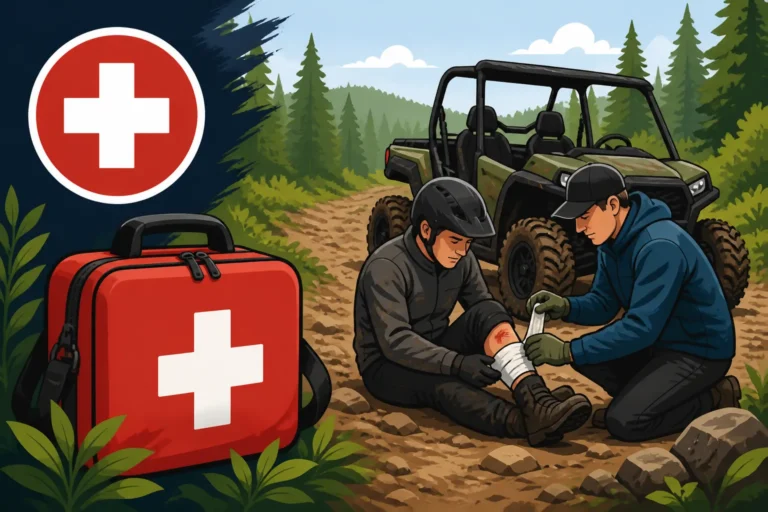
Pack for the ride you planned, not the one you hope to have. Useful basics include water, a small first-aid kit, a charged phone, appropriate clothing, and tools suited to your machine. A paper map or an offline navigation option can be useful if phone service is weak. onX Offroad can support route review and navigation planning, but carry enough information to recognize where you are if a device loses signal or power.
Ride with room, patience, and a backup plan
On a narrow trail, leave enough space between machines to react to a stop, branch, or sudden change in terrain. A tight group can create pressure to follow too closely, especially when riders cannot see far around bends. Keep a pace that suits the least experienced rider and stop in a safe place if the group becomes separated.
If you meet another rider on a tight section, do not force a pass where there is not enough room. Communicate calmly, look for a safe place to yield, and avoid turning a brief wait into a risky maneuver. The same patience applies when approaching hikers, maintenance crews, or other trail users. A narrow route leaves less room for mistakes, so slowing down is often the easiest way to keep a minor inconvenience from becoming an incident.
Before the group sets off, agree on a turnaround point and a plan if someone has a mechanical issue. Identify who has a map, who carries basic tools, and where the group will stop if riders lose visual contact. If you are exploring an unfamiliar area, choose a shorter first outing and add distance after you understand the trail layout. More planning advice is available in [What to Carry on a Northwoods Ride].
Common Mistakes and a Better Pre-Trip Routine
Avoid relying on model names or old maps
One of the most common planning mistakes is assuming a machine is trail-legal because its name includes a width figure, or because another rider says a route is “fine.” A model name is not a substitute for checking the actual machine, and a friend’s experience may refer to a different segment or a different version of the trail system. Width limits, closures, and local access rules need to be checked for the ride you are taking.
Another trap is treating every line on a digital map as a route you can ride. A map may be helpful for orientation but may not display every current restriction or seasonal notice. Use it to understand the area, then verify route access with the managing authority and posted signs. If two sources appear to conflict, do not assume the more permissive interpretation is correct; contact the trail manager for clarification.
It is also easy to plan a route that works for most of the group but not all of it. A 50-inch machine may be within the posted limit while a companion’s vehicle is not. Check every machine, including modified or heavily accessorized vehicles, and choose a route the whole group is allowed to use. [Wisconsin Trails Rated for Full-Size Rigs] can help frame the difference between trail options for narrower machines and wider vehicles.
Use a simple checklist before leaving home
A repeatable checklist makes trip planning easier, especially when you ride different counties or forests. It helps catch small oversights—like an accessory that changed your machine’s width or a closure notice you missed—before they turn into a long drive for nothing.
- Confirm the machine’s actual overall width, including modifications and accessories.
- Find the official map for the specific trail system and check the restriction on each intended segment.
- Review current closure and condition notices from the responsible authority.
- Check staging access, parking, and any road connectors or crossings on your route.
- Make sure every machine in the group fits the route’s rules.
- Pack water, basic tools, first aid, navigation, and clothing suited to the forecast.
- Agree on a turnaround point and a plan for regrouping or a breakdown.
If you are new to Wisconsin riding, begin with a route that is easy to verify and close to a staging area. After your first ride, note where the trail tightened, which intersections were confusing, and whether the route matched your group’s ability. Those small observations make the next trip smoother—and help you choose trails that suit your machine rather than simply chasing the most miles.
Disclaimer
This article is for general informational purposes only and does not constitute professional advice. Laws, prices and regulations vary by location and change over time. Consult a qualified professional for guidance on your specific situation.