What an Insurer Wants After a Wisconsin Theft
The gut-wrenching feeling of walking out to your garage, shed, or even your deer camp only to find your beloved ATV or UTV missing is a nightmare no Wisconsin rider ever wants to experience. Beyond the immediate shock and anger, a cloud of worry descends: "What now? Will my insurance cover this?" This guide is here to walk you through exactly what your insurer will need from you if your machine is stolen, helping you navigate the claims process as smoothly as possible.
The Immediate Aftermath: What to Do First After Discovering a Theft
When you realize your ATV or UTV has been stolen, your mind races. It's a chaotic moment, but taking the right steps immediately can make a significant difference in the subsequent insurance claim process. Don't let the panic paralyze you; focus on these crucial first actions.
Securing the Scene and Reporting to Law Enforcement
The very first thing you need to do, after the initial shock, is resist the urge to touch anything. If your machine was stored in a garage, a shed, or even just parked outside your cabin up north, there might be evidence left behind by the thieves. Preserve that scene as much as possible. This means no tidying up, no trying to figure out how they got in by disturbing locks or gates, and definitely no moving things around.
Once the scene is secured, your immediate next step is to contact local law enforcement. This means calling the sheriff's department if you're out in a rural county, or the city police if the theft occurred in a more populated area. When you call, be prepared to give them the location of the theft, a brief description of what happened, and any initial details you have about your machine. They will dispatch an officer to take a full report. This police report is absolutely critical. It provides an official record of the theft, a case number, and often includes details that you might overlook in the moment due to stress. Your insurance company will not even begin to process a theft claim without a police report number, so getting this done swiftly is paramount. You'll be asked about the make, model, year, and ideally the Vehicle Identification Number (VIN) of your machine, so have that information handy if you can.
Gathering Initial Information for Your Insurer
After you've filed the police report and have that all-important case number, it's time to start compiling information for your insurance company. While you'll have a more in-depth conversation later, having these basic facts ready will streamline your initial contact. Think of it as preparing your "elevator pitch" for the insurance agent.
First, jot down all the identifying details of your stolen machine. This includes the full VIN, the exact make (e.g., Polaris, Can-Am, Honda), the specific model (e.g., Ranger XP 1000, Outlander 800, Foreman), and the model year. Next, note the date and time you discovered the theft, and your best estimate of when the theft actually occurred. Pinpointing the exact location where it was stolen is also vital. Did it happen from your locked garage in Madison, or from an open shed at your deer camp near Minocqua? Any details about the storage location and the immediate surroundings can be helpful. Finally, briefly describe any security measures you had in place. Did you have a heavy chain, a disc lock, an alarm system, or a GPS tracker? Even if those measures ultimately failed to prevent the theft, they demonstrate your efforts to protect your property and can be relevant to your claim. Remember, understanding [Insuring an ATV in Wisconsin] is crucial for anticipating what your policy covers.
Notifying Your Insurance Provider and Starting the Claim Process
With the police report filed and your initial information organized, the next hurdle is reaching out to your insurance provider. This isn't just a formality; it's a critical step that officially kicks off the claims process. Prompt and accurate communication here can prevent delays and frustration down the line.
First Contact: What to Tell Your Agent
Timing is everything when reporting a theft to your insurance company. You should contact them as soon as reasonably possible after reporting the theft to the police. Many policies have clauses about timely reporting, so don't delay. When you make that first call to your insurance agent or the company's claims line, be prepared to provide them with the police report number and the contact information for the law enforcement agency that took the report. This is their immediate verification that a theft has indeed occurred and is under official investigation.
Beyond the police report number, you'll give them a concise overview of the incident. This isn't the time for a lengthy narrative, but rather the key facts: "My [Year, Make, Model] ATV was stolen from [Location] sometime between [Time/Date 1] and [Time/Date 2]. I've filed a report with [Law Enforcement Agency] under case number [Case Number]." They'll likely open a claim file right away and assign you a claims adjuster, who will be your primary point of contact moving forward. It’s a good idea to understand [Wisconsin ATV Insurance Cost] and how it relates to your coverage before you call, so you have a general idea of your policy limits and deductibles.
Understanding Your Policy: Coverage and Deductibles
Before or during your initial call, it's a wise move to pull out your ATV/UTV insurance policy and review the details. Specifically, you'll want to look for "comprehensive coverage" or similar language that covers theft. Unlike liability coverage, which covers damage or injury you might cause to others, comprehensive coverage is designed to protect your machine from things like theft, vandalism, fire, and certain natural disasters. If you only carried basic liability, your policy likely won't cover the theft of your own machine.
The policy will also clearly state your deductible. This is the amount you are responsible for paying out-of-pocket before your insurance coverage kicks in. For example, if your policy has a $500 deductible and your stolen ATV is valued at $8,000, the insurance company would pay you $7,500 if the claim is approved. It's important to understand this figure because it directly impacts your final payout. A higher deductible typically means lower premiums, but also a larger out-of-pocket expense if you ever need to file a claim. Understanding these terms upfront will help manage your expectations throughout the claims process.
Documentation Your Insurer Will Absolutely Need
Insurance companies operate on documentation. They need tangible proof of what happened, what was stolen, and what its value was. This isn't about distrusting you; it's about adhering to protocols and ensuring fair and accurate claim resolution. Getting these documents in order can significantly speed up your claim.
Proof of Ownership and Registration
In Wisconsin, unlike cars, ATVs and UTVs are not titled. This often confuses people and can create a hurdle when trying to prove ownership after a theft. However, your insurer will still require solid evidence that the machine belonged to you. The primary document for this is your ATV's registration card issued by the Wisconsin DNR. This card lists you as the registered owner and includes key details about the machine. Keep this card in a safe place, not necessarily on the machine itself, as it's vital for a claim.
Beyond the registration card, the original bill of sale from when you purchased the ATV or UTV is incredibly important. This document should detail the sale date, the purchase price, the seller's information, and most importantly, the VIN of the machine. If you bought it new from a dealer, you'll have a formal dealer invoice. If you bought it privately, a comprehensive bill of sale is still crucial. This is where a tool like LawDepot can be incredibly helpful for creating robust, legally sound bills of sale even for private transactions. These documents together solidify your claim of ownership. Many riders only realize the importance of documents like these when they need to make a claim, which is why we stress the importance of [Proof of Ownership Without a Title] and [Buying a Used ATV in Wisconsin: The Paperwork].
Detailed Machine Description and Value Assessment
The more specific you can be about your stolen machine, the better. Your insurer will need the VIN (Vehicle Identification Number) again, along with the exact year, make, and model. If you have any photographs of your ATV or UTV, especially clear shots showing its overall condition and any unique features, those will be invaluable. Pictures can often show accessories or modifications that you might forget to list, or simply provide undeniable proof of the machine's appearance.
Beyond the base machine, you'll need to list all aftermarket accessories and upgrades. Think about everything you added: winches, plows, upgraded tires and wheels, light bars, cab enclosures, heated grips, GPS units, storage boxes, and so on. For each accessory, provide details like the brand, model, approximate purchase date, and especially the purchase price if you have receipts. Receipts for these upgrades are gold. They provide concrete evidence of their value and can significantly increase your potential payout. Without them, the insurer might only offer a depreciated estimate. Keeping maintenance records is also a good idea, as they can help demonstrate that your machine was well-cared for, which can indirectly support its overall value. LawDepot can also assist in creating affidavits or detailed personal property inventories if you don't have all your original receipts but need to document specific items and their estimated values.
Here's a quick overview of documents typically required:
| Document Type | Why It's Needed | What It Proves |
|---|---|---|
| Police Report Number | Initiates formal investigation; required for all theft claims. | Official record of theft |
| Wisconsin Registration Card | Primary proof of legal ownership in Wisconsin. | Your legal ownership of the specific machine |
| Bill of Sale/Purchase Invoice | Shows original purchase details and transaction. | Purchase date, price, and VIN |
| Photos of Machine | Visual evidence of condition, accessories, and unique features. | Condition before theft, existence of modifications |
| Receipts for Accessories | Verifies value and existence of aftermarket parts. | Cost and presence of added features |
| Maintenance Records | Demonstrates regular care and good operating condition. | Machine upkeep, potentially higher value |
| Evidence of Security Measures | Shows efforts to prevent theft; can impact policy terms. | Due diligence in protecting your property |
Evidence of Security Measures
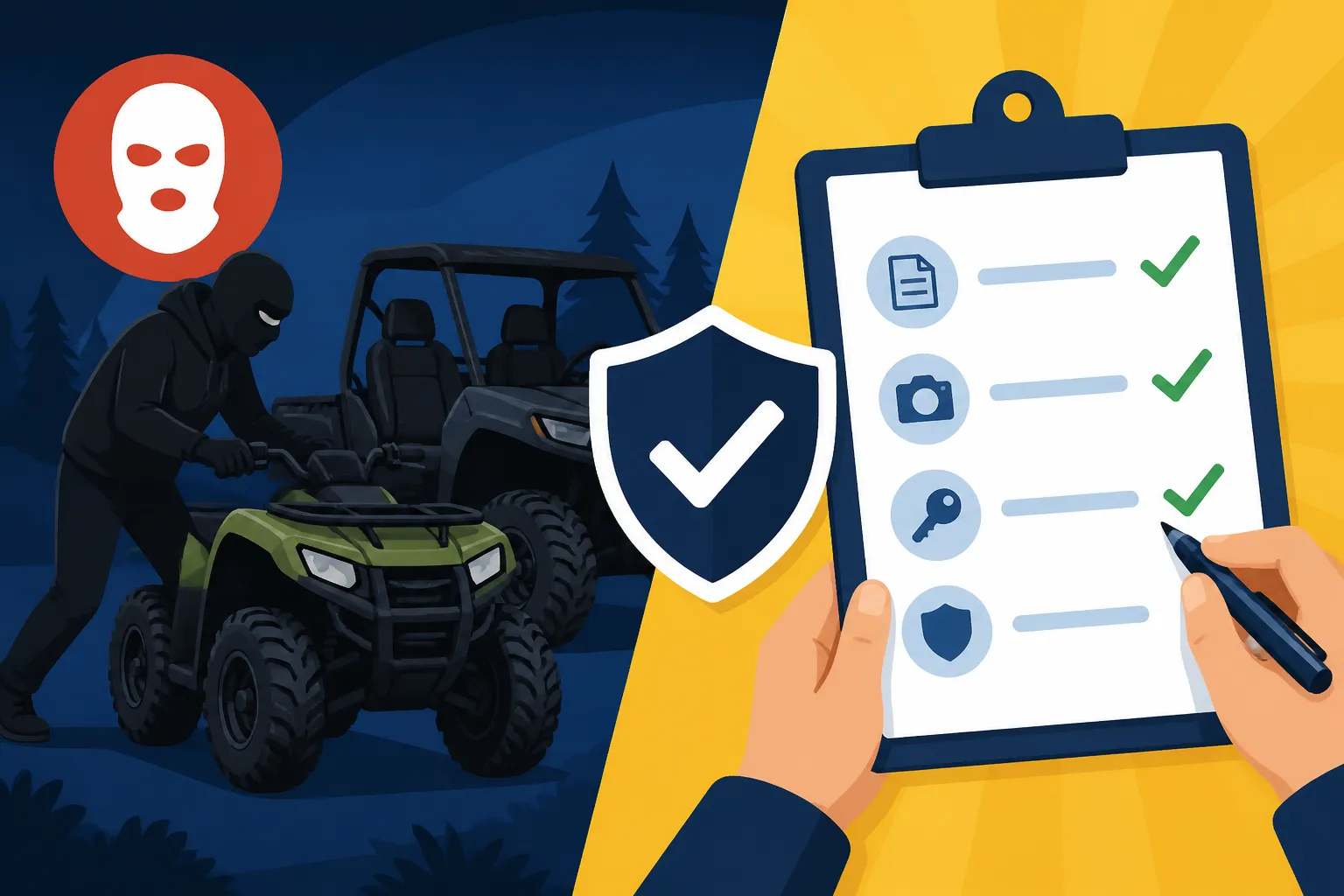
Insurance companies often consider the security measures you had in place when assessing a theft claim. They want to see that you took reasonable steps to protect your property. This doesn't mean you need a Fort Knox setup, but rather that you weren't negligent. Provide evidence of any locks, chains, tracking devices, or alarm systems you were using. If you have photos of your ATV or UTV secured with a heavy chain, a disc lock on the brake rotor, or inside a locked garage, these can be very helpful.
If you have a security camera system, any footage of the theft itself, or even just showing your machine secured before the theft, would be powerful evidence. Similarly, if you had a GPS tracking device installed, provide the details of that service. Even if the device was removed or disabled by the thieves, the fact that it was there shows proactive protection. Finally, if there were any witnesses who saw the machine secured, or perhaps even saw suspicious activity around the time of the theft, their statements could also support your claim. Demonstrating these efforts reinforces your position and can potentially aid in a smoother claims process.
The Investigation and Resolution Process
Once you've submitted all the required documentation, the insurance company's investigation will begin in earnest. This stage requires patience and continued cooperation from your side. It's a dialogue between you, your adjuster, and sometimes even law enforcement, aimed at reaching a fair resolution.
Cooperating with Your Adjuster and Law Enforcement
Your assigned claims adjuster will be your main point of contact throughout this process. They will review all the information you've provided, and they may have follow-up questions or request additional documentation. It's crucial to be responsive and transparent. Answer all questions truthfully and completely. If you withhold information or provide inconsistent details, it can raise red flags and delay your claim. They might ask for more specific details about the layout of where the machine was stolen, your routine, or even past claims you've made.
At the same time, law enforcement will continue their investigation into the actual theft. While your insurance claim can proceed, sometimes a recovered machine will complicate matters. If the police do recover your machine, it's vital to notify both your insurance company and the police immediately. The adjuster will then guide you on the next steps, which could involve inspecting the recovered machine for damage. The whole process can feel lengthy, but staying in touch with both parties helps ensure everything moves forward efficiently. Remember, a claim for [Recovering a Stolen Machine in Wisconsin] might be different than for one that's never found.
Understanding Payouts and Replacement Values
One of the biggest questions on every rider's mind after a theft is, "How much will I get?" The answer depends on your policy's valuation method. Most policies cover either the "actual cash value" (ACV) or "replacement cost." Actual cash value is what the machine was worth at the time of theft, considering depreciation due to age, wear, and tear. For example, a three-year-old ATV will be worth less than what you paid for it new. Replacement cost, on the other hand, would pay to replace your stolen machine with a brand-new one of similar make and model, without deducting for depreciation. Some policies also offer "agreed value," where you and the insurer agree on a specific value for the machine at the start of the policy term, and that's what they pay if it's stolen.
Your adjuster will typically use industry guides, market research, and the documentation you provided (especially receipts for accessories) to determine the value of your machine. If you disagree with their initial offer, don't be afraid to negotiate. Provide additional evidence, such as recent comparable sales of similar machines in your area, or more detailed receipts for your accessories, to support a higher valuation. The goal is to reach a fair settlement that allows you to replace your stolen machine.
Protecting Your Machine from Future Theft
While this guide focuses on what to do after a theft, it's equally important to consider how to prevent it from happening again, or even happening in the first place. Proactive measures are always better than reactive ones.
Enhanced Security Measures and Best Practices
When it comes to securing your ATV or UTV, a multi-layered approach is always best. Don't rely on just one security method. Start with physical barriers:
- Heavy-Duty Locks and Chains: Invest in strong, case-hardened steel chains and disc locks. Loop chains through the frame and around a secure anchor point (like a concrete pillar or ground anchor).
- Kill Switches and Fuel Shut-Offs: Simple, hidden kill switches can prevent a thief from starting your machine, even if they bypass other locks. A hidden fuel shut-off valve can achieve a similar effect.
- Secure Storage: Whenever possible, store your ATV or UTV in a locked garage, shed, or dedicated storage unit. Make sure the doors are reinforced and the locks are robust. Out of sight, out of mind is a powerful deterrent.
- Alarm Systems: Motion-activated alarms can alert you and scare off potential thieves. Many modern alarms also offer smartphone notifications.
- GPS Tracking Devices: These devices are becoming increasingly popular and can be invaluable for [Recovering a Stolen Machine in Wisconsin]. They allow you to track your machine's location in real-time if it's stolen, greatly aiding law enforcement in its recovery.
- Lighting and Cameras: Good exterior lighting, especially motion-activated lights, can deter thieves. Security cameras, even consumer-grade ones, can provide crucial evidence if a theft does occur.
Vigilance and community watch also play a role. Get to know your neighbors, especially in rural areas or at deer camps where machines are often stored. A suspicious vehicle or person might be noticed by someone else before you are aware.
Documentation Habits for Every Rider
Good documentation isn't just for insurance claims; it's a vital part of responsible ATV/UTV ownership. Make it a habit to:
- Photograph Your Machine: Take clear photos of your ATV or UTV from multiple angles, including close-ups of the VIN, engine, and any unique features or accessories. Do this when you first buy it and again after adding any significant upgrades. Store these photos digitally and in a secure physical location.
- Keep Records: Maintain a file (physical and/or digital) with all purchase receipts for your machine and any accessories. Also, keep all maintenance records. This meticulous record-keeping can be simplified with digital tools, or even through services like LawDepot, which can help you organize and formalize personal property records.
- Note Your VIN: Always know your VIN and keep it recorded separately from your machine. It's the unique identifier for your ATV or UTV, and it's essential for police reports and insurance claims. This is also why understanding [Wisconsin DNR ATV Registration Explained] and [Registering an ATV in Wisconsin] is so critical, as these records tie your machine's VIN to you as the owner.
- Regularly Update Your Inventory: If you add new accessories or make significant changes, update your records and take new photos. This ensures your documentation is always current.
By implementing these best practices, you not only make your machine less attractive to thieves but also set yourself up for a much smoother, less stressful experience should the unthinkable happen. Having your paperwork in order, from [What a Wisconsin ATV Bill of Sale Should Carry] to your registration card (which a Wisconsin warden will ask to see), is just good practice for any rider.
Disclaimer
This article is for general informational purposes only and does not constitute professional advice. Laws, prices and regulations vary by location and change over time. Consult a qualified professional for guidance on your specific situation.