Wisconsin Pass Rules at a State Forest
A Wisconsin state forest can look open on a map and still have restrictions on where an ATV or UTV may go. The key is to check both the machine’s pass or registration status and the rules for the specific forest roads and trails you plan to ride. A trail pass does not turn every forest road into an ATV route.
When a Wisconsin Trail Pass Is Required
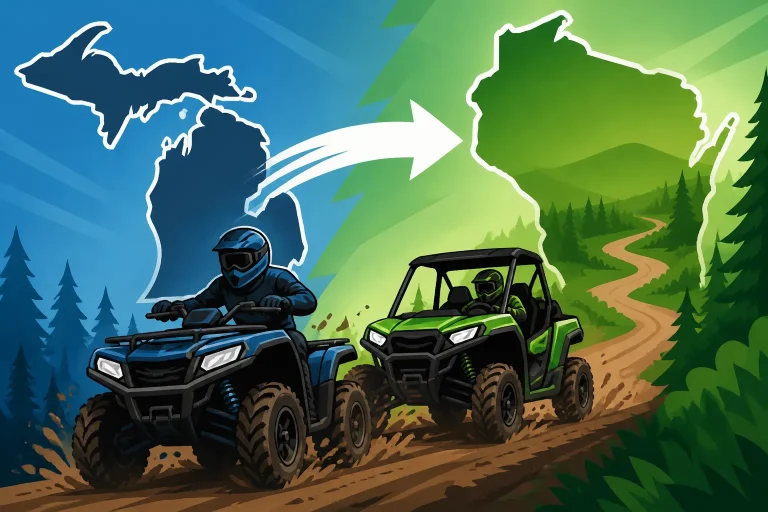
Wisconsin’s nonresident ATV and UTV trail pass generally applies when a machine registered in another state is ridden on Wisconsin’s public ATV trails. That includes designated trails in state forests when those trails are open to the machine and the public. The pass is tied to the machine, not to each person riding it.
Wisconsin-registered machines generally do not need a nonresident trail pass to use public ATV trails. That does not remove the need to keep registration current or follow forest-specific restrictions. If you are unsure whether your machine qualifies, check Machines Registered in Wisconsin and the Pass and the state’s current pass instructions.
| Machine and location | What to check |
|---|---|
| Machine registered in another state, on a public state forest ATV trail | Whether it needs a Wisconsin nonresident trail pass |
| Machine registered in Wisconsin, on a public ATV trail | Whether its registration is current and the trail is open |
| Machine on a forest road or route | Whether that specific road is legally open to ATVs or UTVs |
| Machine on private land within or near a forest | The landowner’s permission and any applicable rules |
| Machine used only on private property | Whether public-trail pass rules apply to the planned use |
A trail pass is not the same thing as registration. Registration identifies the machine under the applicable state system; a trail pass gives a qualifying nonresident machine access to certain public ATV trails. Neither one replaces permission to ride a particular trail or road. For a closer explanation of when the pass applies, see Which Wisconsin Trails Require a Pass and Wisconsin’s Non-Resident Trail Pass.
Don’t assume that buying a pass also satisfies every other requirement. Riders may still need to meet applicable safety, equipment, age, and operating rules. A pass does not authorize riding on a closed trail, an unmarked forest road, or land where motorized use is prohibited.
What the Pass Does and Does Not Allow in a State Forest
A pass is only one part of the permission question. It can meet a pass requirement for an eligible machine on a qualifying public trail, but it does not create general access to a state forest. The forest unit’s maps, signs, closures, and operating rules determine where ATVs and UTVs may travel.
State forests are not all laid out the same way. One unit may have a designated ATV trail system, while another may have limited motorized access or no public ATV trail where you expect to ride. Even within an open unit, a machine may be restricted to signed trails or specified roads. Riding off the designated corridor can damage habitat and may lead to enforcement, even if the machine has a valid pass.
Pay attention to the difference between these types of access:
- Designated ATV trail: A marked trail specifically open to ATV or UTV use, subject to its posted rules and current status.
- Forest road: A road within the forest. Its presence on a map does not by itself mean it is open to ATVs or UTVs.
- Public road route: A road legally opened to ATV or UTV traffic under applicable local rules. A trail pass does not open a road route.
- Private or administrative road: A road that may be restricted to landowners, authorized workers, or other permitted users.
Signs and maps help show where a corridor begins and ends, but riders should not treat a trail connection as permission to continue onto every road it meets. Check Wisconsin Trail Signs and Markers before setting out, and confirm road access separately where your trip leaves a designated trail.
The same care applies at trailheads and forest boundaries. A trail may pass near a campground, parking area, or road that has its own rules. The pass is not a parking permit, campsite reservation, or blanket authorization for other recreational uses. Confirm those details with the relevant forest or facility before relying on a trail-pass purchase to cover them.
How to Confirm the Rules Before You Ride
Use the forest’s current information and the state’s pass guidance together. A general trail map can help you plan, but it may not show a short-term closure or a seasonal restriction. When a rule is unclear, ask the managing office rather than assuming that a road or trail is open.
- Identify the exact forest and access point. A nearby trail system may be managed by a county or another agency, not by the state forest. The managing authority matters because its maps and rules may differ.
- Check your machine’s registration. Confirm which state issued it and whether the registration remains valid. Use that information to determine whether Wisconsin’s nonresident pass rules apply.
- Find the official trail map and current notices. Look for open and closed segments, seasonal restrictions, vehicle limits, and any detours. Check Checking Wisconsin Trail Status Before You Drive close to your trip, especially after wet weather or during seasonal transitions.
- Trace the full route. Confirm every section you intend to ride, including connectors and any road travel between trail segments. A route that begins on a designated trail may enter a road with different rules.
- Check local requirements separately. If the ride uses town, county, or other public roads, confirm that those roads are open to ATV or UTV traffic. A statewide trail pass does not substitute for local route authorization.
- Carry or display what the rules require. Follow current instructions for the pass and registration, and keep required documentation accessible. Do not rely on a receipt alone if the official rules require a pass to be displayed on the machine.
County forests are a useful example of why checking the managing authority matters. Their rules can be different from state forest rules, so riders connecting between systems should review County Forest Rules Wisconsin Riders Follow instead of assuming one agency’s permission carries over to another.
If your planned ride includes a public road, review Wisconsin Permit Rules on County Trails and the relevant local ordinance. Some roads may be open only under specific conditions, and restrictions can change from one town or county to the next. The pass answers a limited question about trail access; it does not settle every question about road use.
Common Mistakes to Avoid
The most frequent mistake is treating a pass as a universal license to ride. It is not. A machine may have the right pass and still be prohibited from a particular forest road, closed trail, or adjacent property. Always match the pass requirement to the route and the route to the forest’s current rules.
Other common assumptions can cause problems:
- “The road is inside the forest, so it must be open.” Forest roads can have different access rules. Look for explicit authorization rather than relying on the road’s location.
- “The trail is on a map, so it must be open today.” Maps may not reflect a temporary closure, maintenance work, weather damage, or seasonal restriction. Check current notices before leaving.
- “A pass covers every machine in the group.” The pass applies to the qualifying machine, not to a whole group. Check requirements for each vehicle.
- “The pass lets us ride the connecting road.” It does not automatically authorize road use. Verify the connecting segment and any local route rules.
- “A pass replaces registration.” Pass and registration requirements are separate. Confirm what applies to your machine and carry or display the required items.
- “A nearby county trail follows the same rules.” County and state lands may have different managing agencies and restrictions. Check each system separately.
When in doubt, pause before riding onto an uncertain segment. A short call or map check is easier than dealing with a citation, a blocked route, or damage to a closed area. Build time into the trip to check for signs at intersections and turn around if the posted information conflicts with your plan.
Disclaimer
This article is for general informational purposes only and does not constitute professional advice. Laws, prices and regulations vary by location and change over time. Consult a qualified professional for guidance on your specific situation.