Enforcement and Checkpoints in Wisconsin
Enforcement and Checkpoints in Wisconsin
A checkpoint can interrupt a ride just when you are focused on the trail, and it is easy to be unsure which papers or permits matter. In Wisconsin, the details depend on where you are riding, how the machine is registered, and whether local rules apply. Here’s what an ATV or UTV rider can expect, what to have ready, and how to avoid preventable problems.
Why Wisconsin ATV and UTV Riders May Be Stopped
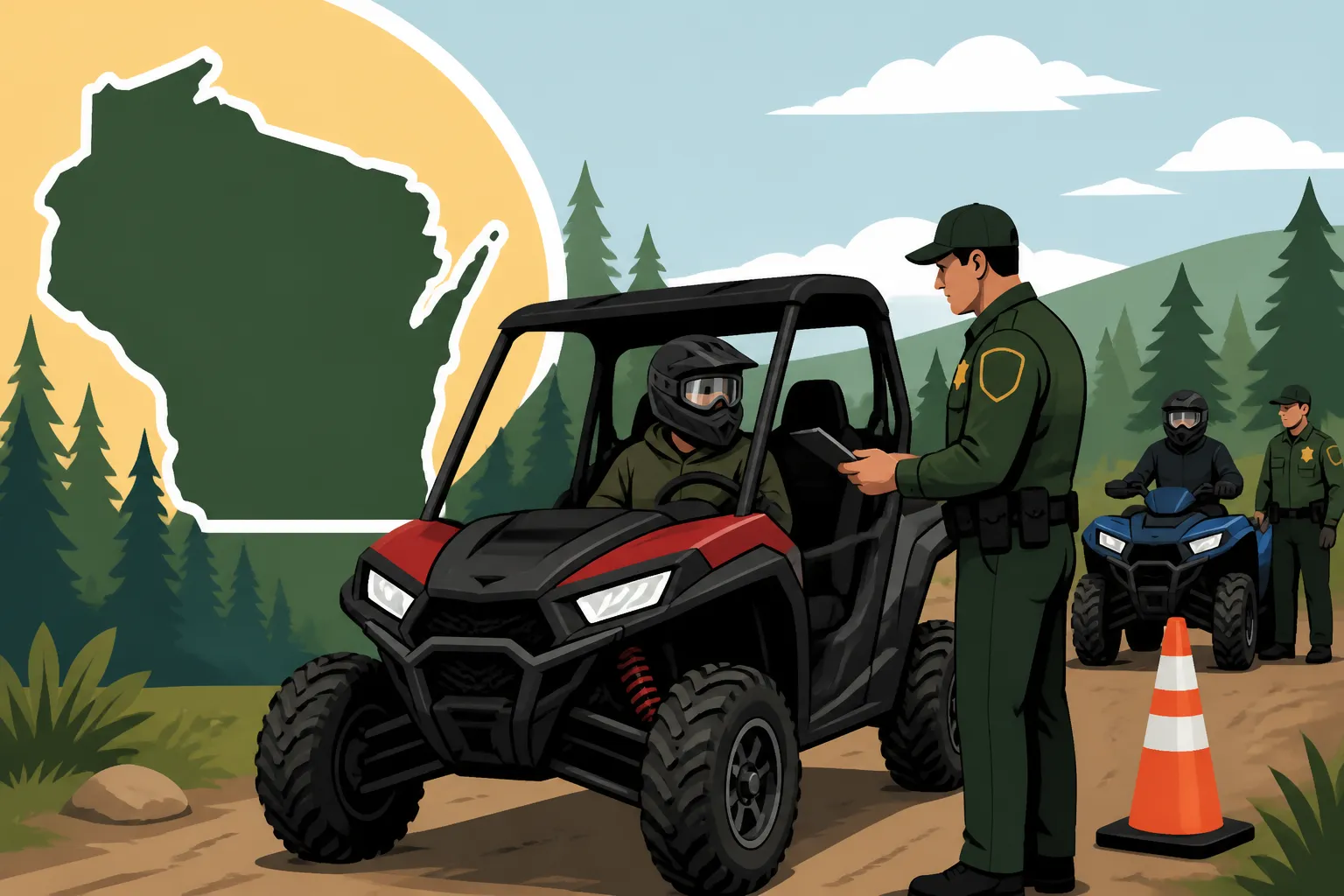
Wisconsin enforcement on public ATV and UTV trails and routes can involve conservation wardens and other law enforcement officers. They may patrol while moving or stop riders at a staging area, trail crossing, route connection, or other location. A checkpoint may be set up to check several machines in one place, but not every stop is a checkpoint and not every checkpoint has the same purpose.
Officers may be checking compliance with state rules, local ordinances, or both. Depending on the location and circumstances, that can include registration, trail-pass requirements, operator qualifications, required equipment, or conduct on the trail or route. A stop might also follow a safety concern, a complaint, a crash, or a suspected violation. The presence of a checkpoint does not mean every rider is suspected of wrongdoing.
A machine’s status can matter. Wisconsin registration and a Wisconsin nonresident trail pass are not interchangeable. A Wisconsin-registered machine generally uses its registration to meet the relevant state trail-access requirement, while an out-of-state machine may need a nonresident pass for eligible public riding. Exemptions and access rules depend on the machine and where it is being operated, so check the current requirements before setting out. Which Wisconsin Trails Require a Pass explains the access question in more detail, and Wisconsin Non-Resident Trail Pass covers what visiting riders should check.
Local rules can add another layer. A town or other local government may set conditions for routes within its jurisdiction, and those conditions can differ from the general rules for trails. Noise, operating hours, insurance, equipment, and route conduct are examples of subjects that may be addressed locally. A machine that is properly registered is not automatically allowed on every road or trail. Review Municipal Ordinances Wisconsin Riders Must Read if your ride includes a road route.
It also helps to keep enforcement separate from trail access. A rider might have the correct paperwork but still be on a closed trail, operating in a restricted area, or violating a local rule. Conversely, a trail that is open to riding does not waive registration, pass, safety, or equipment requirements. Confirm both that the route is open and that your machine and riders meet the conditions for using it.
What an Officer May Check
A roadside or trail stop can be brief, or it can involve several questions. The exact checks depend on the circumstances. Being organized makes the interaction simpler, but it does not mean every rider will be asked for every item on the list.
| What may be checked | Why it may matter | What to do before riding |
|---|---|---|
| Registration or trail pass | Confirms that the machine meets applicable registration or access requirements | Check which requirement applies to your machine and destination |
| Registration information | Helps match the machine and its record | Keep required documents available and make sure identifying details are legible |
| Operator qualifications | Age and safety-certificate rules may apply | Confirm the operator meets the rules for that machine and riding location |
| Equipment and condition | Required safety or noise equipment may apply | Check lights, required protective equipment, and exhaust condition |
| Route or trail conduct | Speed, hours, and operating rules can vary by location | Read local signs and check the applicable ordinance |
| Insurance or other local conditions | Some local routes may impose additional requirements | Verify local rules and carry any proof you are required to have |
Registration, decals, and passes
Start by knowing what credential your machine needs. Wisconsin residents and visitors may face different registration or pass requirements, and having a registration card from another state does not necessarily remove Wisconsin’s trail-pass requirement. An out-of-state machine also does not become eligible to ride everywhere simply because it is registered where it is normally kept.
Before a trip, verify that the registration or pass is valid for the machine and the area. Confirm that required decals are displayed in the proper place and can be read. If a decal has peeled off, is missing, or is difficult to see, resolve that before riding rather than assuming the registration record alone will settle the matter at a checkpoint. For general guidance, see Displaying a Wisconsin Trail Pass and Wisconsin Pass Rules for an Off-Highway Motorcycle if the machine is an off-highway motorcycle rather than an ATV or UTV.
Registration and pass rules may have exceptions, and they are not the same as permission to enter private property. If you ride on land you own, land you lease, or land where someone has invited you, the rules can differ from those on public trails. Do not assume that a private-land exception carries over to a public trail connector or road route. Wisconsin Rules on Private Land and Riding a Friend’s Land by Permission in Wisconsin address those situations.
Operator requirements
An officer may ask who is operating the machine and whether the operator meets the applicable age and safety requirements. Rules can differ for ATVs and UTVs, and a passenger’s age or position may also matter. A parent or adult supervising a young rider should make sure the rider meets the requirements for the specific machine and place of operation—not just that the young person has ridden before.
If a safety certificate is required, the operator should have completed the accepted course and be prepared to show proof if asked. Check the current rule for the rider’s age and birthdate rather than relying on a general assumption that certification is either required for everyone or required for no one. Wisconsin’s ATV Safety Certificate Requirement summarizes the issue, while Wisconsin Age Rules for ATVs and UTVs is relevant when a young rider is involved.
Equipment and local conditions
A check may focus on equipment or the way the machine is being operated. That could include whether required safety equipment is present, whether the machine’s exhaust meets applicable standards, or whether the operator is following route-specific rules. Local requirements can also apply to insurance, operating hours, and other conditions.
Make a quick machine check before the ride. Look for damaged or obscured lights, missing safety equipment, loose parts, and an exhaust modification that could cause a compliance problem. If you are riding after dark, on a town route, or in an area with special rules, check those requirements separately. A machine that passed an inspection or was legal in another jurisdiction may still need to meet Wisconsin and local rules.
Do not treat a checkpoint checklist as a complete list of every legal obligation. Rules depend on the machine, rider, land, and route. When a question is uncertain, verify it with the relevant official source before the ride rather than trying to work it out beside the trail.
How to Prepare for a Checkpoint
Preparation is mainly about knowing your route and being able to show that you have met the requirements that apply there. You do not need to overcomplicate it. A short pre-ride routine can prevent a missing pass, expired credential, or avoidable argument from spoiling the day.
- Confirm where the route goes. Identify whether you will use public trails, town or county routes, private land, or a combination. A connector can take you into a jurisdiction with different local rules. Check trail status as well as access requirements.
- Check the machine’s registration or pass. Confirm the credential fits the machine and the intended riding area. Visitors should not assume that an out-of-state registration is accepted as a substitute for every Wisconsin requirement.
- Inspect decals and required documents. Make sure decals are attached and visible where required. Keep any required registration or pass documentation available. For practical details about carrying papers, see Do You Carry Papers on a Wisconsin Trail?.
- Review rider qualifications. Check age and safety-certificate requirements for each operator. If you are supervising a youth rider, make sure the rule applies to that machine and location.
- Check local rules. Look at town or county information for route hours, insurance, sound, and other conditions. Follow posted signs as you ride, even if your trip plan was based on a map.
- Inspect basic equipment. Check lights, protective equipment, tires, brakes, and the machine’s general condition. An equipment problem can become a safety issue even if no citation is involved.
- Brief the group. Make sure every operator knows where the documents are, what to do if the group is stopped, and where to wait if machines become separated.
Visitors can use the same routine, with extra attention to the difference between a machine’s home-state registration and Wisconsin trail access. For a trip involving several machines, check each one individually. A pass displayed on one ATV does not necessarily cover another, and a rider’s paperwork does not automatically satisfy the requirements for a different machine.
A useful approach is to keep the essentials together in a place protected from rain and mud, while still making them easy to reach. If documents are stored on a phone, think about whether the device will have power and whether the relevant information will be accessible without a signal. Do not rely on a screenshot or a verbal explanation if the applicable rule calls for a particular credential or proof.
Also check for changes in trail status before leaving home. A route may be closed, restricted, or subject to temporary conditions. Correct registration does not authorize riding on a closed route, and a map that was accurate on an earlier trip may not reflect current access. A checkpoint is a poor time to discover that your group planned to use a route that is no longer open.
What to Do During a Stop
When an officer signals you to stop, do so safely and promptly. Slow down, move to a suitable place if directed, and make sure other riders in the group do not continue past the stop. If you are riding in a group, avoid crowding the officer or blocking the trail. Keep the machine under control and wait for instructions.
Be calm, courteous, and direct. Listen to the request before reaching for anything. If you need to retrieve a document from a pocket, storage compartment, or phone, say what you are doing first. Sudden movements can create confusion, especially in a noisy or crowded area. If an officer asks you to move the machine or change where you are standing, follow the direction.
Answer questions honestly and avoid guessing. If you do not know the answer, say so rather than supplying a detail you cannot confirm. If the officer asks for a credential you cannot find, explain where you normally keep it and ask what would be helpful. Do not make the conversation harder by arguing about the rule at the roadside. If you believe a citation or decision is wrong, use the appropriate process afterward.
If several machines are involved, the operator of each one should be ready to respond for that machine. One rider should not answer on behalf of someone else when they do not know the facts. Keep passengers and children close to the group and out of the way of moving machines. If an officer wants to speak with a particular operator, let that rider answer.
A stop may lead to a warning, a request to correct something, or a citation, depending on the facts and applicable rules. Do not assume that a polite interaction guarantees a warning, and do not treat a warning as permission to continue the same conduct. If an issue affects whether the machine can legally or safely proceed, ask what action is required before you ride on.
If you receive a citation, read it carefully and keep it with your trip records. Note the location, time, and the circumstances while they are still fresh. Follow the instructions on the citation for next steps and deadlines, and get qualified legal advice if you need help understanding your options. Avoid posting identifying details or trying to settle a dispute with the officer during the ride.
For a more specific sense of what may come up in a trail stop, What a Wisconsin Warden Asks a Rider For discusses common document and compliance questions. The exact questions will still depend on the situation.
Common Problems and How to Avoid Them
Many enforcement problems begin before a rider reaches a checkpoint. A credential may be expired, a decal may be missing, or a group may have assumed that the rules for a trail also apply to a road route. A few checks before departure can reduce the risk of a citation and, just as importantly, keep a ride from ending early.
Assuming every machine has the same access credential
Riders sometimes confuse registration with a trail pass. The distinction matters most for visitors, but Wisconsin riders should confirm their own machine’s status too. Do not copy another rider’s setup without checking whether their machine is registered differently, used in a different area, or covered by an exception that does not apply to you.
Riding through a route without checking the local ordinance
A route may pass through more than one municipality, and local conditions can change along the way. Read the signs and verify the local requirements before planning a long ride. Pay attention to posted hours and route limits, and do not treat a public-road connection as a general right to ride on any road. What a Wisconsin ATV Route Actually Is and Riding an ATV on a Wisconsin Road Route can help clarify the difference between route access and unrestricted road use.
Keeping paperwork but failing to display a required decal
A document stored safely in a trailer does not help much if a required decal is not properly displayed on the machine. Before riding, check that the decal is attached, legible, and in the required position. If you recently renewed, replaced, or transferred a credential, confirm that the machine carries the correct one.
Assuming private land eliminates every rule
Private property may have different requirements from public trails, but an ATV or UTV can leave private land and enter a public route, trail, or other regulated area. A machine’s use can also involve landowner permission, local rules, and safety obligations. Check the details for the place where you are actually riding, not only where you started. Do You Need a Pass on Deeded Wisconsin Land? is useful for landowners, but it should not be read as permission to use public trails without meeting their requirements.
Continuing after an officer identifies a problem
If an officer points out a missing credential, unsafe condition, or route violation, do not simply continue as before. Ask what needs to happen next and follow the direction. If the group must turn around, stop using a machine, or take another route, make the change safely and keep the rest of the group informed.
The consequences for a violation depend on the conduct and the applicable rule. Expired decals, operating without a required pass, riding where machines are prohibited, or violating local route rules can be treated differently. Do not rely on an online account of someone else’s ticket as a prediction of what will happen in your case. Wisconsin Penalties for Expired Decals and Fines for Riding Wisconsin Without a Pass address specific issues, but current requirements and consequences should be verified before riding.
Treating a checkpoint as a reason to avoid the area
A checkpoint is not a reason to turn around suddenly, take an unauthorized trail, or ride onto private property without permission. Such a move can create a safety hazard and lead to a separate problem. If you are uncertain about your compliance, stop safely and ask for clarification. If you already know that a required pass or credential is missing, do not try to evade enforcement; resolve the issue before continuing on the affected route.
A practical rule is simple: plan a legal route, carry what is required, maintain the machine, and cooperate during a stop. That routine works for residents and visitors alike, even though the specific credential or local requirement may differ.
Frequently Asked Questions
Can an officer stop an ATV or UTV on a Wisconsin trail?
Law enforcement officers may conduct patrols and stops to address safety or enforce applicable laws. A stop can happen during a routine patrol or at a checkpoint. Follow directions and ask questions calmly if you are unsure what is being requested.
Does an out-of-state registration automatically let me ride Wisconsin trails?
No. An out-of-state registration does not automatically satisfy every Wisconsin trail-access requirement. Visitors should check whether the machine needs a Wisconsin nonresident trail pass and whether any exception applies to their situation.
Does a checkpoint mean I have done something wrong?
No. A checkpoint may involve routine checks of multiple riders. The fact that an officer stops you does not by itself mean you are accused of a violation.
What if I cannot find a document during the stop?
Stay calm, explain the problem, and ask what the officer needs. Do not guess or make sudden movements while looking for it. The outcome depends on the applicable rule and the facts of the stop.
Are the same rules used on every Wisconsin route?
Not necessarily. State requirements apply alongside local ordinances and posted restrictions. Check the rules for the specific trail or route you plan to use.
Disclaimer
This article is for general informational purposes only and does not constitute professional advice. Laws, prices and regulations vary by location and change over time. Consult a qualified professional for guidance on your specific situation.