Sales Tax on a Private Quad Sale in Wisconsin
One of the most common questions and biggest head-scratchers when you're looking to buy a used ATV or UTV in Wisconsin from a private seller is whether you actually owe sales tax. It feels like a handshake deal between two individuals shouldn't involve the government, right? But the reality can be a bit more nuanced, and misunderstanding it can lead to frustrating delays when you try to get your machine legally registered. This guide is going to walk you through exactly how sales tax works for private ATV sales here in Wisconsin, so you can confidently budget and avoid any surprises.
The Reality of Sales Tax on Private ATV Sales in Wisconsin
It's a common misconception that if you buy something from a private individual, sales tax doesn't apply. Many people assume sales tax is only collected by businesses. While it's true that a dealership will collect the tax at the point of sale, that doesn't mean the state of Wisconsin doesn't expect its due when you buy privately. The Wisconsin Department of Revenue generally considers the sale of an ATV or UTV, even between private parties, as a taxable event if the machine is going to be registered for use.
This often catches buyers off guard. You've negotiated a great price, shaken hands, and you're already picturing yourself out on the trails. Then you get to the registration counter, ready to make your machine official, only to be hit with an additional fee you hadn't anticipated. It's not just about what the seller charges you; it's about what the state says is owed on the transaction.
Why Private Sales Aren't Always Tax-Free
The core reason private sales of ATVs and UTVs in Wisconsin are subject to sales tax lies in the state's desire to collect revenue on transferable property. Unlike a lamp or a used couch that doesn't require state registration, an ATV or UTV does. This registration process provides a clear point for the state to enforce its sales tax collection. If the machine requires registration, the state can easily track ownership changes and, by extension, collect applicable taxes.
Think of it this way: the state wants its portion, whether that machine changes hands at a big dealership in Green Bay or in a driveway in the Northwoods. The method of collection might differ, but the underlying tax obligation often remains. When you register your machine, that's when you typically square up with the state for the sales tax, not when you hand over cash to the seller.
When the Buyer is Responsible for Sales Tax
In almost all private ATV or UTV sales in Wisconsin, the buyer is the one responsible for paying the sales tax directly to the state. This happens at the time you register the machine with the Wisconsin DNR. It's not the seller's job to collect this tax from you. Instead, you'll need to declare the purchase price and pay the applicable sales tax as part of the [Registering an ATV in Wisconsin] process.
This is why having a clear and accurate bill of sale is so important. The DNR will use the purchase price listed on your bill of sale to calculate the sales tax you owe. If they suspect the price is artificially low, they might have their own methods for valuing the machine, which could lead to a higher tax bill than you expected. You can find more information about this in our guide on [Wisconsin Sales Tax on an ATV Purchase].
No Sales Tax on a Gift or Inheritance
There are specific exceptions to the sales tax rule for private transfers. The most common ones are when a machine is genuinely given as a gift or when it is inherited. If you receive an ATV or UTV as a bona fide gift, you typically don't owe sales tax on it. The same applies if you inherit the machine after someone passes away.
However, "gift" means exactly that – no money exchanged, no trade of goods or services. If there's any perceived consideration (even a nominal sum, or if you're "buying" it for a dollar), the state might consider it a sale. For gifts, you'll still need to provide documentation to the DNR showing it was a gift, often requiring both parties to sign a statement. For inherited machines, you'll need proper estate paperwork to prove the transfer.
Calculating and Paying Sales Tax on Your Private ATV Purchase
Once you understand that sales tax is likely due, the next step is to figure out how much and how to pay it. It’s not as complicated as it might seem, but it does require attention to detail, especially regarding the stated purchase price and any local taxes.
Determining the Sales Price
The sales tax calculation starts with the purchase price. This is typically the amount you agree upon with the seller and should be clearly stated on your bill of sale. A well-drafted bill of sale, perhaps generated using a service like LawDepot, will be invaluable here, ensuring both parties are on the same page regarding the transaction details.
However, the Wisconsin DNR isn't necessarily bound by whatever number you put on a piece of paper. If the purchase price seems unusually low compared to the market value of the ATV or UTV, they have the authority to assess the value themselves. This is to prevent people from declaring a $1 sale price on a $5,000 machine just to avoid tax. If your stated price is challenged, you might need to provide further proof of the actual transaction, or the DNR could use a standard valuation guide. It's always best to be truthful about the actual sale amount.
State and County Sales Tax
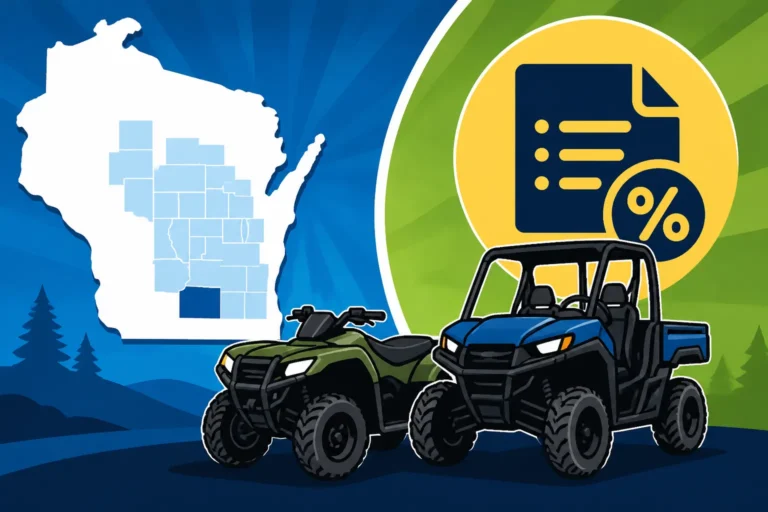
Wisconsin has a statewide sales tax that applies to most retail sales, including ATVs and UTVs. On top of that, many counties in Wisconsin have an additional county sales tax. This means the total sales tax you pay can vary depending on which county you live in, or where the machine will primarily be housed and registered.
You’ll pay the state sales tax no matter what. To figure out if your county has an additional tax, you'll need to check the Wisconsin Department of Revenue's website or simply ask the registration agent when you go to register. They will be able to tell you the exact percentage based on your registration address. It’s crucial to factor in both the state and any applicable county tax when budgeting for your used machine purchase. You can read more about this in our article [County Sales Tax on a Wisconsin Machine].
Here's a simplified look at how tax might vary:
| Location Example | State Sales Tax | County Sales Tax (Example) | Total Sales Tax Rate |
|---|---|---|---|
| Most of Wisconsin | X% | 0% | X% |
| Specific Counties | X% | Y% | (X+Y)% |
(Note: Actual percentages are omitted as per instructions, but the structure shows how it works.)
How to Pay the Tax
When you go to register your privately purchased ATV or UTV, either online through the Wisconsin DNR website or in person at a registration agent, you will be prompted to pay the sales tax. This is typically done at the same time you pay the registration fees and the [The $5 Wisconsin Transfer Fee]. You'll declare the purchase price on the registration application, and the system or agent will calculate the total sales tax due.
The DNR requires [Proof of Sales Tax Wisconsin Requires] has been paid before they will finalize your registration. This proof comes from their own collection system once you've made the payment. Make sure you have your bill of sale handy, as it's the primary document they'll use to verify the purchase price you declare. Don't leave the registration office until you're sure all taxes and fees are paid, otherwise, you could face delays or issues later.
Navigating the Paperwork: Your Bill of Sale and Proof of Tax Paid
Paperwork might not be the most exciting part of buying an ATV, but it's absolutely essential, especially when it comes to proving ownership and satisfying the state's tax requirements. A little effort here can save a lot of headaches later.
The Critical Role of a Bill of Sale
A detailed bill of sale is your best friend in a private ATV transaction. It's not just a formality; it's a legal document that protects both the buyer and the seller. For the buyer, it proves you legally purchased the machine, specifies the agreed-upon price (which is critical for sales tax calculation), and often lists the date of sale and the machine's VIN. Services like LawDepot can help you create a professional and legally sound bill of sale that covers all the necessary bases for Wisconsin transactions.
Without a solid bill of sale, you might struggle to prove the purchase price to the DNR, potentially leading to them assessing a higher value for sales tax purposes. It also helps clarify that the transaction was a sale and not, say, a gift, which can avoid scrutiny. We highly recommend reviewing our detailed guide on [What a Wisconsin ATV Bill of Sale Should Carry] to ensure you're including all the vital information. This document is a cornerstone for a smooth transfer of ownership and proper tax payment.
What Happens if You Don't Pay Sales Tax
Attempting to avoid sales tax on a private ATV purchase in Wisconsin can lead to significant problems. First and foremost, the DNR will likely refuse to register your machine until all outstanding taxes and fees are paid. This means you won't be able to legally ride on public trails or routes. Riding an unregistered ATV can result in fines and penalties, not to mention the potential liability if you're involved in an accident.
Furthermore, if the state discovers you intentionally misrepresented the purchase price to avoid sales tax, there could be additional penalties for tax evasion. It's simply not worth the risk. Paying the correct sales tax upfront is a small price to pay for legal peace of mind and the ability to enjoy your machine without worry. Honesty and transparency are always the best policies when dealing with state agencies.
Credit for Tax Paid to Another State
Sometimes, you might buy an ATV or UTV from a private seller in a neighboring state like Minnesota or Illinois, and then bring it into Wisconsin to register. In such cases, Wisconsin often provides a credit for sales tax you've already paid to that other state. This prevents you from being double-taxed on the same purchase.
To claim this credit, you'll need definitive proof that you paid sales tax in the other state. This usually means a receipt or a bill of sale from the out-of-state transaction clearly showing the sales tax paid. The amount of credit you receive will depend on the sales tax rate of the other state compared to Wisconsin's. If the other state's tax was less than Wisconsin's, you might still owe a difference. If it was more, you won't get a refund, but you won't owe any more to Wisconsin. For a full breakdown, check out our article on [Credit for Tax Paid to Another State].
Common Questions and Misconceptions
Buying a used ATV or UTV can feel like a maze, and the sales tax aspect is definitely one of the trickier parts. Let's tackle some common questions and clear up a few persistent misconceptions that often arise.
What if the Seller Lost the Registration Card?
This is a common scenario when buying a used machine from a private seller. Sometimes, the seller simply can't find the old registration card. While it certainly adds a layer of complication, it doesn't necessarily prevent you from registering the machine or paying your sales tax. You'll still need a valid bill of sale to prove your purchase and the price paid.
The DNR might have procedures for dealing with a missing registration card, often involving verification of the VIN and ensuring no outstanding liens or issues. You will still pay the sales tax based on your bill of sale, regardless of whether the previous registration card is present. It’s always best to ensure you are within the [Transferring a Wisconsin Registration Within Ten Days] window, even with a missing card, as penalties might apply if you exceed this period. If the seller lost the card, you can still proceed, but be prepared for a few extra steps at the DNR.
Why Some Private Sales Seem Tax-Free
You might hear stories from friends or neighbors who bought a used ATV privately and swear they never paid sales tax. This can be incredibly confusing and lead to the misconception that private sales are always tax-free. However, there are a few reasons why this might appear to be the case, and it’s important to understand the reality.
Sometimes, individuals might unknowingly fail to pay the tax. This doesn't mean the tax wasn't due; it just means it wasn't collected, and they could potentially face issues later if it's discovered. Another common reason is if the machine was genuinely a gift, as discussed earlier. Or, perhaps the person moved from a state with different rules. The point is, the expectation in Wisconsin for a transferable, registrable machine is that sales tax will be paid by the buyer at the time of registration. Don't let anecdotal evidence from others lead you astray; it's always best to operate under the assumption that the tax will apply.
Documenting a Low Sale Price or Trade-In
There are legitimate reasons why an ATV or UTV might sell for a lower price, or why a trade-in might be involved, reducing the cash portion of the transaction. Perhaps the machine needs extensive repairs, or it's an older model with limited value. If your purchase price is genuinely low, it's crucial to document this thoroughly on your bill of sale. Clearly state any known issues or conditions that justify the price. A detailed bill of sale, perhaps using a template from LawDepot, can include clauses about "as-is" sales and acknowledge the machine's condition.
For trade-ins, the sales tax is generally calculated on the difference between the selling price of the new machine and the value of the trade-in. However, in a private party sale, managing the trade-in value for sales tax purposes can be tricky, as there isn't a dealership to facilitate the exchange and document it for the state. If you traded another item, be sure its value is clearly outlined on the bill of sale for the ATV you purchased. This transparency helps avoid any suspicion of undervaluing the machine to minimize tax, protecting you if the DNR reviews the transaction. Remember, honesty in documentation is your best defense against potential inquiries.
Disclaimer
This article is for general informational purposes only and does not constitute professional advice. Laws, prices and regulations vary by location and change over time. Consult a qualified professional for guidance on your specific situation.