Wisconsin Safety Courses Online and In Person
Wisconsin riders may need a safety certificate before using public ATV trails or routes, but choosing a course can be confusing. Online and instructor-led options may both work when they meet state requirements. Here’s how to check eligibility, choose an approved course, finish the training and confirm your certificate before you ride.
What Wisconsin ATV safety courses are for
Wisconsin’s safety course teaches riders how to operate an ATV or UTV responsibly and understand rules that apply to riding. It is also the route to certification for riders who fall under the state’s safety-certificate requirement. The course is not a substitute for registration, a trail pass when one is required, or local rules about where and when you can ride.
Wisconsin generally requires people born on or after January 1, 1988, to complete an approved ATV safety course to operate on public ATV trails and routes. The details depend on the rider’s age, where the machine is being used and whether an exception applies. A certificate also does not give a young rider permission to operate a machine in places or circumstances restricted by age rules.
If you are unsure whether the rule applies to you, check Who Must Certify to Ride in Wisconsin and The January 1988 Birthdate Rule. These can help you identify the basic age and birthdate questions, but confirm current requirements through Wisconsin’s official ATV safety information before enrolling or riding.
A course may be available online or through an instructor-led class. The key is not the format by itself: it is whether the course is approved for Wisconsin certification and whether you complete every required step. A general ATV video, a manufacturer’s tutorial or a course that only issues a certificate for another state may not meet Wisconsin’s requirements.
| Course format | Best suited to | What to confirm |
|---|---|---|
| Online | Riders who need flexible scheduling and can study independently | That the provider and course are accepted for Wisconsin certification, and whether any additional steps apply |
| Instructor-led | Riders who learn better with a teacher, discussion and group activities | That the class is an approved Wisconsin course and that you know its location, schedule and completion requirements |
| Either format | Riders focused on getting a valid certificate | That your personal information is recorded correctly and you can retrieve proof of completion |
Training is worthwhile even when a rider is not legally required to hold a certificate. A machine can accelerate quickly, handle differently on loose ground than on pavement, and carry a passenger or cargo in ways that change its stability. Knowing how to inspect it, manage speed and respond to hazards makes a real difference.
For a closer look at who must certify and what proof to carry, see Wisconsin’s ATV Safety Certificate Requirement and Wisconsin ATV Safety Certificate Requirements.
Taking a Wisconsin course online
An online course can suit a rider with a busy schedule, a long drive to a classroom or a preference for working through material at their own pace. It may also be easier for a parent or guardian to help a young rider review the material and plan the next step. Convenience, however, is not a reason to skip provider checks.
Start with Wisconsin’s official course information or the state’s listed course providers. Confirm that the exact course you are about to take is approved for Wisconsin ATV safety certification. A provider may offer multiple courses for different states or purposes, and a course with a similar name is not automatically interchangeable.
The phrase “online course” can mean different things. Some courses are completed entirely online. Others may use online instruction but include an additional requirement, such as a scheduled assessment or contact with an instructor. Read the course description carefully and check what successful completion means before paying or beginning. If the provider is unclear about whether it leads to a Wisconsin certificate, contact the provider or the state program before proceeding.
Before you enroll
Use this checklist to avoid common problems:
- Check the provider’s approval. Look for the course in Wisconsin’s official safety-course information, not just in a search result or advertisement.
- Confirm the course is for ATV safety. A general off-road course, UTV orientation or safety video may not be the certification course you need.
- Review the completion steps. Find out whether there is a final test, a minimum age, an identity check or any follow-up requirement.
- Check what proof you receive. Confirm whether completion is reported to the state, whether you receive a certificate or card, and how to access it later.
- Use accurate personal details. Enter the rider’s legal name and other requested information carefully. A typo can make a record harder to locate or correct.
- Review the current cost with the provider. Providers set their own charges and policies; check the current terms directly before enrolling.
Do not assume that a certificate shown immediately on a website is valid for Wisconsin simply because it looks official. The provider and course must be appropriate for the state’s requirements. If you find an online course through a marketplace or an advertisement, verify it independently against Wisconsin’s official information. A manual or study aid sold on Amazon may help someone review basic ideas, but buying one is not the same as completing an approved course.
Make online study work
Online learning requires more than clicking through screens. Give the rider enough time to read the material, work through the examples and understand the explanations. Rushing through a lesson to reach the quiz can leave gaps that matter once a machine is moving.
Choose a quiet place, keep a notebook nearby and pause when a rule or technique is unfamiliar. If a young rider is taking the course, an adult can help with setup and discuss the material without taking the course or test for them. The rider should understand the material and complete any required assessment independently according to the provider’s rules.
Topics may include safe riding practices, basic machine controls, protective equipment, trail awareness and ways to avoid common collisions or loss-of-control incidents. Treat those lessons as practical preparation rather than a box to check. A course cannot teach every detail about a particular machine, so read the owner’s manual and learn the controls before a first ride.
For a step-by-step look at the online option, see Taking the Wisconsin Course Online.
Taking an instructor-led course
A classroom or instructor-led course can be a better fit for riders who prefer to ask questions as they go. It gives learners a chance to hear explanations, discuss examples and learn alongside other riders. Depending on the class, an instructor may be able to clarify how a safety principle applies to a particular situation.
Classes vary in schedule, location and format. Some may be offered in a traditional classroom; others may combine instruction with different learning activities. Don’t rely on an old event listing or assume a class is still running. Check the current schedule and course details through the approved provider or Wisconsin’s official course information.
Before registering, ask what the rider must bring, how attendance is recorded, whether the entire class is required, and what happens if a session is missed. If the rider is a minor, check whether a parent or guardian must register, give consent or attend. Follow the provider’s instructions rather than guessing.
A classroom course is not necessarily a practical driving test. The class format and course requirements determine what activities are included. Ask the instructor or provider what the course covers and whether additional machine-specific practice is recommended. Even a classroom certificate does not mean a rider is ready to handle every ATV or UTV in every terrain condition.
What to bring and how to prepare
Follow the provider’s directions first. If the class requires paperwork, registration confirmation or a parent’s consent, organize those before the session. Arriving prepared helps the rider focus on the material rather than sorting out administrative issues at the door.
Encourage the learner to ask questions. Useful topics include how to select protective gear, what to check before starting a machine, how passengers affect handling, and how to respond when visibility or traction changes. It is reasonable to ask the instructor which rules apply to public trails, routes or other riding areas, but local ordinances and land-manager rules may still need separate checking.
If the course includes a practical component, use only the machine and equipment specified by the instructor. Do not bring a machine or attempt a demonstration unless the provider has requested it and explained the safety requirements. A course should be conducted under the provider’s procedures, not improvised by participants.
An instructor-led class may take more coordination than online study because the rider must be available at a set time and travel to the location. In return, the opportunity to ask questions in real time can be valuable, especially for new riders or families learning together. Details about classroom options are covered in Wisconsin Hands-On Safety Classes.
How to choose the right format and complete certification
The best course format is the one the rider can complete carefully while meeting Wisconsin’s requirements. A self-directed online course can be efficient for someone comfortable reading and studying independently. An instructor-led course can be preferable if the rider benefits from discussion or needs more structure.
Think about the learner, not just the calendar. A younger rider may need an adult’s help staying focused online, while an adult who has questions may find a classroom more useful. Someone with limited internet access may prefer a scheduled class. A rider with transportation constraints may find the online option easier, provided it is approved and all requirements can be completed remotely.
Use this sequence to keep the process straightforward:
- Determine whether a certificate is required. Consider the rider’s birthdate, age and intended riding location. If the situation is not clear, ask the state program or check official guidance.
- Choose a Wisconsin-accepted course. Verify the provider and the exact course, not only the provider’s name.
- Read all requirements before starting. Check age rules, parent or guardian steps, the format, any assessment and how completion is documented.
- Complete the course honestly and thoroughly. The rider should do the lessons and assessment personally and follow provider instructions.
- Save proof of completion. Keep the certificate or other official record where it can be found later. Store a digital copy securely and follow any directions for carrying or presenting proof.
- Resolve record problems promptly. If the name is wrong, the record cannot be found or the expected certificate does not arrive, contact the provider before assuming the issue will correct itself.
- Check the riding rules separately. Confirm registration, pass, age, supervision and local access requirements for the place you plan to ride.
A completed course addresses only the training requirement. It does not automatically register a machine, authorize use on a particular trail, or replace a required trail pass. Riders planning a trip can review What Wisconsin Riders Need Before They Ride for the other requirements to check.
How families can support a young rider
A parent or guardian can help a young rider select the right course, enter information correctly and understand why the rules matter. The adult should not answer test questions for the learner or complete lessons in their place. The purpose is to build knowledge the rider can use, not simply produce a certificate.
Talk about the machine the young person will actually use. A youth ATV and a full-size UTV are not interchangeable in size, controls or weight. Before a first ride, review the owner’s manual, practice the controls in a suitable safe area and establish clear limits for speed, terrain and supervision.
Certification does not override minimum-age or supervision rules. Check Wisconsin Age Rules for ATVs and UTVs and Wisconsin Rules for Riders Aged 12 to 15 when a young person will be riding. The course is one part of a larger safety plan that includes choosing an appropriate machine, protective gear and adult oversight where required.
After the course: certificate, reciprocity and riding readiness
When the course is complete, save the certificate and make sure you know how to retrieve the record. Follow the provider’s instructions about whether completion is sent to Wisconsin or whether the rider must take another step. Do not assume that an email receipt, payment confirmation or screen showing a passing score is the same as official proof of certification.
If the certificate is lost, first contact the course provider or use the official process for retrieving or replacing a record. Keep identifying details consistent when making a request. For information on whether the credential remains valid over time, see Does a Wisconsin Certificate Expire?.
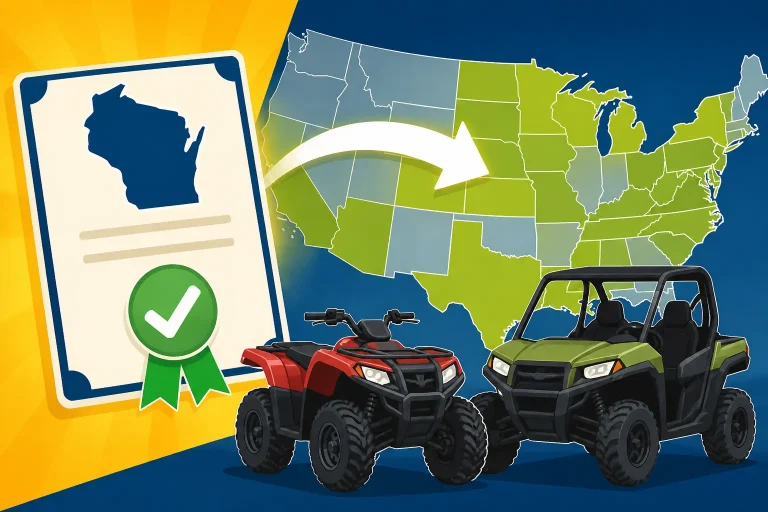
Riders who completed training elsewhere should not assume every out-of-state card automatically qualifies. Acceptance depends on Wisconsin’s rules and the type of credential. Check Out-of-State Certificates Wisconsin Accepts before relying on a certificate from another state, an employer or a private training program.
Before each ride, do a separate readiness check:
- Confirm the machine is properly registered for its intended use.
- Check whether a trail pass or another permit is needed for the area.
- Review age and supervision requirements for every operator and passenger.
- Read local rules for routes, hours and insurance, where applicable.
- Inspect the machine, tires, brakes, lights and controls.
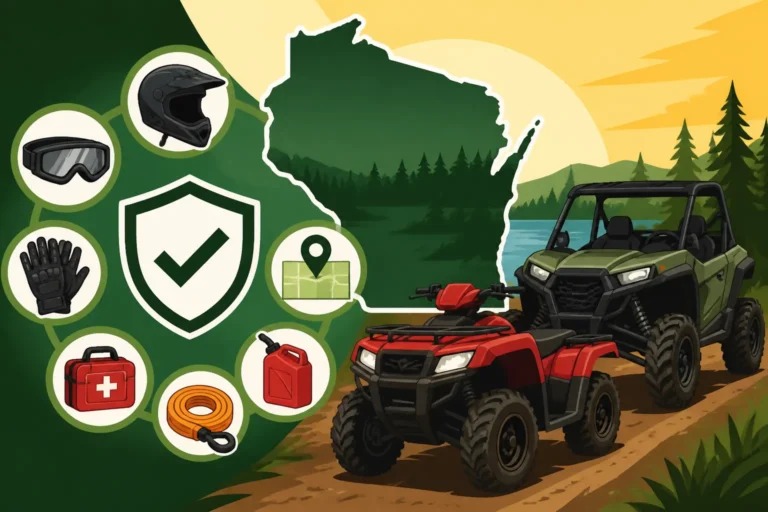
- Wear appropriate protective equipment and make sure it fits.
- Plan the route and check for closures or changing conditions.
A safety course helps a rider make better decisions, but it cannot predict every hazard. Trails can change after rain, visibility can drop at dusk, and a passenger or load can affect handling. Begin with terrain suited to the rider’s skill, leave room to stop and avoid pushing beyond what the machine or operator can safely manage.
Frequently Asked Questions
Is an online course accepted in Wisconsin?
An online course can qualify when it is an approved option for Wisconsin certification and the rider completes all required steps. Verify the specific course through Wisconsin’s official information or an approved provider before enrolling.
Is a classroom course better than an online course?
Neither format is automatically better for everyone. Online study offers flexibility, while an instructor-led class offers direct discussion and a set learning schedule. Choose the format that helps the rider understand and complete the material.
Does taking a course mean I can ride anywhere in Wisconsin?
No. Certification does not replace registration, required passes, age restrictions, supervision rules or local access requirements. Check the rules for the specific trail, route or land where you plan to ride.
Does a certificate from another state count?
It may, but do not assume it does. Confirm that Wisconsin accepts the specific credential before relying on it.
What should I do if my certificate is missing?
Contact the course provider or follow the official process for locating or replacing the record. Keep course details and the rider’s personal information available when making the request.
Disclaimer
This article is for general informational purposes only and does not constitute professional advice. Laws, prices and regulations vary by location and change over time. Consult a qualified professional for guidance on your specific situation.