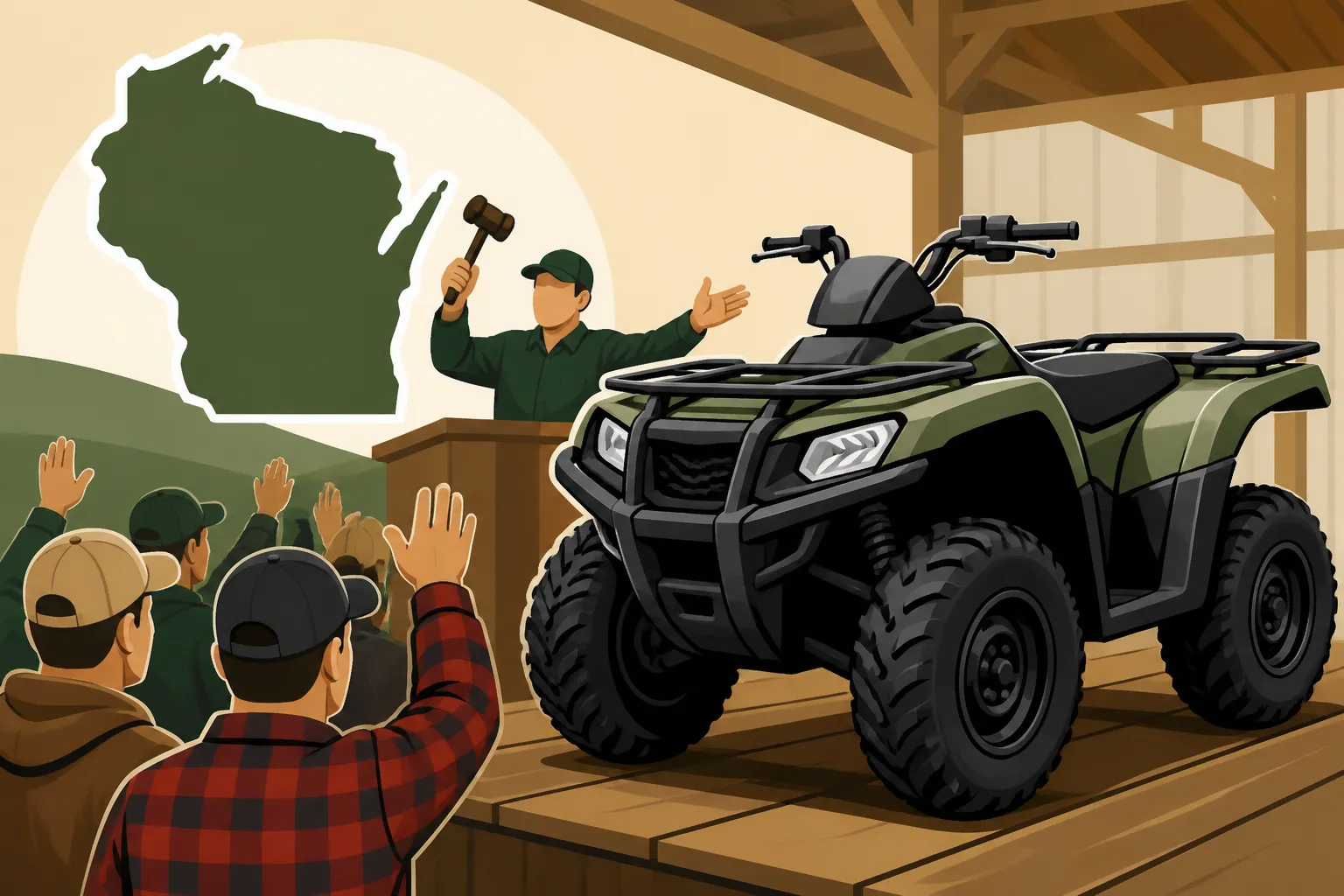
Buying a Quad at a Wisconsin Farm Auction
Buying an ATV or UTV at a Wisconsin farm auction can feel like hitting the jackpot – the thrill of the chase, the possibility of a bargain, and the unique finds are incredibly enticing. But let's be realistic: it's also a minefield of potential problems, from questionable machine history to missing paperwork. This guide is all about helping you understand the landscape of farm auctions for off-road vehicles in Wisconsin, what to look out for, and how to navigate the paperwork maze so you don't end up with a yard ornament instead of a trail machine.
The Allure and Reality of Farm Auctions for ATVs and UTVs
There's something uniquely Wisconsin about a farm auction, isn't there? The crisp air, the auctioneer's rapid-fire chant, the promise of finding that perfect piece of equipment that's been faithfully serving a local farm for years. When it comes to ATVs and UTVs, these auctions hold a special kind of appeal, especially for those looking for a workhorse rather than a pure sport machine.
Why Auctions Can Be So Appealing
First off, the potential for a really good deal is a huge draw. Unlike a dealership with fixed prices and overhead, or even a private sale where a seller might be firm on their asking price, an auction often feels like a true market value discovery. You might stumble upon a well-maintained utility quad or a sturdy side-by-side that was used for chores around a farm, meaning it might have lower recreational miles than a trail-ridden machine. These machines are often built for durability, focusing on towing capacity, cargo space, and reliability, which can make them ideal for hunting, property maintenance, or even just getting around a larger piece of land.
The variety can also be surprising. You might find older models that are no longer manufactured but are still perfectly capable, or specific farm-spec machines with unique attachments that would be hard to find elsewhere. For many, it's also the thrill of the hunt – the anticipation of uncovering a hidden gem, a machine that just needs a little TLC to bring it back to its prime, all while soaking in the atmosphere of a community event. It taps into that resourceful, DIY spirit many Wisconsin riders share.
The "Buyer Beware" Nature of Auction Purchases
Now, let's pull back the curtain a bit and talk about the realities. That old adage, "buyer beware," was practically invented for auctions. When you buy an ATV or UTV at a farm auction, you're almost always doing so "as-is, where-is." This means there's typically no warranty, no returns, and very limited recourse if something goes wrong after you've hauled it home. Unlike a dealership where you might get a limited warranty or a private seller who might offer some guarantees, an auction is usually final the moment the hammer drops.
One of the biggest frustrations is the inability to conduct a thorough inspection or, often, even a test ride. You might get a few minutes to look the machine over, start it up if you're lucky, but you won't be able to put it through its paces. This means you're often relying on visual cues and the seller's (or auctioneer's) limited description. There's also the emotional factor; it's easy to get swept up in the bidding process, especially when you feel like you're close to a good deal. That adrenaline can sometimes override careful judgment, leading to overlooking potential red flags that you might have spotted in a calmer, private viewing. Without a detailed ownership history, you're also taking a leap of faith on how the machine was maintained, if it was involved in any accidents, or if it has any outstanding mechanical issues that aren't immediately apparent.
Essential Pre-Auction Homework and On-Site Inspection
Going into a farm auction unprepared when you're hoping to score an ATV or UTV is like heading out on a new trail without a map – you might get lucky, but you're more likely to get lost. A little homework before you even set foot on the auction grounds, and a focused approach once you're there, can save you a lot of heartache and money.
Researching the Auction and Seller (When Possible)
Before auction day, your first stop should be the auction house's website or their catalog. Many reputable auctioneers in Wisconsin will post a list of items, often with photos and basic descriptions, days or even weeks in advance. Look for details on the ATVs or UTVs being offered. Does the description mention the make, model, year, or engine hours? Is there any information about the seller? Sometimes, auction houses will indicate if the machine is coming from a known estate or farm. This pre-information is gold. It allows you to do a quick online search for common issues with that particular model, typical resale values, and even parts availability.
It’s also crucial to understand the auction's terms and conditions. What are the payment methods accepted? When is payment due? Is there a buyer's premium (an extra fee added to the hammer price)? When do you need to pick up the machine? These are all important budget considerations. If the VIN is listed in the catalog, try to run a quick check for theft records. There are online services that can help with this, giving you a bit more peace of mind before you even see the machine in person. However, getting this information pre-auction isn't always possible, but it's always worth trying to [Running a Used Quad Past Theft Records] if you can.
Your Limited Window for Inspection at the Auction Site
Once you're at the auction, your time to inspect the machine will be limited – sometimes just a few minutes before the bidding starts. Make the most of it. This isn't the time for a leisurely stroll; it's a focused mission. Start with a visual once-over: Look for obvious signs of damage, cracks in plastics, bent frames or components, and any repairs that look hasty or unprofessional. Check for fluid leaks around the engine, transmission, and differentials – fresh puddles or dark, crusty residue are definite red flags.
Next, focus on the tires. Are they worn evenly? Are there any significant gouges or cracks? Uneven wear can indicate suspension issues or a frame that's out of alignment. Briefly check the suspension components – look for bent A-arms, leaky shocks, or excessive play in wheel bearings. Move on to the drivetrain: check the condition of the drive shaft boots (if applicable) for tears, which can lead to costly CV joint repairs.
Locate the VIN (Vehicle Identification Number). It's typically stamped on the frame, often near the front left wheel, or sometimes on the engine casing. It's good to know [Where the VIN Sits on a Utility Quad] for common models. Make sure it's clear, legible, and doesn't appear tampered with. This VIN is critical for future registration. If possible, ask if you can attempt to start the engine. Listen for any knocking, ticking, or grinding noises. Does it blow excessive smoke? Does it idle smoothly? Keep in mind that auction rules might prevent starting machines, so be prepared for that limitation. This limited inspection means you really need to be disciplined. Don't let the excitement of the auction make you overlook critical details. Stay calm, stick to your checklist, and be prepared to walk away if the risks seem too high.
The Critical Paperwork: What You Should Expect (and What You Might Not Get)
This is where buying an ATV or UTV at a Wisconsin farm auction can get really tricky, and it's often the biggest source of frustration for new owners. Wisconsin has unique rules for off-road vehicle ownership that differ significantly from cars and trucks, and auctions often add another layer of complexity.
Understanding Wisconsin's ATV Ownership Rules
Here’s the first, and perhaps most important, piece of information for any ATV or UTV buyer in Wisconsin: The state of Wisconsin does not issue titles for ATVs or UTVs. I know, it sounds wild, especially if you're used to buying cars, but it's true! This is a common point of confusion, and it means you won't be receiving a "title" in the mail for your new-to-you quad. The primary document of ownership that usually transfers from seller to buyer is the current Wisconsin DNR registration card. This card holds the machine's VIN, the owner's name, and the registration expiration date. So, when you're looking at a machine, you want to know if it has a current or recently expired registration. This card is usually [What a Wisconsin ATV Seller Must Give the Buyer] in a private sale.
For a machine purchased at an auction, the ideal scenario is that the previous owner has provided the auction house with the registration card. The auction house would then give it to you as the buyer. This card acts as your proof of previous registration and simplifies the transfer process considerably. However, the reality at auctions is often far from ideal. You might find a machine that has never been registered, or the previous owner lost the card, or the machine has been off the trails and unregistered for years. Each of these scenarios presents its own set of hurdles for you, the new owner.
What to Do If the Seller Has No Registration Card
So, what if you win the bid, and the auctioneer hands you a receipt but no registration card? This is a very common situation and can be a headache. Since Wisconsin doesn't title ATVs, if there's no registration card, you're essentially left with a strong need for [Proof of Ownership Without a Title]. This is where a robust bill of sale becomes absolutely crucial. A simple auction receipt might not contain enough detail to satisfy the DNR or future buyers.
You absolutely need a comprehensive [What a Wisconsin ATV Bill of Sale Should Carry] that clearly states:
- The full names and addresses of both the seller (or auction house representative) and the buyer.
- The complete and accurate Vehicle Identification Number (VIN) of the ATV or UTV. Double-check this against the machine itself before you leave the auction.
- The make, model, and year of the machine.
- The purchase price.
- The date of the sale.
- A clear statement that the machine is sold "as-is, where-is" with no warranties, but also a statement that the seller is transferring all rights of ownership to you.
- Signatures of both the seller (or authorized auction house representative) and the buyer.
For situations like this, especially when you need to cover all your bases, I always recommend using a reliable template to ensure you haven't missed any vital information. Services like LawDepot offer excellent, customizable bill of sale templates that can be incredibly helpful for private transactions or to formalize an auction purchase where the paperwork is sparse. Having a legally sound bill of sale goes a long way in proving ownership to the Wisconsin DNR when you go to [Registering an ATV in Wisconsin], especially if the machine hasn't been registered in years or the previous card is missing. Without a clear chain of ownership, you could face significant delays or even refusal to register, turning your bargain into a very expensive paperweight.
Post-Auction Registration and Sales Tax
Once you have your bill of sale and, hopefully, the old registration card, the clock starts ticking. In Wisconsin, you generally have ten days to [Transferring a Wisconsin Registration Within Ten Days] to your name. This is an important deadline to meet. You can typically do this online through the Wisconsin DNR website, or by visiting a local registration agent.
Even though you bought the machine at an auction, you are still responsible for paying [Wisconsin Sales Tax on an ATV Purchase]. The sales tax is typically 5% of the purchase price, plus any applicable county sales tax, which varies by county. You’ll need to provide [Proof of Sales Tax Wisconsin Requires] when you register the machine. If you bought it from an auction house that collected sales tax, your receipt should clearly show this. If it was a true private party sale facilitated by an auction (which is less common for machinery but can happen), or if the auction house didn't collect tax for some reason, you'll be responsible for reporting and paying the sales tax directly to the Wisconsin Department of Revenue. This is a crucial step that often catches people off guard when buying at auction.
The entire process of getting your new machine legally ready to ride in the Badger State involves understanding these steps. The Wisconsin DNR has clear guidelines for [Wisconsin DNR ATV Registration Explained], and familiarizing yourself with these will make the post-auction process much smoother. Don't let the excitement of the auction make you forget these critical administrative steps; they're just as important as the purchase itself!
Navigating the Purchase and Beyond
Congratulations, you've won the bid on an ATV or UTV at a Wisconsin farm auction! The hammer has fallen, and that machine is officially yours. But the journey isn't over yet. There are immediate next steps to secure your purchase and, just as importantly, plans to make for what happens once you get it home.
Securing Your Purchase and Payment
Most farm auctions operate on a strict payment schedule. You'll typically be expected to pay for your machine in full, often on the same day as the auction or within a very short timeframe. Make sure you understand the accepted payment methods beforehand – often it's cash, certified check, or a wire transfer. Personal checks might be accepted from known buyers, but don't count on it unless you've made prior arrangements. Get a detailed receipt or invoice from the auction house that clearly shows the purchase price, any buyer's premium, and the total amount paid. This document is vital as proof of payment and ownership.
Once paid, you'll need to arrange for transport. ATVs and UTVs are not light, and unless you have a trailer and the right tie-downs, you might need to arrange for a friend with suitable equipment or even a professional hauler. Make sure your tie-downs are secure; those Wisconsin roads can be bumpy, and you don't want your new acquisition shifting around on the way home. It’s a good idea to bring some basic tools with you to the auction site, like a wrench set or ratchet straps, just in case you need to adjust anything for transport or secure loose parts.
What Happens After You Bring It Home?
The moment your new-to-you ATV or UTV rolls off the trailer at home, the real work (and fun!) begins. Assuming you've navigated the registration paperwork, your first priority should be a thorough mechanical inspection and basic maintenance. Remember, you likely couldn't do a full inspection at the auction, so now is the time to go through everything.
Start with all the fluids: check the engine oil, transmission fluid, differential fluids, and coolant. It's often a good practice to just change them all, along with the oil filter, air filter, and fuel filter, especially if you don't know the machine's maintenance history. This fresh start gives you a baseline. Inspect the brakes, tires, battery, and all the lights. Check for any loose bolts or connections. You might also want to consult a service manual for the specific make and model to understand recommended maintenance intervals and common issues.
Budgeting for unexpected repairs is also crucial. That "great deal" at the auction can quickly become less great if you immediately need to replace a set of tires, fix a leaky seal, or address an electrical issue. Having a contingency fund for these initial post-purchase expenses is a smart move.
Finally, don't forget about protection once it's running smoothly. While Wisconsin doesn't mandate ATV insurance statewide, some municipalities or trail systems might require it. Plus, having your machine covered against theft, damage, or liability is just plain common sense. Take the time to get quotes and consider [Insuring an ATV in Wisconsin] as soon as possible. The peace of mind alone is worth it, allowing you to focus on enjoying your new off-road adventures instead of worrying about "what if."
| Feature/Consideration | Dealer Purchase | Private Sale | Farm Auction |
|---|---|---|---|
| Price Potential | Fixed, higher | Negotiable | Highly variable, potential for bargain or overpay |
| Pre-Purchase Inspection | Thorough, often with technician access | Limited but usually a test ride | Very limited, "as-is" |
| Warranty/Recourse | Often limited new, none used | None, "as-is" | None, "as-is" |
| Machine History | Often available, some certifications | Relies on seller honesty | Often unknown, minimal info |
| Paperwork Certainty | Dealer handles registration/tax | Varies, buyer responsible for transfer/tax | Often challenging, requires buyer vigilance |
| Sales Tax | Collected by dealer | Buyer pays DOR directly | Varies, depends on auction house |
| Initial Maintenance | Often inspected/serviced | Varies, buyer's responsibility | Highly recommended, buyer's responsibility |
| Emotional Factor | Low pressure | Moderate | High, can lead to impulsive decisions |
Disclaimer
This article is for general informational purposes only and does not constitute professional advice. Laws, prices and regulations vary by location and change over time. Consult a qualified professional for guidance on your specific situation.