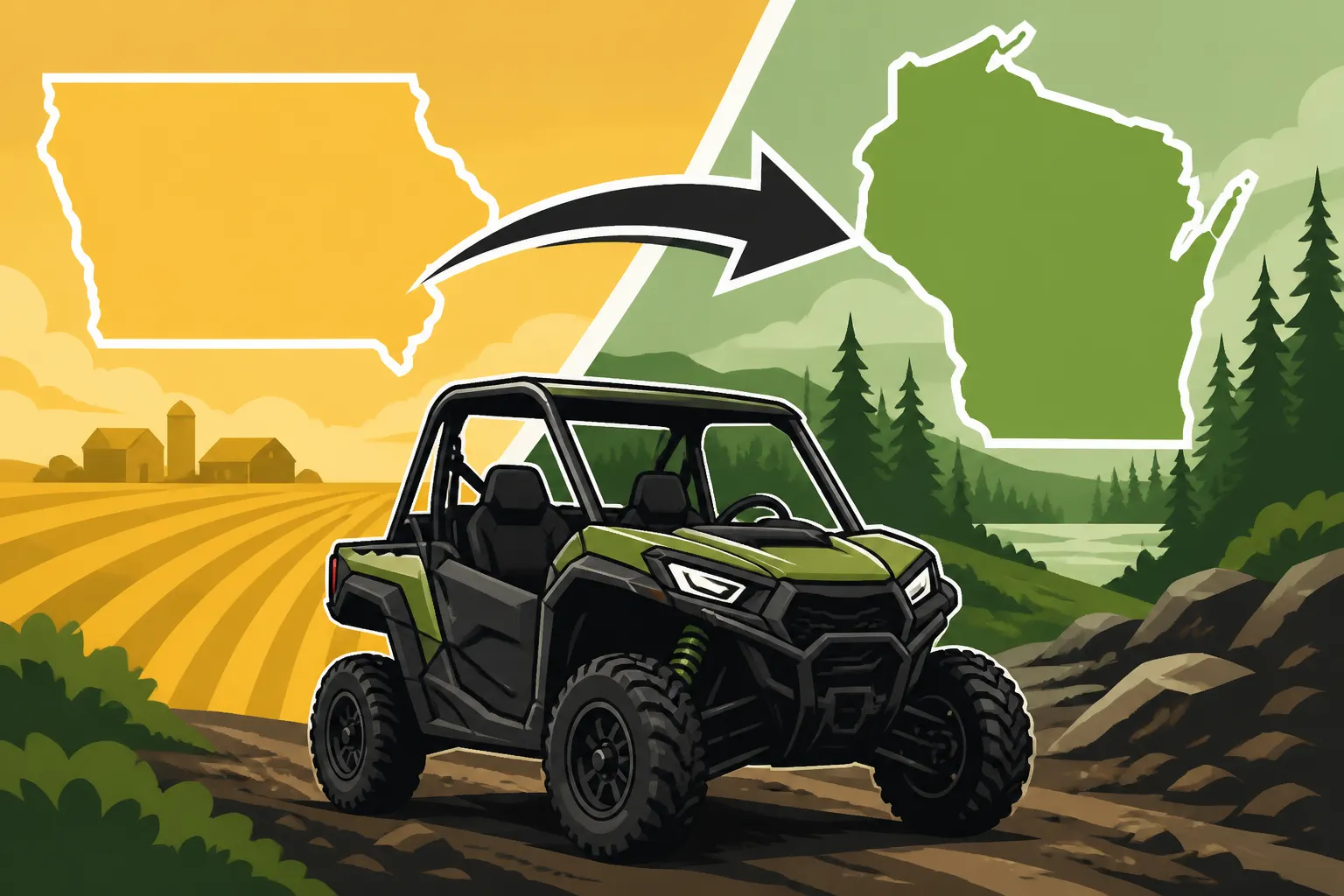
Bringing an Iowa Machine to Wisconsin
Moving your ATV or UTV from Iowa to Wisconsin can feel like navigating a maze of paperwork and rules, especially when you're used to one state's system only to find another's is completely different. Many riders get frustrated trying to figure out if their Iowa title or registration is even relevant in the Badger State. This comprehensive guide will walk you through the specifics of what you need to do when bringing an Iowa machine to Wisconsin, covering everything from sales tax to the necessary forms and where to get those essential decals.
Understanding Wisconsin's Registration System for Out-of-State Machines
One of the biggest hurdles for riders coming from states like Iowa is the fundamental difference in how Wisconsin handles ATV and UTV ownership. Many states issue titles for these machines, similar to cars or trucks, which serves as clear proof of ownership. Wisconsin, however, operates on a registration-only system, which can initially throw a lot of people off.
Why Wisconsin's System is Different
Unlike Iowa, which typically titles ATVs and UTVs, Wisconsin does not issue titles for these off-road vehicles. This means you won't be looking for a new title certificate when you bring your machine here; instead, you'll be focusing solely on registration. For someone accustomed to a title, this can feel a bit unsettling, as the piece of paper that usually signifies ownership simply doesn't exist in the same way here. This difference is largely historical, stemming from how ATVs were initially regulated in the state. Don't let it confuse you – the state relies on a robust registration system combined with other proofs of ownership, like a bill of sale, to track who owns what. If you're curious about this unique approach, you might want to read more about [Why Wisconsin Does Not Title ATVs].
Wisconsin also differentiates between how you plan to use your machine, which dictates the type of registration you'll need. There's a specific registration for public use, which allows you to ride on designated trails and routes, and another for private use, typically for machines that will primarily stay on private property or be used for agricultural work. It's really important to understand which one applies to you, as they have different fees and requirements. We'll dive into the nuances of each, but for a quick overview, you can check out [Wisconsin's Public Use ATV Registration] and [Wisconsin's Private Use ATV Registration].
The Process for New Wisconsin Residents
So, you've moved from Iowa to Wisconsin, and your beloved ATV or UTV has come with you. Now what? The state gives you a specific window to get your machine registered once you establish residency. It's not something you can put off indefinitely without potentially running into issues. The first step is to gather your proof of ownership from Iowa – this will likely be your Iowa registration card and a bill of sale, especially if you purchased it there.
You'll then need to complete a Wisconsin ATV/UTV registration application. This form is fairly straightforward, asking for details about your machine, its Vehicle Identification Number (VIN), and your personal information. You can typically find these forms online on the Wisconsin Department of Natural Resources (DNR) website or pick one up at a DNR service center or an authorized registration agent. When you go to register, these agents are looking for specific documents to ensure everything is above board. To be fully prepared, it's a good idea to know exactly [Documents a Wisconsin Agent Wants] before you head out. Being organized can save you a lot of time and a second trip!
Navigating Sales Tax When Bringing an Iowa Machine to Wisconsin
One of the trickiest parts of bringing a vehicle from out of state, be it an ATV or a car, is dealing with sales tax. It's a common point of frustration for new residents, as they often feel like they're paying tax twice or simply didn't anticipate the additional cost. Wisconsin has specific rules about sales tax on vehicles brought into the state, even if you paid tax in Iowa.
Wisconsin's Sales Tax Requirements
The general rule in Wisconsin is that if you're going to register and operate an ATV or UTV in the state, you'll need to pay Wisconsin sales tax. This applies even if you bought the machine in Iowa. Wisconsin's state sales tax rate applies to the purchase price of the machine. Let's say you bought your side-by-side in Des Moines for a certain price; Wisconsin will apply its sales tax rate to that same purchase price, regardless of where the transaction took place, provided you haven't met certain exemptions or paid an equivalent tax elsewhere.
On top of the state sales tax, many counties in Wisconsin also impose a local sales tax. This means the total tax you pay could be slightly higher depending on which county you live in or where you register the machine. It's essential to factor this into your budget when you're planning to register. The specific county tax rates can vary, so it's worth checking this out beforehand. For more information on how this might affect you, you can look into [County Sales Tax on a Wisconsin Machine]. It’s a detail that often surprises people, so being prepared for it is always a good idea.
Getting Credit for Tax Paid in Iowa
Here's the good news: Wisconsin generally provides a credit for sales tax you've already paid to another state on the same machine. This means you won't necessarily be paying the full Wisconsin sales tax rate if you can prove you already paid a sales tax in Iowa. This is a common practice across states to prevent double taxation on large purchases. To claim this credit, you'll need solid documentation of the sales tax you paid in Iowa. This usually comes in the form of your original bill of sale from the dealer or seller, clearly showing the sales tax itemized and paid.
However, there's a catch. If the sales tax rate you paid in Iowa was lower than Wisconsin's combined state and county sales tax rate, you'll typically owe the difference to Wisconsin. For example, if you paid 5% sales tax in Iowa, but Wisconsin's combined rate is 5.5%, you would owe that remaining 0.5% difference to Wisconsin. It's not about paying the full amount again, but rather ensuring you've met Wisconsin's minimum tax obligation. This can be a bit confusing, but the DNR and authorized agents can help calculate this for you. Understanding [Credit for Tax Paid to Another State] is key to avoiding overpayment or unexpected charges.
Essential Paperwork and Practical Steps
Getting your Iowa machine registered in Wisconsin requires a bit of legwork and gathering the right documents. It's not just about filling out a form; it's about proving ownership, demonstrating tax compliance, and making sure all the necessary information is accurately recorded.
What You'll Need for Registration
First and foremost, you'll need strong proof of ownership. Since Wisconsin doesn't title ATVs, your Iowa title, while useful as a historical document, isn't what the state will primarily rely on for new registration. Instead, focus on your Iowa registration card and, most critically, a detailed bill of sale. This bill of sale should clearly list the buyer and seller, the purchase price, the date of sale, and the Vehicle Identification Number (VIN) of the machine. This document acts as your primary proof that you legally acquired the ATV or UTV.
You'll also need proof that you've paid sales tax (or be prepared to pay it) as discussed above. This might be a receipt from the Iowa Department of Revenue or an itemized dealer invoice. The Wisconsin registration application form will be required, and it's essential to have your machine's VIN on hand, as this is how the state uniquely identifies it. Sometimes, a physical VIN verification might be required, but often, just providing the number on the application is sufficient. If you ever find yourself needing to create or update official documents for private sales or transfers, resources like LawDepot can be incredibly helpful for drafting a clear, legally sound bill of sale that includes all these vital details. They offer templates that ensure you don't miss anything important, making your life easier down the line.
Where to Register and What to Expect
Once you've got all your ducks in a row with the paperwork, it's time to actually register. You have a few options for where to do this. The most convenient for many is often online through the Wisconsin DNR website, which allows you to complete the application and pay fees electronically. This is usually the quickest way to get things done, provided you have all your information ready. You can learn more about this process by checking out [Registering Through the Wisconsin DNR Website].
Alternatively, you can visit a DNR service center in person or go to one of the many authorized registration agents located throughout the state. These agents are typically dealerships, bait shops, or sporting goods stores that are equipped to handle registration transactions. They can process your application, collect fees, and often issue temporary documentation on the spot. Be prepared to pay the applicable registration fees. If you plan to ride on public trails, you'll need to pay the [Wisconsin ATV Registration Fee for Public Use]. If your machine is strictly for private property use, there's a [Wisconsin Private Use Registration Fee]. Once your registration is processed, you'll receive your registration card and, most importantly, the decals that need to be affixed to your machine. Make sure you understand [Sticker Placement on a Wisconsin Machine] so you put them in the correct spot to avoid any issues with wardens.
Avoiding Pitfalls and Common Questions
Bringing an out-of-state machine to Wisconsin comes with its own set of potential headaches if you're not careful. Many riders make common mistakes that can lead to fines, delays, or unnecessary stress. Being aware of these pitfalls can save you a lot of trouble.
Common Mistakes to Avoid
One of the biggest blunders new Wisconsin residents or frequent visitors make is not understanding the distinction between public and private use registration. If you register your machine for private use, but then take it out on a public trail system, you are essentially riding an unregistered machine in the eyes of the law. This can lead to citations and penalties. It’s crucial to know exactly [Public Use Versus Private Use in Wisconsin] and register accordingly, based on your actual riding habits. Don't assume that because it's registered at all that it's good for public trails.
Another frequent error is delaying the registration process. Wisconsin has specific timelines for new residents to register their machines. Putting it off can result in [Penalties for an Unregistered ATV in Wisconsin]. These fines can be steep, and it's simply not worth the risk. Make it a priority as soon as you settle in or decide your Iowa machine will be primarily used in Wisconsin. Finally, overlooking sales tax differences can lead to unexpected costs. Many assume that because they paid tax in Iowa, they're all set. As we've discussed, this isn't always the case, and you might owe a small difference. It's much better to clarify this upfront than to be surprised at the registration counter.
What if I Only Ride on Private Land?
This is a question I hear all the time: "If my ATV never leaves my own land or my friend's private property up north, do I still need to register it?" The answer, in most cases, is yes, you still need a private use registration. While it might seem counterintuitive to register a machine that stays off public trails, Wisconsin law generally requires all ATVs and UTVs operated in the state to be registered, regardless of where they are used, with very few exceptions (like certain farm implements under specific conditions).
Even if you only ride on your own sprawling property, a private use registration covers you. This becomes especially important if you ever need to cross a public road or drive a short distance on a shoulder to get from one section of your land to another, or to access a neighboring private property with permission. Without at least a private registration, you could still be subject to fines. Furthermore, having a current registration also serves as part of your proof of ownership, which can be invaluable in situations like insurance claims or if your machine is ever stolen. Using a reliable resource like LawDepot to keep your personal records—such as a detailed bill of sale—organized can be very helpful here, even for machines that rarely leave private property, as it solidifies your ownership documentation alongside the state registration. This helps clarify [Registering a Machine That Never Leaves Your Land] and keeps you on the right side of Wisconsin's rules.
Here's a quick comparison to help you visualize the key differences:
| Feature | Iowa ATV/UTV Rules | Wisconsin ATV/UTV Rules |
|---|---|---|
| Titling | Generally required | No titles issued, only registration |
| Primary Proof of Ownership | Title certificate, then bill of sale | Bill of sale, then registration card |
| Registration Types | Often single registration type for all use | Two distinct types: Public Use & Private Use |
| Sales Tax Credit | Varies, often credit for out-of-state tax | Credit for tax paid in Iowa, pay difference if lower |
| Required Registration | For public use, some private land exemptions | Generally required for all use (public/private) in state |
| Decals | Issued as part of registration | Issued as part of registration, specific placement |
Disclaimer
This article is for general informational purposes only and does not constitute professional advice. Laws, prices and regulations vary by location and change over time. Consult a qualified professional for guidance on your specific situation.