How Long Wisconsin Safety Certification Takes
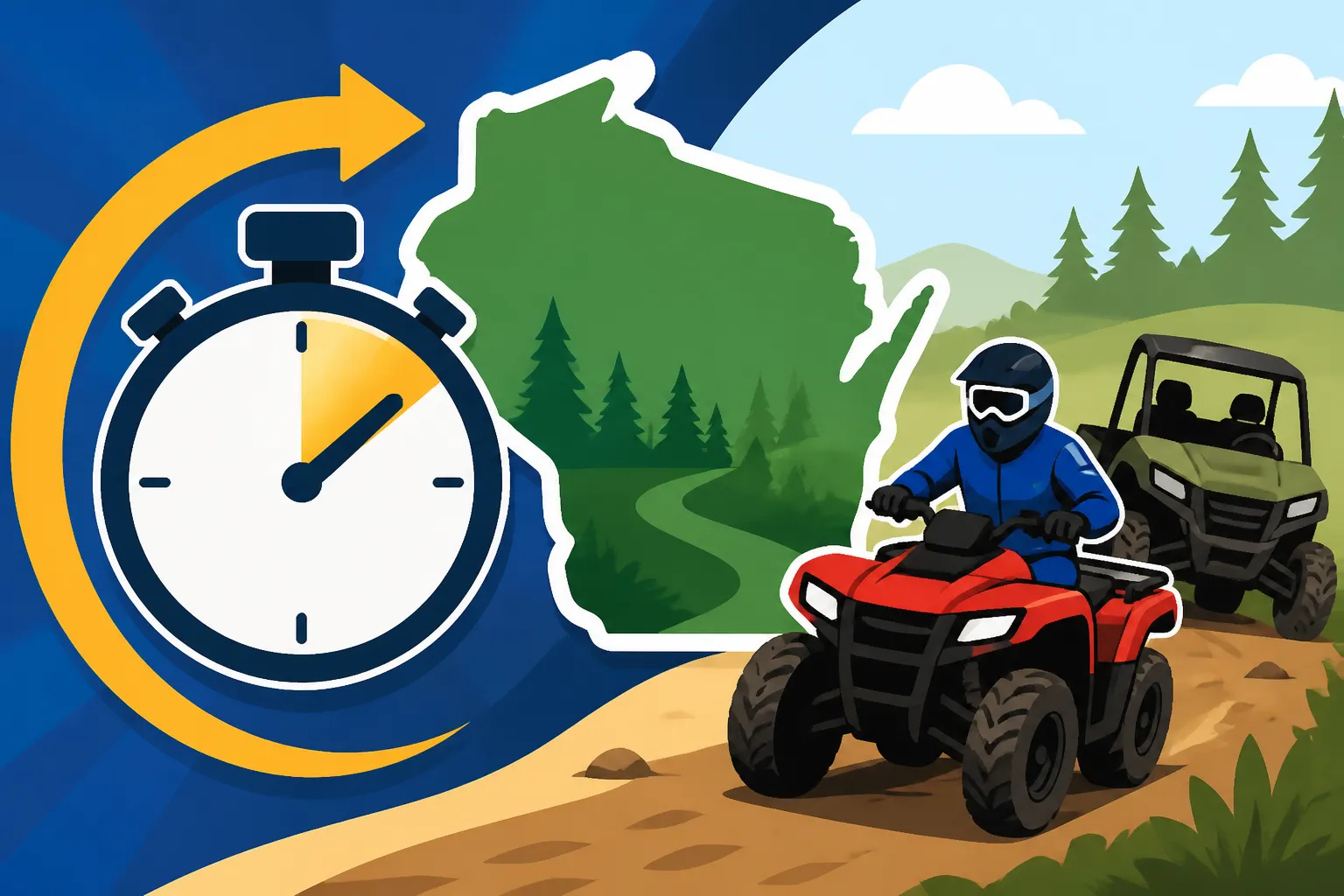
Wisconsin ATV safety certification can take a few hours of study, but finishing the course is only one part of being ready to ride. The time depends on your course format, how quickly you work through the material, and whether you need to wait for completion to appear in the state’s records. Here’s how to plan without confusing course time with ride-ready time.
How much time to set aside for the course
For many riders, the course itself takes several hours. The exact time varies by provider and learner: some people move through the lessons in one sitting, while others pause and return later. Use the course provider’s stated time estimate as a planning guide, not a promise that every student will finish within that window.
Online courses are often self-paced, so you may be able to study in shorter sessions. That can be useful for a young rider or anyone who learns better with breaks. An in-person option follows a set schedule, which may mean less flexibility but a clearer end time for the instruction. Course formats and availability can change, so check the Wisconsin DNR’s current approved options before enrolling. Wisconsin Safety Courses Online and In Person
| Part of the process | What affects the time | Planning tip |
|---|---|---|
| Enrollment | Account setup, course choice and any required information | Confirm you have the right course before starting |
| Lessons | Course format, reading speed and familiarity with the material | Allow several hours and take breaks if needed |
| Quiz or exam | Preparation, test format and any retake rules | Review the lessons rather than rushing to finish |
| Completion record | Provider reporting and record verification | Leave time between passing and your planned ride |
| Ride preparation | Age rules, supervision, registration and trail requirements | Check each requirement separately |
A course’s estimated seat time does not necessarily include every step around the instruction. You may also need time to create an account, review safety material, complete a final assessment and confirm that your completion has been recorded. If you get interrupted or need to revisit a topic, the calendar time can stretch beyond the time you spend actively studying.
For a deadline such as a family trip, avoid scheduling the course for the night before departure. Instead, choose a course early enough to handle a login problem, a missed session or a record that has not updated yet. That extra time is especially useful if a young rider is taking the course for the first time.
The course is intended to teach safe operation, not simply to provide a credential. Give the material attention, particularly the sections on terrain, visibility, other trail users and riding within the machine’s limits. If a question or rule is unclear, pause and check the course material or current Wisconsin requirements rather than guessing.
What happens after you pass
Finishing the lessons and passing the assessment are important milestones, but they are not always the same thing as having proof ready to show. The course provider may need to record or transmit your completion, and you should check what proof the provider issues and how to access it.
Before you plan a ride, confirm that your completion is reflected in the required record or that you have the accepted proof available. The process and timing can differ by course provider, so do not assume that a successful test automatically means every system has updated immediately. If the provider gives you instructions for checking your status, follow them. If the record is missing, contact the provider before heading out.
It helps to keep a copy of any completion confirmation in a place you can access. If the provider issues a digital certificate or other documentation, save it where you can retrieve it without relying on a weak cell connection. Carrying proof does not replace any requirement to have the course completed and recorded, but it can make it easier to resolve a question.
If you already hold a safety certificate from another state, do not automatically assume that it will meet Wisconsin’s requirement. Check the current acceptance rules before you enroll in a second course or ride. Out-of-State Certificates Wisconsin Accepts
There is also a difference between passing the course and being eligible to operate a particular machine. Age requirements, supervision rules and the type of vehicle all matter. A certificate does not waive those conditions. For a quick overview of who must take the course, see Who Must Certify to Ride in Wisconsin and The Wisconsin Rule for Riders Born On or After 1988.
Who needs certification and when to take it
Wisconsin’s certification requirement depends in part on the rider’s birthdate and the kind of riding involved. Riders born on or after January 1, 1988 generally need to meet the applicable safety certification requirement to operate an ATV or UTV in situations covered by Wisconsin’s rules. Requirements can differ with age and vehicle type, so check the details that apply to the rider, rather than relying only on a parent’s or friend’s experience. Wisconsin’s ATV Safety Certificate Requirement
For a rider who needs certification, the practical deadline is before the first ride that requires it. Completing the course after a trip has started does not make an earlier ride compliant. This is easy to overlook when a machine is already registered or the rider has been out with family on private property; registration, permission to ride and safety certification are separate matters.
Age limits are a separate consideration. A certificate does not by itself make a rider old enough to operate every kind of machine or remove supervision requirements that may apply. Wisconsin’s rules distinguish between ATV and UTV operation, including age-related limits. Review Twelve for an ATV, Sixteen for a UTV and Wisconsin Rules for Riders Aged 12 to 15 if a young person will be operating.
It’s sensible to complete the course well before the start of the riding season or a planned trip. That gives the rider time to absorb the material and gives you a chance to verify the completion record. It also leaves room to sort out other trip requirements. For example, a Wisconsin safety certificate is not the same as an ATV registration or a non-resident trail pass. Visitors should check the applicable permit rules separately in Wisconsin’s Non-Resident Trail Pass.
Certification is not a one-time substitute for judgment on the trail. A new rider still needs practice in a safe setting, appropriate protective equipment and clear supervision where required. Conditions can change quickly, and a course cannot prepare someone for every rut, slope, weather shift or interaction with another rider. A responsible first outing starts on terrain and at a pace suited to the rider’s experience.
A simple timeline for planning
Use this sequence to keep course completion and ride planning from getting tangled:
- Check whether the rider needs a Wisconsin certificate. Confirm the birthdate, vehicle type and riding setting. If the rider is visiting from another state, check whether an existing certificate is accepted.
- Choose a current approved course. Compare online and in-person options, including the provider’s estimate of course time and instructions for completing the assessment.
- Set aside enough study time. Plan for several hours, with additional time available if the rider needs breaks or wants to review a lesson.
- Finish the assessment and follow the provider’s completion instructions. Save any confirmation or certificate information the provider supplies.
- Verify the record before riding. If the completion is not visible or you are unsure what proof is accepted, contact the provider or the appropriate Wisconsin authority before the trip.
- Check the remaining requirements. Confirm age eligibility, supervision, registration, trail access and any required pass. A safety certificate handles only the certification part.
This approach is more reliable than choosing a course based on the shortest advertised completion time. A few extra hours of lead time can prevent a last-minute scramble and, more importantly, gives the rider a chance to understand the safety material. If a planned ride is soon, the best next step is to check the approved course options and their current completion and record instructions before paying or beginning.
Disclaimer
This article is for general informational purposes only and does not constitute professional advice. Laws, prices and regulations vary by location and change over time. Consult a qualified professional for guidance on your specific situation.