Wisconsin Campgrounds With Trail Access
Choosing a Wisconsin campground for an ATV or UTV trip is harder than finding a place to park a camper: a campground can be close to a trail yet have no legal machine connection to it. This guide explains how to check actual access, compare riding regions, and plan a stay that avoids surprise road gaps, trail closures, and unnecessary trailer trips.
What “trail access” means at a Wisconsin campground
Direct access is different from being nearby
A campground may advertise itself as being near ATV trails, but that can mean several different things. The trail might run beside the property, start a short drive away, or be reachable only by a legal town or county road route. Those options are not interchangeable. If there is no approved connection, you may need to trailer your machine to a designated staging area.
Before booking, ask the campground manager a specific question: “Can I ride from your property to an open ATV or UTV trail without using an unapproved road?” Then ask which trail or route provides that connection and whether the answer changes by season. A vague “trails are close” is a reason to investigate further, not proof that you can ride from your campsite.
This distinction matters especially in northern Wisconsin, where a route may pass through town roads, county roads, private land, or forest land with different rules. A connector that appears simple on a map may include a road segment that is not open to your machine. Review [What a Wisconsin ATV Route Actually Is] before assuming that every marked route is a trail.
Confirm access for your machine and the dates of your stay
ATV and UTV access can differ. Some trail sections have width restrictions, and some routes or properties may have rules that affect larger side-by-sides. When you contact a campground, give the staff your machine type and width rather than asking only whether “ATVs” are allowed. If you plan to bring a passenger, ask whether any campground or local rules apply to passenger-carrying machines.
Season matters just as much. Wisconsin trails can close during spring thaw, and county or local closures may affect a route you were counting on. Winter access can also vary, particularly where trails share corridors or connect to other types of recreation. A campground being open does not mean the nearby trail system is open.
For a useful first check, compare the campground’s directions with the relevant county or forest trail map, then contact the campground and trail manager if the connection remains unclear. [Checking Wisconsin Trail Status Before You Drive] can help you build a pre-trip routine instead of relying on an old social media post or a map screenshot saved last year.
Wisconsin riding regions to consider for a campground stay
The best base camp depends on the kind of trip you want. Some riders want a long day on connected trails, while others prefer short rides with access to a small town for fuel or a meal. Use the regions below as starting points, then confirm specific campground connections and trail conditions before making a reservation.
| Riding area | A useful base to research | What to verify before booking |
|---|---|---|
| Eagle River and Conover | Campgrounds in or near the Vilas County trail network | Whether a legal route connects the campground to open trails and towns |
| Black River Falls | Campgrounds around Black River State Forest and the surrounding trail network | Seasonal closures, staging needs, and whether your machine fits the trail system |
| Crivitz and Wausaukee | Campgrounds near Marinette County routes and trail areas | Which trails are open during your dates and whether the campground has an approved connector |
| Bayfield County | Campgrounds near county forest routes and Northwoods riding areas | Distance to an access point, current closures, and fuel gaps along the ride |
Eagle River and Conover for a Northwoods base
Eagle River and Conover are familiar starting points for riders exploring Vilas County. The area can suit a trip where you want to combine trail time with access to Northwoods services, but “staying in Eagle River” does not automatically mean a campground is connected to a trail. Check the exact property location and ask whether you can legally ride from the campground or must haul to an access point.
Hi-Pines Campground in Eagle River is one name travelers may encounter while researching a stay. Treat any campground listing as the beginning of the access check: ask staff what routes connect to the property, whether the connector is open for your dates, and whether it accommodates your ATV or UTV. If you are staying farther toward Conover or another smaller community, do the same check rather than assuming that proximity to a trail system means direct access.
This area can work well when the group wants to ride between communities, but route riding is not the same as unrestricted road riding. Check the local rules for every town or road segment on your planned loop. [Vilas County Trails and the Towns They Link] is a useful next read when you are deciding whether your trip should be based near Eagle River, Conover, or another part of the county.
Black River Falls, Crivitz, and Bayfield County
Around Black River Falls, riders may research camping near Black River State Forest and the broader Jackson and Clark County trail areas. Forest campgrounds and nearby private campgrounds can offer different experiences, from a more rustic setting to a full-service RV stay. Do not assume that a campsite inside or near a forest puts you directly on an open riding trail. Confirm the current map, permitted machine types, and whether you need to trailer to a staging area.
Crivitz and Wausaukee are useful places to investigate for Marinette County riding. The area’s mix of trail and road-route connections makes it especially important to trace a legal path from the campground to your intended riding area. Ask about seasonal conditions and route status, and plan fuel stops before setting out. A campground that is convenient for one trail segment may not be the best choice for a longer loop.
Bayfield County offers another Northwoods option, particularly for riders who want forest scenery and a quieter base. Check the county map and the campground’s exact location: “near Bayfield County trails” could still mean a drive to the trailhead. If you are comparing these destinations, [Wisconsin County Forest Trail Systems] and [Chequamegon-Nicolet National Forest Trails] can help you understand the different land managers and trail areas you may encounter.
How to choose a campground that fits your riding trip
Compare the access, not just the amenities
It is easy to get pulled into comparing swimming beaches, hookups, showers, playgrounds, and cabin options. Those amenities matter, but for a machine-based trip, first establish whether the campground supports the riding plan. A beautiful site can become frustrating if every ride starts with loading the machines onto a trailer.
Make a short list of questions and ask them before booking:
- Is there a legal ATV or UTV connection from the property to an open route or trail?
- Which trail map or route should guests use?
- Is the connection open during the dates of my stay?
- Are there width, noise, operating-hour, or machine-type restrictions?
- Is there space to park a truck and trailer, and can the trailer remain on site?
- If direct access is not available, where is the closest appropriate staging area?
The campground’s answer should be specific enough to check against a map. “Ride out the driveway and turn left” is not sufficient unless you can confirm that the road is open to your machine and that the connector leads where you expect. For a broader camping checklist, see [Camping Beside Wisconsin ATV Trails].
Match the region to your group’s riding style
A family traveling with newer riders may value short loops, clear signage, and a campground close to services more than a large mileage total. A group of experienced riders may prefer a base that connects to longer routes and provides enough trailer parking for several machines. For either group, the actual trail conditions and machine fit matter more than marketing language.
Think through a typical day before reserving. If you want to ride out after breakfast and return for lunch, direct access could be a major benefit. If you are planning one long ride and do not mind trailering each morning, a campground near a staging area may be perfectly practical. Be honest about how much loading, unloading, and road-route navigation your group wants to handle.
Also consider where you will get fuel, food, and basic supplies. In more remote areas, a campground that looks close to a trail may still leave a long gap between fuel stops. Use [Fuel Planning for a Wisconsin Trail Day] to think through range, stops, and how much of the day you want to spend reaching services.
Use maps as a planning tool, not a guarantee
Digital maps are handy for comparing campgrounds with trailheads and towns. A tool such as onX Offroad can help you visualize nearby routes and organize a proposed ride, but treat any map as one part of the check. Confirm that the route is currently open and legal through the responsible county, forest, or local authority. A line on a screen does not establish permission to ride a private road or a closed trail.
A sensible planning sequence is to identify a campground, locate its nearest legal access point, and trace the full route to the trails you want to ride. Then check current notices and call the campground with any unresolved questions. If your trip crosses multiple jurisdictions, check each one; one county’s open trail does not mean every connecting segment is open.
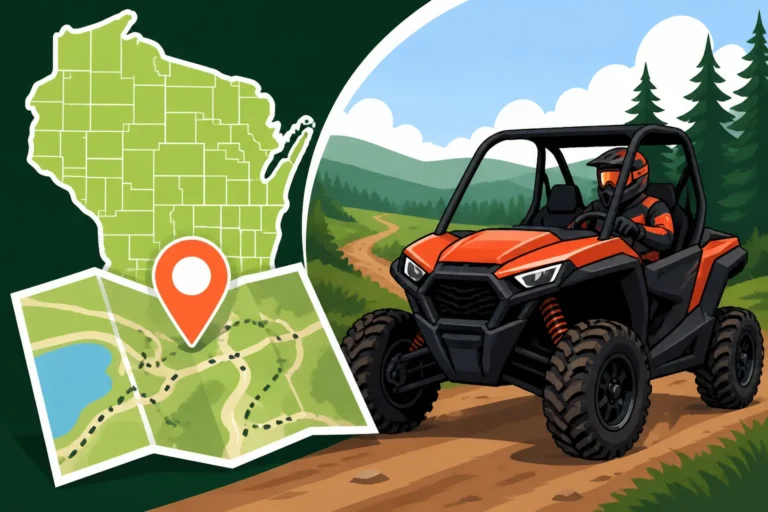
For a trip with several possible routes, save or download the maps you need before leaving home. Cell service can be limited in parts of the Northwoods, and a dead zone is a poor time to discover that your only map requires a connection. [Reading a Wisconsin County Trail Map] can help you prepare for the signs, access points, and boundaries you may encounter.
A practical booking and riding checklist
Before you reserve
Start with the dates and the kind of machine you are bringing. Then compare campgrounds in the region you want, looking for a clear statement about legal ride-out access rather than a general claim that trails are nearby. Call or message the property if the listing does not explain the connection.
Check whether the campground has the space your group needs. A full-size UTV, a trailer, and a tow vehicle can take up considerably more room than a tent and one ATV. Ask about parking arrangements, quiet hours, machine storage, washing rules, and whether trailers can stay at the site. These details are easier to sort out before arrival than after a long drive.
Confirm the registration, pass, and safety requirements that apply to your machine and intended riding. Requirements can depend on the machine, where it is registered, and whether you are using public trails or a road route. Review [What Wisconsin Riders Need Before They Ride] and check the applicable local information before setting off.
Before each ride
Check that the trails and connecting routes are open that day. Weather, maintenance, seasonal thaw, and local conditions can change what is usable. Look for current notices from the relevant county or land manager, and ask campground staff whether they have heard of a closure or access change.
Carry the information you need to get back to camp, including an offline map or paper map, the campground address, and a way to contact your group. Agree on a plan if riders become separated. Before leaving, check fuel, tires, lights, and basic recovery equipment, especially if the route includes remote sections.
Finally, follow posted signs and keep machines on approved routes. If a campground advertises “trail access,” that does not mean guests may cut across neighboring land or use an unmarked shortcut. Respecting local restrictions helps protect access for the next group of riders and keeps a relaxing camping weekend from turning into a citation or a difficult recovery.
Disclaimer
This article is for general informational purposes only and does not constitute professional advice. Laws, prices and regulations vary by location and change over time. Consult a qualified professional for guidance on your specific situation.