Wisconsin Areas Closed to Motorized Use
Wisconsin’s trail pass or vehicle registration does not give you permission to ride everywhere. State parks, state forests, and public hunting and fishing areas can be closed to motorized use, even when a trail or road looks rideable. The key is to confirm that the specific route is designated for ATV or UTV use before you enter, and to treat boundaries and signs as part of your route plan.
Which Wisconsin areas are generally closed to ATVs and UTVs
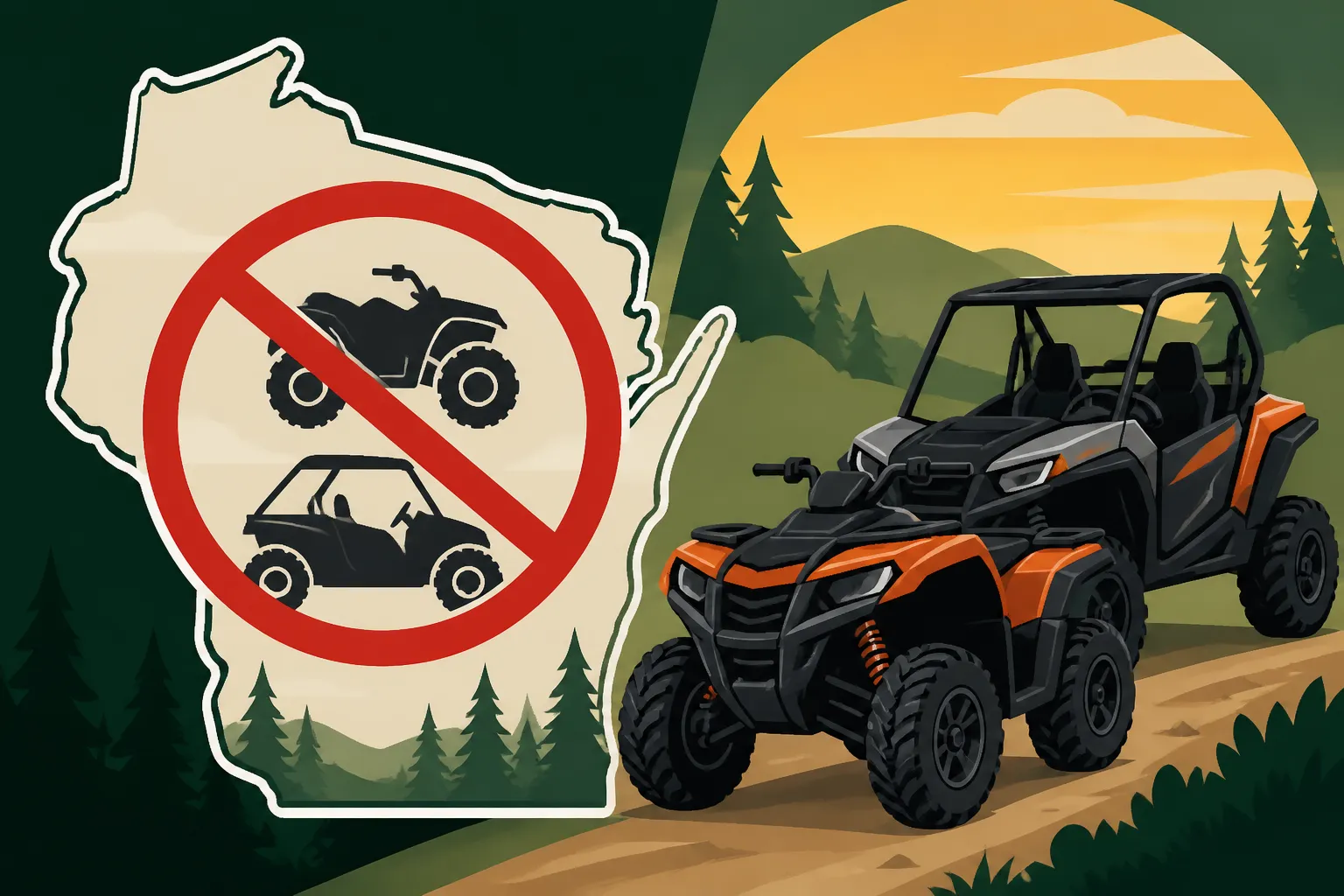
According to the Wisconsin Department of Natural Resources, restricted public areas that are generally closed to motorized ATV and UTV use include state parks, state forests, and state-owned public hunting and fishing areas, unless specifically designated otherwise.
“Generally closed” is the important distinction. A named public area is not automatically open to motorized riding just because it has roads, trails, parking areas, or public access. Nor does a trail pass or registration sticker establish that a machine may use every route on that property. Look for an explicit designation allowing motorized use in the particular place you plan to ride.
| Area or route | Practical starting assumption | What to verify |
|---|---|---|
| State park | Motorized ATV and UTV use is generally closed | Whether a particular route or area is specifically designated |
| State forest | Motorized use is generally closed unless designated | Current trail designation, boundaries, and closures |
| State-owned public hunting or fishing area | Motorized use is generally closed unless designated | Whether the specific route is open to your machine |
| County forest or county trail system | Do not assume the rules match state land | County rules, trail status, and any required permit |
| Highway route | Use only where it has been legally designated and signed | The route, applicable local ordinance, and crossing rules |
| Private land | Public trail access does not automatically extend onto it | Permission and any applicable posted restrictions |
This is a useful starting point, not a substitute for checking the current rules for a particular property. Land boundaries can be easy to miss in the field, and a route may pass close to different types of public or private land. A connected road or trail does not necessarily carry the same motorized-use permission all the way through.
If you are deciding where to ride, start with Where to Ride an ATV in Wisconsin. For state park questions, Wisconsin State Park ATV Restrictions focuses on that land type, while County Forest Rules Wisconsin Riders Follow is a useful reminder that county-managed areas have their own rules to check.
Why a registration or trail pass does not make a closed area open
Registration, a trail pass, and land access answer different questions. Registration identifies the machine under Wisconsin’s registration system. A trail pass or use receipt may meet a riding requirement on certain designated routes. Neither should be treated as broad permission to operate on every public property or trail.
For nonresidents, the Wisconsin Department of Natural Resources says an ATV or UTV may be operated on designated corridors and frozen waterways with the required trail pass or 5-day trail use receipt. The requirement applies to those designated places; it does not turn an otherwise closed area into an open riding area. The department also says nonresidents who keep their machine in Wisconsin must register it in the state.
If you are visiting, sort out the machine’s paperwork and your route separately. The annual nonresident trail pass costs $35 and expires on March 31 each year, while the 5-day trail use receipt costs $20 and covers five consecutive days, according to the Wisconsin DNR. Check current requirements with the department before setting out.
For Wisconsin residents, the same basic distinction matters: having a valid registration does not prove that every trail is open to motorized use. Wisconsin Permit Rules on County Trails can help explain why a permit may apply to one system but not another, and Wisconsin Pass Rules at a State Forest is relevant when planning around forest land.
A practical way to think about it is:
- Registration concerns the machine and its status under state registration rules.
- A trail pass or use receipt concerns eligibility to ride where that pass or receipt is required.
- A land or route designation determines whether motorized riding is allowed in that place.
- A local rule or temporary closure may add restrictions, even on a route that is normally open.
Keep those questions separate when you plan. If one answer is uncertain, do not assume that another document covers it. A valid pass is not a substitute for confirmation that the exact segment is open.
How to check a route before riding
Do the route check before unloading the machine, not after you reach a confusing junction. Start with the managing authority for the land or trail system, then compare its information with the map and signs on the ground. For public land, pay attention to whether the route is specifically designated for motorized use; for a highway route, confirm that the route is legally established rather than simply visible on a map.
Use this process:
- Identify who manages the land. It may be a state agency, county, municipality, or private owner. The managing authority is the best place to confirm the rules that apply there.
- Check the route, not just the destination. A trail system may include sections with different access rules. Confirm that every segment you plan to ride is open to your machine.
- Look for current closures. Seasonal conditions, maintenance, or other notices can affect access. Do not rely only on an old map or a route remembered from a previous visit.
- Read signs at entrances and junctions. A sign can identify a boundary or restriction that is not obvious from the trail itself. If the signage conflicts with what you expected, stop and verify rather than continuing.
- Plan a legal way in and out. A route that begins legally may lead toward a closed area or a road where riding is not authorized. Confirm connecting segments before you depend on them.
- Save the information you checked. Keep the map or relevant rules available during the ride, especially if cell service is unreliable.
A route shown on a general map is not necessarily an approved ATV or UTV route. Wisconsin’s Department of Transportation explains that a roadway is not an ATV route until an ordinance has been enacted and the roadway is signed and posted according to law. That distinction is useful beyond roads: visible access, a worn track, or a map line should not be mistaken for permission.
For more on legal road access, see What a Wisconsin ATV Route Actually Is and Finding a Wisconsin Town’s ATV Ordinance. If your planned ride crosses private property, Wisconsin Passes and Trails That Cross Private Land can help you think through the separate access question.
What to do when the boundary or status is unclear
If you reach a gate, sign, trail junction, or property boundary that leaves the route’s status uncertain, do not treat uncertainty as permission. Stop before entering the area, check the managing authority’s information, or turn around and use a route you have confirmed. This is especially important where a permitted trail appears to continue into a state park, forest, or public hunting or fishing area.
Avoid relying on assumptions such as:
- “The trail connects, so the next section must be open.”
- “Other riders went through, so it must be allowed.”
- “My registration or pass covers this whole property.”
- “There is no gate, so motorized use is permitted.”
- “A road on the map must be an ATV route.”
If you cannot confirm that a route is designated for motorized use, choose another route until you can. A short detour is better than entering a closed area and having to explain why you believed it was open. Keep your machine on the authorized route, and do not create a new path around a barrier or closure.
When you are planning a broader trip, use the official trail and land information together with the Wisconsin ATV/UTV Regulations. The Wisconsin DNR recommends that operators familiarize themselves with relevant laws and regulations before riding. It also advises riders to operate within their abilities, wear a helmet and seat belt, and ride sober.
The main takeaway is straightforward: treat state parks, state forests, and state-owned public hunting and fishing areas as closed to motorized ATV and UTV use unless the specific place or route is designated otherwise. Confirm the route with the land manager, check current notices and signs, and remember that a registration or trail pass does not replace land-access permission.
Sources
- Wisconsin Department of Natural Resources — All-terrain vehicle (ATV) and utility-terrain vehicle (UTV) registration | | Wisconsin DNR (checked November 3, 2026)
- Wisconsin DNR — Nonresident ATV and UTV Trail Passes | | Wisconsin DNR (checked November 3, 2026)
- Wisconsin Department of Transportation — Wisconsin Department of Transportation All-Terrain Vehicles and Utility Terrain Vehicles on state highways (checked November 3, 2026)
Disclaimer
This article is for general informational purposes only and does not constitute professional advice. Laws, prices and regulations vary by location and change over time. Consult a qualified professional for guidance on your specific situation.