Riding a Friend’s Land by Permission in Wisconsin
Riding a friend’s land can seem simple: get permission, unload the ATV or UTV, and stay on the property. The tricky part is knowing where permission applies and which rules still matter. This article explains how to confirm boundaries, distinguish private-land riding from public-trail access, and avoid assuming that a friend’s invitation covers permits, safety requirements, or neighboring land.
What permission from a friend does and does not cover
Permission gives you consent to ride on land your friend has the right to let you use. It does not automatically give you access to the next parcel, a public trail, a town road, or a route that crosses the property. Nor does it make every use of the land lawful.
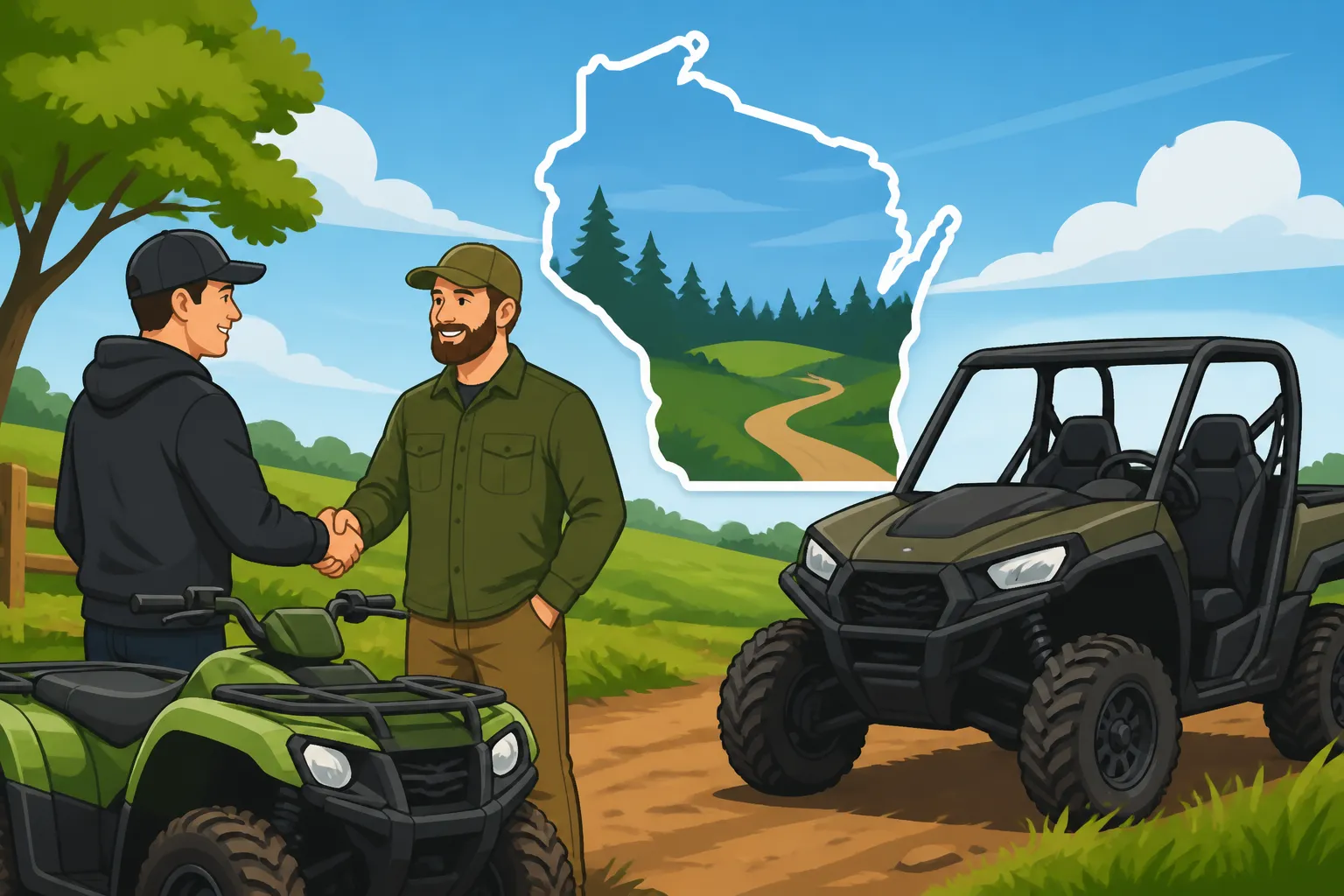
Before unloading, get clear agreement from the owner or the person authorized to manage the property. A casual invitation may be enough for a short visit, but specific details prevent misunderstandings:
- Which property or area you may ride
- Where the allowed riding area begins and ends
- Whether you may bring guests or additional machines
- Whether riding is allowed at a particular time or season
- Whether you can use a driveway, field, woods road, or trail to reach the riding area
- Whether the landowner has asked you to avoid crops, livestock, buildings, water, or other sensitive areas
If your friend is a tenant, a family member, or a caretaker rather than the owner, check that the person actually has authority to grant access. A friend’s permission cannot override a lease, an owner’s restrictions, or an agreement with another land manager.
Confirm the boundaries
A property line can be hard to recognize in a wooded area, and a trail or two-track may cross more than one parcel. Ask the landowner to point out the permitted area on the ground or on a map. If they are unsure where the boundary lies, do not treat a fence, path, or tree line as definitive without checking.
Permission for one parcel does not carry over to adjoining land, even when it looks like one continuous forest. If the ride reaches another owner’s property, stop before crossing unless you have separate permission. Wisconsin’s trespass rules still matter; see Wisconsin Trespass Law for Riders for more on staying within authorized areas.
Also distinguish between permission to ride on a private trail and permission to use a public route that happens to cross private land. A marked public route may have its own access conditions and rules. The owner’s invitation for a private ride does not substitute for any requirement that applies to the public route. Wisconsin Passes and Trails That Cross Private Land explains why the land beneath a trail and the legal status of the trail are not the same thing.
Agree on practical limits
Even when access is clearly permitted, a landowner can set conditions. They may ask you to keep away from a wet area, stay on existing paths, avoid a field during planting or harvest, or stop riding when the ground is soft. Take those requests seriously. Tire ruts and damaged crops can turn a friendly invitation into a dispute.
It also helps to agree on basic conduct before the ride: keep speeds low near homes and animals, do not ride after the agreed time, and leave gates as you found them. If the owner asks you to stop or leave, do so promptly.
Permits and rules still depend on where you ride
One of the most common misunderstandings is that permission from a private landowner replaces Wisconsin registration, trail-pass, or safety requirements. It does not. The rules depend on the machine, the rider, and the type of land or route being used. Private-land access and public-trail access are separate questions.
Private land is not a public trail
If you are staying entirely on a friend’s private property, a public-trail pass is generally not the same kind of requirement as it is for riding an eligible out-of-state machine on Wisconsin’s public ATV trails. A pass does not give you permission to enter private land, and permission to enter private land does not qualify as a pass for a public trail.
If your ride leaves the property and enters a public trail, trail system, or route, check the requirements for that part of the trip before you go. These can depend on the machine’s Wisconsin registration status and whether the machine is registered in another state. The rules are not interchangeable. Start with Wisconsin’s Non-Resident Trail Pass and Which Wisconsin Trails Require a Pass if the machine or ride may involve public trails.
A machine that is registered in Wisconsin may be treated differently from one registered elsewhere for trail-pass purposes. Do not assume that a friend’s residence, your own state registration, or the property owner’s permission settles the question. Confirm the rule for your specific machine and intended riding area.
Registration is a separate question
Wisconsin has different registration categories, including options associated with public use and private use. How a machine is used can affect which category applies. A machine used only on private property may be treated differently from one that is taken onto public trails or routes, but that does not mean every machine can simply be operated without checking registration rules.
The landowner’s permission does not change the machine’s registration status. For details about private-property use and possible registration requirements, see Do You Need Registration on Your Own Wisconsin Land? and Wisconsin Rules on Private Land. Check the current Wisconsin DNR requirements if you are uncertain, particularly if you plan to use more than one type of property during the same trip.
A useful distinction is:
| Where you ride | What to check |
|---|---|
| Only on the friend’s private property | Permission, boundaries, machine registration rules, rider age and safety requirements |
| On a public trail or trail system | Registration status, any applicable trail-pass requirement, trail rules, and safety requirements |
| On a public road or designated route | Whether that road or route is open to ATVs or UTVs, local ordinances, and applicable operating rules |
| Across neighboring private land | Separate permission from the person authorized to allow access |
| On a trail that crosses private land | Whether it is a public trail or private trail, plus the rules for that trail and machine |
A route through the property changes the picture
A friend may allow you to ride around their acreage but not to use a road or trail that connects the property to a public system. Even if the connecting path has trail signs, do not assume the invitation covers it. Ask whether the path is private, part of a public route, or simply a way the landowner has used in the past.
Before riding onto a town road or route, verify that ATVs or UTVs are allowed there and review the local rules. Permission to cross a friend’s land is not a substitute for a town opening a route to ATV use. What a Wisconsin ATV Route Actually Is and Finding a Wisconsin Town’s ATV Ordinance can help clarify what kind of route you are approaching.
Rider age and safety requirements still matter
A private invitation is not a blanket exemption from rider-safety rules. Requirements can vary with the rider’s age, the machine, and whether the ride is on private property, a public trail, or a road route. Parents and supervising adults should check the specific rules before bringing a young rider.
Do not assume that an exception tied to family-owned land applies to a friend’s property. An exception based on ownership or family relationship may not cover a guest riding on someone else’s land. Wisconsin’s Safety Certificate Exception for Family-Owned Land explains why the wording of an exception matters.
For a ride that includes public trails or routes, confirm that each rider meets the relevant age and safety-certificate requirements. A private-property ride that later joins a public trail can bring a different set of rules into play. Check Wisconsin ATV Safety Certificate Requirements and Wisconsin Age Rules for ATVs and UTVs before planning a trip with children or teenagers.
Safety precautions are worthwhile even when a particular requirement does not apply to a private ride:
- Match the machine to the rider’s size, ability, and experience.
- Use a properly fitted helmet and eye protection.
- Make sure a passenger is allowed on that machine and has a designated seat.
- Keep children away from areas where they may be difficult for the operator to see.
- Set a speed appropriate to the terrain and visibility.
- Agree on a stopping signal and a plan if riders become separated.
- Avoid riding near livestock, buildings, other people, or equipment unless the owner has specifically approved it.
The operator remains responsible for controlling the machine. A landowner’s permission does not make an unsafe speed, unsuitable passenger setup, or poor supervision safe.
A simple checklist before riding a friend’s land
A quick conversation before unloading can prevent most problems. Use this checklist when arranging the visit.
- Ask the right person. Confirm that the person granting access owns or manages the land and has authority to allow riding.
- Mark the boundaries. Identify the permitted parcel and any areas that are off limits. Ask about adjoining properties and connecting trails.
- Clarify the route in and out. Confirm that the access path, driveway, or woods road is included in the permission.
- Ask about conditions. Check for limits on time, season, speed, guests, noise, or particular areas.
- Check the machine’s status. Determine whether its registration category fits how and where it will be used. If public trails are part of the trip, check whether a trail pass is required.
- Check each rider’s requirements. Age and safety rules can differ by rider and location. Do not rely on an exception unless it clearly applies.
- Keep the ride on approved land. Stop before crossing a property line or entering a public route that has not been confirmed as open.
- Leave the property as agreed. Close gates, avoid damaging terrain, and follow the owner’s instructions about cleanup and parking.
If the friend’s property is part of a hunting lease or another managed arrangement, ask whether the land manager’s permission is also needed. Permission from the person who owns the land may not be the only permission required under a lease or management agreement. Wisconsin Permit Rules on Leased Hunting Ground covers that distinction.
It is also sensible to ask what the landowner expects if a machine gets stuck or something is damaged. Do not drive through a wet area, cross a ditch, or attempt a recovery that could cause more damage just because the machine can physically reach it. A short conversation about recovery access and emergency contact information can make a remote ride safer.
For anything beyond a straightforward private ride, verify the current rules with the relevant Wisconsin authority or local government. That is especially important when the route involves a public trail, a town road, a trail crossing private land, or a young rider. Treat the landowner’s permission as one necessary piece of the plan, not as permission to ignore the rules that apply elsewhere.
Disclaimer
This article is for general informational purposes only and does not constitute professional advice. Laws, prices and regulations vary by location and change over time. Consult a qualified professional for guidance on your specific situation.