Riding Family Land Without a Wisconsin Safety Certificate
Wisconsin’s safety-certificate exception for family land can be useful, but it is narrower than “I’m riding somewhere a relative owns.” The key questions are who owns the land, whether the ride stays on private property, and when you enter a public trail or route. Here’s how to think through the exception and avoid assuming it covers more than it does.
What the family-land exception does
Wisconsin generally requires certain ATV and UTV operators to complete an approved safety course and carry proof of certification when riding in places covered by the state’s certification rules. The family-land exception can remove that certification requirement while an eligible operator rides on land owned by the operator or a qualifying immediate family member.
The exception is about where you ride. It is not a blanket exemption from Wisconsin ATV and UTV rules, and it does not automatically apply because a relative gave you permission to use a property. Ownership and the boundaries of the ride matter.
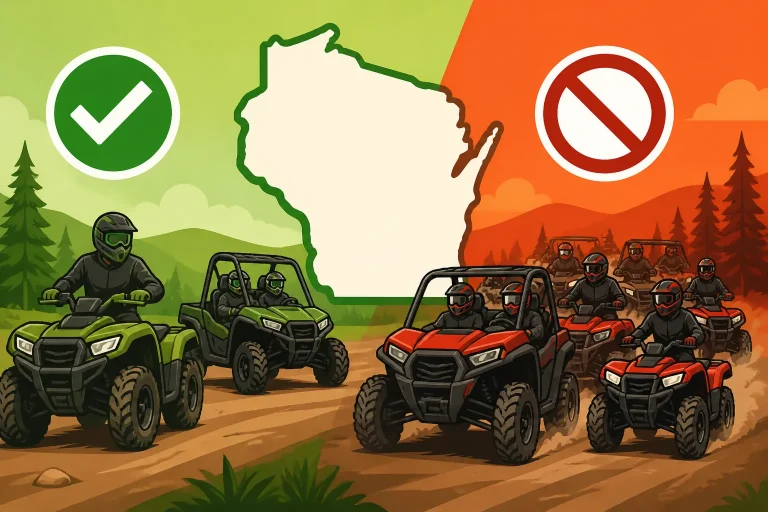
If your entire ride stays on qualifying family-owned land, the exception may apply even if you have not completed a safety course. If you leave that property and continue onto a public trail, route, or other area where certification is required, the exception no longer covers that part of the ride. Before heading out, check Who Must Certify to Ride in Wisconsin and Wisconsin’s Safety Certificate Exception for Family-Owned Land for the current requirements and scope.
| Riding situation | Does family-land exception likely apply? | What to check |
|---|---|---|
| Riding on land you own | It may apply to the safety-certificate requirement | Whether you stay on your property and meet other applicable rules |
| Riding on land owned by an eligible immediate family member | It may apply while riding on that land | Whether the owner fits the applicable family definition |
| Riding on a friend’s or cousin’s property with permission | Do not assume it applies | Permission is not necessarily the same as qualifying family ownership |
| Riding from family land onto a public trail or route | Not for the public portion | Certification, age, registration, pass, and local requirements |
| Riding on family land that connects to a public trail | Only the qualifying private-land portion may be covered | Where the public trail begins and whether you cross onto it |
Treat the exception as a limited rule for a defined piece of private land, not as a general pass for uncertified riders. A property can be privately owned while still containing a designated public route or trail. Private ownership of the ground beneath a route does not necessarily make riding there the same as riding freely around a private yard or field.
Safety certification is also separate from registration and trail-pass rules. An operator may qualify for the family-land exception and still need to consider whether the machine must be registered for the intended use, whether a trail pass applies, and whether the property owner permits the activity. For the distinction between land use and pass requirements, see Wisconsin Rules on Private Land and Do You Need a Pass on Deeded Wisconsin Land?.
Which land and family relationships count
The easiest case to assess is land owned by the operator. If you own the property and stay on it, the family-land exception may cover the safety-certificate requirement for that ride. The next question is whether the landowner is within the family relationship included by the rule.
Do not read “family land” as any property owned by anyone in your extended family. A relative’s ownership may not be enough if that person does not fit the rule’s definition of immediate family. Relationships such as a cousin, aunt, uncle, or in-law are not safe assumptions. Check the current Wisconsin DNR definition rather than relying on how your family uses the word “family.”
Likewise, permission and ownership are different. A parent might allow a young rider to use a friend’s farm, a hunting lease, a cabin property, or a neighbor’s acreage. That permission can make the ride lawful from the owner’s point of view, but it does not necessarily make the land eligible for the safety-certificate exception. The operator should not treat “we have permission” as proof that the exception applies.
Other arrangements can also be less clear than they first appear:
- Leased or rented land: A lease gives use rights, but it may not mean the operator or an eligible family member owns the land. Check the rule before relying on an exemption.
- A shared cabin or family company: The property may be held by a trust, business, or multiple co-owners. The connection between the operator and the legal owner may need clarification.
- A relative’s property used for hunting: Access for hunting does not necessarily change who owns the land or expand the certification exception.
- A property with public access: An ATV route or trail may cross private property under a public-access arrangement. Follow the route’s designation rather than assuming the whole parcel is private riding territory.
When the ownership structure is complicated, identify the legal owner and ask the Wisconsin DNR how the exception applies to that arrangement. If you cannot confirm that the land qualifies, the practical choice is to have the rider complete the required course before riding in places where certification applies. Details on private property and permission are also covered in Riding a Friend’s Land by Permission in Wisconsin.
It helps to make the boundaries clear before the machine is started. A trail on a map, a mowed path through a field, and a marked public route can look similar on the ground. Ask the landowner which paths are private, where the parcel ends, and whether any trail connection is open to public riding. If the owner is unsure, check the local map or contact the relevant land manager rather than guessing.
Where the exception stops
The most common mistake is assuming the family-land exception follows the machine or rider wherever they go. It does not. The exemption is tied to qualifying land, so a ride can move in and out of the exception as it crosses property boundaries or enters areas with different rules.
For example, a rider may begin on a parent’s property, follow a private track to the road, and then join a public ATV route. The private portion and public portion are not interchangeable. The rider needs to meet the rules for each part of the trip, including any applicable certification requirement once on a public route or trail.
The same issue comes up when family land touches public recreation land. A gate, bridge, or path may provide convenient access, but it does not make a public trail an extension of the family’s property. Confirm the exact route status before riding. The route-specific rules can differ from riding on private land; What a Wisconsin ATV Route Actually Is explains why a marked route should not be treated as an informal private trail.
The family-land exception also does not settle these separate questions:
- Age and supervision: A safety-certificate exception is not permission for every age group to operate every machine in every location. Check the rules for the rider’s age and the type of machine. See Wisconsin Age Rules for ATVs and UTVs.
- Registration: A machine may have registration requirements based on its use and where it is operated. The certificate exception does not register the machine.
- Trail passes: A pass requirement is separate from a safety course. A rider who does not need a certificate on family land may still need the appropriate pass when using a trail system that requires one.
- Local restrictions: Property rules, municipal ordinances, and land-manager rules may restrict where, when, or how a machine can be operated.
- Permission and liability: Even where the certificate exception applies, the landowner’s permission and any property-specific conditions still matter.
A useful way to keep the rules straight is to ask two questions separately: “Does this rider need a safety certificate here?” and “Is this machine allowed to ride here under the other applicable rules?” A “no” to the first question does not automatically mean “yes” to the second.
A practical check before riding
Before an uncertified rider uses an ATV or UTV on family property, work through the details instead of relying on a casual description of the land.
- Confirm who owns the property. Ask the landowner or check the ownership information if it is unclear. If the property belongs to a trust, business, or multiple people, do not assume the relationship meets the exception.
- Confirm the relationship. Make sure the owner fits the current definition used for the family-land exception. If the relationship is outside the clearly covered group, verify it with the DNR.
- Map the ride. Identify the property boundaries and any public trail, route, road, or neighboring parcel the rider might enter. Pay special attention to trail connections and crossings.
- Check the rider and machine rules. Age restrictions, supervision, machine type, and location can affect what is permitted. The certificate exception addresses certification only.
- Check registration and pass requirements separately. Use the intended route and type of use to determine whether the machine needs registration or a trail pass. The rules may change when the ride moves off the family property.
- Get the landowner’s permission and conditions. Agree on where riding is allowed, which paths are off-limits, and whether other people or animals may be using the property.
- Keep proof of certification if the ride includes public areas. If the rider will enter a place where a certificate is required, complete the approved course and carry the required proof rather than relying on the private-land exception.
If there is any chance the ride will leave the qualifying property, completing the safety course before the trip is usually the simplest way to avoid a boundary mistake. Wisconsin offers course options that riders can check through the DNR; see Wisconsin Safety Courses Online and In Person. A certificate does not replace safe riding, but it can remove uncertainty about whether an operator meets the training requirement on public trails or routes.
When the ride is strictly on family-owned land, the key is to keep it strictly there and confirm the landowner fits the rule. If the route crosses onto public land, a public route, or property that does not qualify, stop and reassess before continuing. For the broader age-based rule, Wisconsin’s Rule for Riders Born On or After 1988 may help clarify when certification applies.
Disclaimer
This article is for general informational purposes only and does not constitute professional advice. Laws, prices and regulations vary by location and change over time. Consult a qualified professional for guidance on your specific situation.