Overnight Trailer Parking in a Wisconsin Town
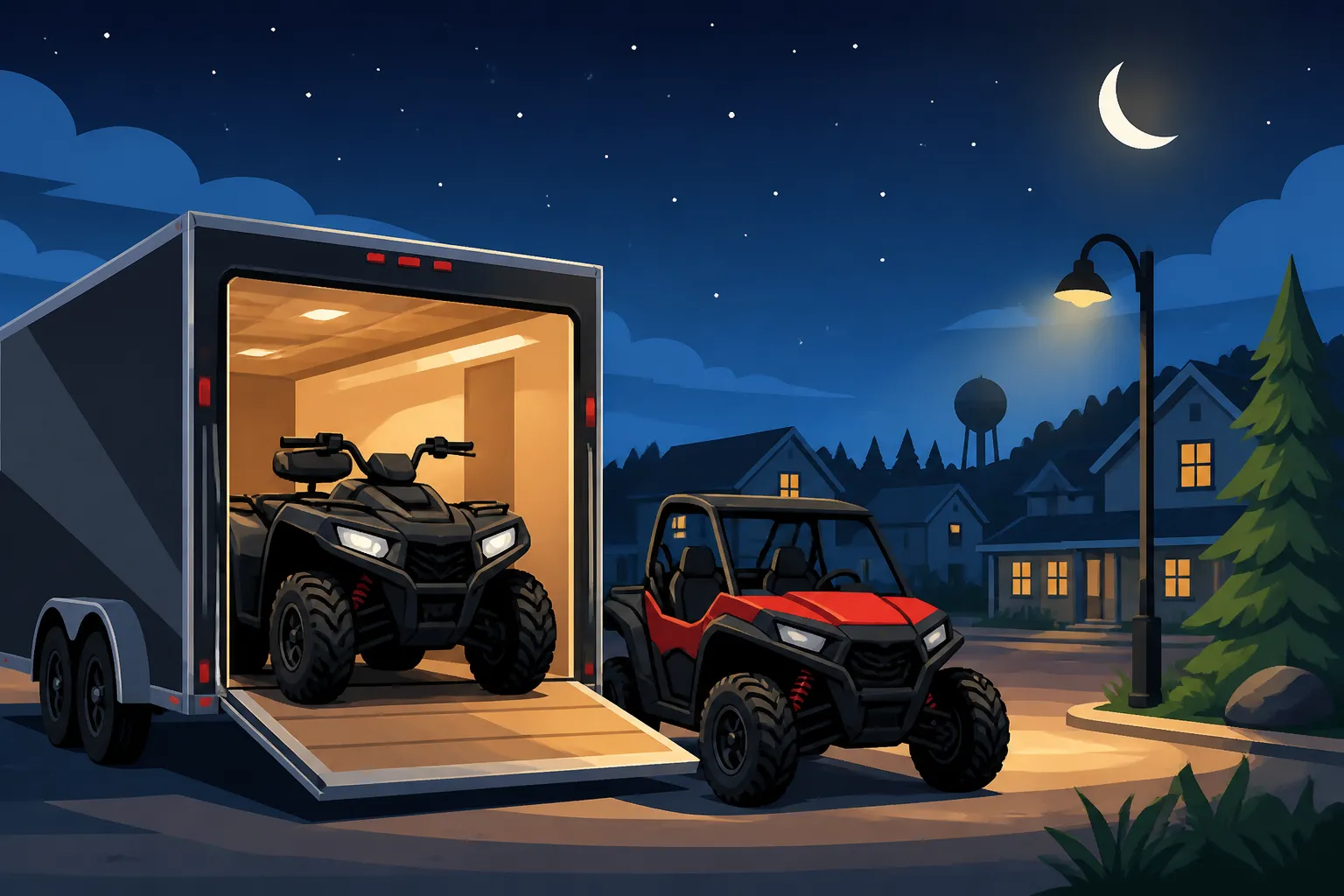
Finding a place to leave an ATV or UTV trailer overnight can be harder than finding a room, especially when a small Wisconsin trail town has limited parking and local rules vary. This guide explains how to arrange legal, practical overnight trailer parking, what to confirm before you arrive, and how to avoid blocking businesses, streets, or trail access.
Start by confirming who allows overnight parking
An empty spot is not automatically an overnight parking spot. A lot may belong to a town, county, private business, campground, or lodging property, and each owner can set different rules. Overnight parking may be restricted even where daytime parking is allowed.
That uncertainty can be frustrating after a long drive, particularly if you arrive in a town such as Eagle River, Hayward, Rhinelander, Crivitz, or Black River Falls and discover that the motel lot is too tight for a truck and trailer. Make parking part of your trip planning—not a decision to leave until you reach town.
Ask the property owner, not just someone nearby
If you are staying at a motel, resort, campground, or cabin rental, contact the property directly and ask whether it permits overnight parking for your particular combination of tow vehicle and trailer. Explain the trailer’s approximate length, whether it will remain attached to the truck, and how many nights you need the space. A property may have room for a pickup but not enough turning space for a long trailer.
Ask where the vehicle should be parked, whether you need to display a permit, and whether the trailer can stay in one place while you ride. Some properties may direct guests to a designated overflow area or ask them to park away from entrances and fire lanes. Get the instructions from the person who can authorize the parking, and save a text or email if one is provided.
Do not assume that a business’s customer lot is available just because you bought fuel there or plan to eat nearby. A store, restaurant, or bar may close overnight, lock its lot, or have restrictions on unattended vehicles. If the owner has not given permission, choose another option rather than risking a tow or an awkward conversation the next morning.
Check public and municipal parking rules directly
For a town-owned lot, street, or public facility, look for posted signs and ask the municipality which department handles parking questions. Depending on the location, that could mean contacting the town, village, or city office, or asking local law enforcement where to find the applicable rules. Confirm both overnight parking and the permitted location for a trailer; a rule that allows parking a vehicle may not clearly cover a long trailer.
Avoid relying on a general statement such as “people park there all the time.” That does not confirm the lot is open to overnight use, that unattended trailers are allowed, or that a seasonal restriction is not in effect. Parking limits may also differ by street, event, snow-removal needs, and time of year.
If you are riding a trail system near a town, remember that a trailhead or staging area is not necessarily a place to leave a trailer overnight. Check the relevant information in [Wisconsin Trailhead Parking and Staging](Wisconsin Trailhead Parking and Staging) and [Overnight Trailer Parking in a Wisconsin Town](Overnight Trailer Parking in a Wisconsin Town) is the specific issue to resolve with the property or municipality before you rely on a spot. Trail access and parking permission are separate questions.
Match the parking space to your trailer and riding plan
A parking spot can be technically available but still unsuitable. Before agreeing to leave a trailer somewhere overnight, think about how you will get in, where the trailer will sit, and whether you can safely move it again in the morning. A tight lot that works for a car may not work for a truck towing a trailer.
Measure and describe your full setup
Know the approximate overall length of your tow vehicle and trailer, including any machine extending beyond the trailer deck. If you expect to unload the ATV or UTV at the parking location, ask whether unloading is allowed and whether you need extra room to use ramps. Do not plan to unload into a travel lane or a spot where other vehicles need to pass.
When you call, be specific: “I have a pickup towing a two-place trailer, and I need to leave both overnight,” is more useful than asking whether there is “trailer parking.” If the trailer will be detached, say so and ask whether it may be left unhitched. Some owners may allow a vehicle and trailer only when they remain connected, while others may have a separate trailer area.
Consider turning space as carefully as the parking space itself. A large rig might fit in a wide row but be impossible to back out if vehicles park close behind it. If the property is unfamiliar, ask about the lot’s entrance, surface, and designated area. For very long or heavy trailers, a flat, firm surface is preferable to a soft shoulder or uneven edge that could make repositioning difficult.
Choose a site that fits the way you will ride
A motel or resort near your intended route may be convenient, but do not assume the closest lodging has the best trailer access. A campground, designated staging area, or property that regularly accommodates riders may be a better match. Confirm that the facility allows overnight trailer storage, not just day-use parking, and ask whether guests need to register the trailer.
Use a trail map to understand the distance between your lodging, the parking location, and the riding area. Tools such as onX Offroad can help you review nearby routes and orient yourself while planning. But a mapped location does not establish that you can park there, leave a trailer unattended, or use a route to reach it; confirm access and parking rules with the landowner or local authority.
For a larger trip, compare the trade-offs before booking:
| Parking option | What may make it useful | What to confirm |
|---|---|---|
| Lodging property | Convenient if you are staying there | Trailer size, overnight permission, designated space, and whether the trailer can stay while you ride |
| Campground or resort | May have room for trail equipment | Guest requirements, storage location, surface, and access hours |
| Municipal lot | Could be useful when public overnight parking is expressly allowed | Local rules, signs, time limits, trailer restrictions, and seasonal closures |
| Trailhead or staging area | Places the trailer near a ride | Whether overnight parking is allowed and whether unattended trailers are permitted |
| Private lot | May offer an option by arrangement | Clear permission from the owner, duration, fees if any, and what happens if plans change |
If your route planning depends on trail connections from a particular town, review [Finding a Wisconsin County Trail Map] and [Checking Wisconsin Trail Status Before You Drive]. Maps and status information can help you plan where you intend to ride, but you still need to arrange a legal place for the rig.
Make a clear parking plan before departure
The easiest time to solve a parking problem is before you are towing through an unfamiliar town. A few short calls can prevent a late-night search for a space, a difficult backup maneuver, or an unexpected parking restriction.
Ask these questions when you call
Keep the conversation simple and concrete. Tell the owner or municipal office when you will arrive, how many nights you need, and the size of your setup. Then ask:
- Is overnight parking allowed for a truck and ATV or UTV trailer?
- May the trailer remain there while we are away riding?
- Is the trailer allowed to stay attached, or must it be parked separately?
- Where exactly should we park, and is the space reserved or first come, first served?
- Are there posted limits, permits, fees, or check-in requirements?
- Are there seasonal restrictions, event-related changes, or snow-removal rules?
- Is there enough room to turn around or back out with our full rig?
If the answer is unclear, ask who can confirm it. A front-desk employee may know a property’s routine, but a town clerk, parking office, or property manager may be better placed to clarify a rule. Avoid treating silence as permission: if you cannot confirm overnight use, ask about another approved location.
Keep the name of the person who gave permission and any written instructions with your trip details. This does not replace a posted restriction or official rule, but it can help you remember where you were told to park and whom to contact if you arrive and find the assigned space occupied.
Plan for arrival, departure, and changing conditions
Try to arrive while the property or office is open, especially if you need directions to a less obvious parking area. If you arrive after dark, follow the instructions you received rather than choosing a convenient-looking space near a door, dumpster, or loading area. Leave access clear for emergency vehicles, deliveries, snow equipment, and other guests.
Wisconsin weather can change the parking picture. Snow accumulation, plowing, thawing ground, and temporary closures can make a space unusable even if it worked on a previous visit. Check again before departure if your stay spans several days, and ask whether the property expects you to move the rig during snow removal or other maintenance.
If you are using a trailhead or staging area during the day, verify the current rules and avoid leaving a trailer overnight unless overnight use is specifically allowed. For planning a ride, [Wisconsin Trailhead Parking and Staging] and [Where to Ride an ATV in Wisconsin] can help you think through access points and destinations. Check the local authority or land manager for the final word on a specific lot.
Protect your equipment and avoid common parking mistakes
A permitted parking spot is only part of the plan. A trailer left unattended contains valuable equipment, and careless positioning can inconvenience other visitors or create safety problems. A little preparation helps protect your machines and keeps your visit welcome in the community.
Secure the trailer and machines
Use the trailer’s coupler lock, wheel lock, or other suitable theft deterrent, and secure the ATV or UTV to the trailer with properly rated tie-downs. Close ramps and latch gates. Keep registration and ownership documents accessible to you, but avoid leaving unnecessary paperwork visible in the tow vehicle.
Park in the location the owner designated, not in a way that blocks a sidewalk, driveway, accessible space, fire lane, entrance, or neighboring vehicle. Do not spread equipment around the lot or leave fuel cans and riding gear outside the rig. If the assigned area is full, call the property or office for instructions rather than improvising in a restricted space.
If you are leaving the trailer for more than one night, ask whether the site has any security procedures or whether the trailer must be moved. Do not assume that a property monitors its lot or accepts responsibility for stored equipment. Your own precautions matter, and you should consider insurance needs separately; [Insuring an ATV in Wisconsin] covers a related ownership concern.
Keep backup options and ride responsibly
Have a second parking option in mind before you leave home. That might be another lodging property that has confirmed space, a campground willing to accommodate your rig, or a different town where you can stay closer to your chosen riding area. A backup is especially helpful during busy weekends, local events, and popular riding periods when space can be limited.
When comparing locations, consider the full trip rather than choosing solely by the shortest distance to a trail. A longer drive to a confirmed, secure parking area may be less stressful than arriving at an uncertain lot with a trailer that cannot turn around. Planning navigation with onX Offroad may help you understand the route between a town and a riding area, while a direct call to the parking owner confirms whether your rig can remain there.
Finally, respect local rules and residents. Keep noise down when loading or unloading early or late, avoid blocking access roads, and leave the space clean. If a town or property does not allow overnight trailer parking, move on to an approved alternative. [Municipal Ordinances Wisconsin Riders Must Read] is a useful reminder that local requirements can affect a ride even when the broader route plan looks straightforward.
Disclaimer
This article is for general informational purposes only and does not constitute professional advice. Laws, prices and regulations vary by location and change over time. Consult a qualified professional for guidance on your specific situation.