Wisconsin Trailhead Parking for a Toy Hauler
A toy hauler can make a Wisconsin riding weekend wonderfully simple: bring your machines, gear, and sleeping space in one rig. The stressful part is often the first stop—discovering a trailhead lot is too tight, crowded, or unsuitable for a long trailer. This guide helps you plan parking, access, and unloading before you leave home.
Start With Your Toy Hauler’s Real Footprint
Measure the full rig, not just the trailer
A parking plan can fall apart when you measure only the toy hauler. You need to account for the tow vehicle and trailer together, including the space required to turn, back up, and open ramps. Write down the overall length and width, the height at the highest point, and the turning space you typically need. If you are towing with a long-bed pickup, include that in your estimate.
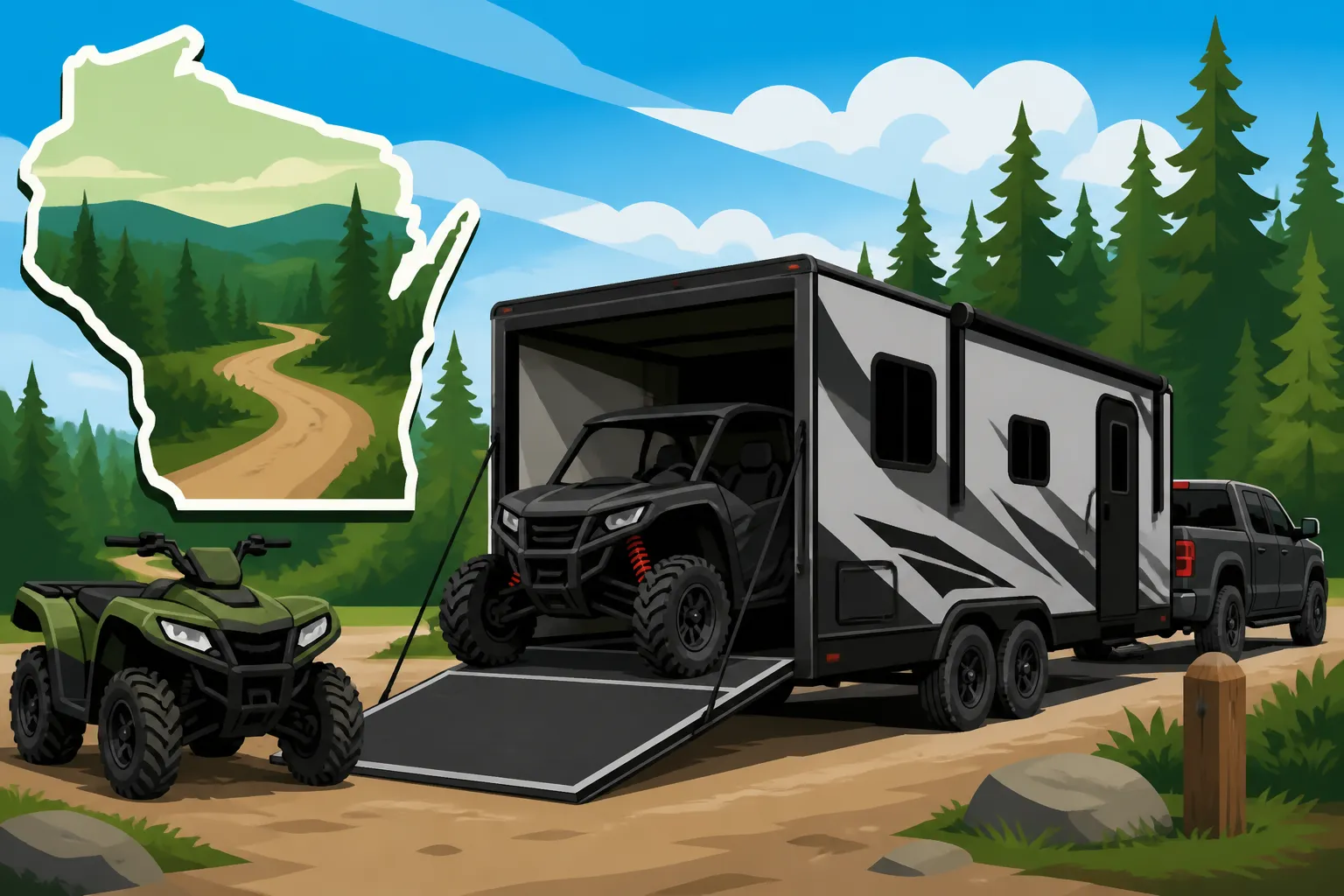
Also consider what happens after you park. You may need enough room to lower a ramp, unload an ATV or UTV, move gear, and still leave a clear path for other visitors. A spot that technically fits the rig may not work if the ramp extends into a travel lane or blocks access to another vehicle.
Before heading north, test your setup somewhere familiar, such as a large, quiet lot where you can practice reversing and unloading. Note how much room you actually use. It is much easier to learn that your ramp needs extra clearance in a spacious lot than at a busy trailhead outside Eagle River or Black River Falls.
Know what kind of parking area you are looking for
“Trailhead parking” can mean a wide gravel lot, a small staging area, a roadside pull-off, or a developed recreation site with marked spaces. Those setups do not offer the same room for a long toy hauler. A parking area suitable for a pickup and short utility trailer may be difficult to use with a larger rig, especially when other vehicles are already parked.
Look for information about the specific access point rather than assuming every trailhead in a county has the same layout. Search for signs of a designated staging area, a trailer-friendly lot, or a nearby campground where you can leave the hauler and ride out on the machine. The guide to [Wisconsin Trailhead Parking and Staging] can help you think through those differences before choosing a starting point.
Do not treat an unmarked roadside space as overflow parking unless it is clearly permitted and safe. A shoulder may be soft, narrow, or close to moving traffic. On rural roads, a parked trailer can also obstruct farm equipment, logging trucks, or local access. If the parking instructions are unclear, ask the managing office before you arrive.
Check the rules for the exact lot
A lot that looks large on a map may have local restrictions, seasonal closures, or limits on overnight parking. The operator may be a county forestry department, a town, a state agency, or another land manager. Rules can differ even between nearby access points, so do not rely on a friend’s experience at a different trailhead as confirmation.
Confirm whether trailers are allowed, whether the lot is open to overnight parking, and whether there are restrictions on unloading or camping. Ask about gate hours, seasonal conditions, and any vehicle-size concerns. If staff cannot confirm that a long toy hauler will fit, ask for the name of a nearby alternative or a recommended staging location.
A quick check with the managing office can save you from reaching a narrow lot late in the day and having to search for another place to turn around. Keep the answer, including the office contact details, with your trip notes.
Choose a Wisconsin Riding Area With Parking in Mind
Match the lot to your route and machines
Wisconsin riding destinations are spread across a mix of county forests, state forest areas, and trail systems near small Northwoods communities. Eagle River and Conover, Rhinelander, Crivitz, and Black River Falls are examples of areas riders may consider, but the parking layout and access options depend on the specific trailhead. Choose the riding area and the place to park as one plan, rather than picking a trail first and hoping the lot works.
Make sure the route suits your machine as well as your trailer plan. Some trails or connecting roads may have restrictions that affect machine width, and trail conditions or closures can change the route you intended to ride. Use a county map and verify the current status before setting your GPS destination. [Planning a Wisconsin Riding Trip] and [Wisconsin Trails for a Full-Size Truck] are useful starting points when comparing access and trail suitability.
If you are bringing a wide side-by-side, check whether the routes you plan to use allow that machine. A large trailer does not make a trail unsuitable by itself, but it can make a poor trailhead choice much harder to fix once you arrive. Confirm the vehicle access, the permitted riding area, and the parking location separately.
Use maps to narrow the search, then verify on the ground
Online maps can help you find likely staging areas, roads, and nearby services, but a map pin is not proof that a toy hauler can park there. Satellite imagery may be old or may not show a seasonal gate, a newly posted restriction, soft ground, or a crowded lot. Treat maps as a way to shortlist locations, not as permission to use them.
The county or land manager’s trail map is especially useful for checking where a trail begins, which roads connect to it, and whether a proposed lot is actually near the route. [Finding a Wisconsin County Trail Map] and [County Forestry Offices and Trail Maps] can help you locate the right information. If you use onX Offroad to compare access points, confirm important details with the land manager as well. A mapped road or parking pin does not guarantee that parking is allowed or that the space is suitable for a long trailer.
When possible, identify a primary lot and a backup before leaving. Save both locations offline, along with the route between them. This matters in areas where cell reception is unreliable, especially when you are navigating unfamiliar forest roads with a trailer behind you.
Build in a backup that does not depend on roadside luck
A practical backup is a campground, resort, or other established place that permits trailer parking and has suitable access to your riding area. That may mean leaving the toy hauler at your campsite and towing the machines separately, or parking the full rig at an approved staging lot for the day. Ask before assuming that a business or campground will let you use its lot without being a guest.
Consider how far you are willing to tow the machines from the hauler to the trail. A nearby access point can reduce the time and hassle of unloading, but a longer tow may be worthwhile if it gives you a safer, more spacious place to park. [Wisconsin Campgrounds With Trail Access] can help you consider a base camp instead of relying entirely on public trailhead parking.
Keep your backup plan realistic. A tiny village lot, a gas station, or a roadside pull-off is not a reliable substitute unless the owner or managing agency has explicitly approved it. If the primary parking area is full, you want a legitimate alternative—not an improvised one that could block traffic or create a safety problem.
Plan the Approach and Arrival
Check road access before towing the rig
The shortest route on a navigation app is not always the easiest route with a toy hauler. Narrow local roads, sharp turns, low clearances, construction, gravel, and soft shoulders can all complicate the drive. Review the route in advance and pay attention to the final approach, not just the highway portion. A forest road that is comfortable in a pickup may feel very different with a long trailer.
Use a map to identify turnarounds and places where you could safely stop if the lot is full. Avoid relying on a driveway or private access road as a place to turn around unless you have permission. If the final road looks questionable, contact the land manager or a nearby campground for guidance before committing to it.
It can help to arrive during daylight, particularly if you have not used the access point before. You will have a better view of the lot entrance, gravel edges, overhead branches, signs, and other parked vehicles. For remote routes, download maps and directions before losing service; [Cell Dead Zones in Northern Wisconsin] covers why offline planning can be useful.
Arrive with a simple unloading routine
Before you pull into a busy lot, know what you will unload and where it will go. Secure loose gear inside the trailer, keep the ramp area clear, and make sure helmets and riding equipment are easy to reach. If possible, park so that the ramp opens into a space where you are allowed to unload without blocking traffic or another vehicle.
Take a moment to assess the surface before lowering the ramp. Loose gravel, mud, snow, or a sloped shoulder can affect traction and stability. If the lot is crowded, do not force the trailer into a space that leaves no room for safe unloading. It is better to ask other members of your group to wait or to use a more suitable approved location than to create a pinch point in a narrow aisle.
Once unloaded, arrange the tow vehicle and trailer according to the lot’s rules. Do not assume that the machines can be left in the trailer area while the rig is moved elsewhere, or that you may occupy multiple spaces. Follow posted signs and leave room for emergency access, maintenance vehicles, and other riders.
Have a plan for a full lot
Trailhead parking can be tightest when many riders arrive at once, such as on popular weekends or during favorable riding weather. If you reach the lot and cannot fit safely, do not block the entrance while you decide what to do. Move to a safe, legal place and use your backup plan.
Before the trip, save the contact information for the parking-area manager and identify the nearest approved alternative. If the lot is managed by a town or county, ask whether staff recommend a different staging point for large trailers. You can also check [Checking Wisconsin Trail Status Before You Drive] for a reminder to verify access conditions before setting out.
A full parking area can also be a sign that your group should adjust its timing or base location. For example, you may choose to stage at a campground and tow the machines to the trail, or ride from a permitted location with access to the route. That may take extra coordination, but it is safer than squeezing a long rig into a space that was never designed for it.
Make Parking Part of the Whole Weekend Plan
Compare parking options before choosing where to stay
Your best parking solution may not be at the trailhead itself. A campground with suitable access, a lodging property that welcomes trailers, or a designated staging area can provide more predictable space. Ask directly about the full combination of tow vehicle and toy hauler, rather than asking only whether there is “trailer parking.”
| Parking option | Potential advantage | What to confirm |
|---|---|---|
| Designated trailhead or staging lot | Direct access to the riding area | Trailer permission, available space, unloading room, and overnight rules |
| Campground with trail access | A base for the rig and a place to stay | Trailer fit, machine access, route connections, and guest parking rules |
| Town or business lot | May be near food or services | Explicit permission, time limits, security, and whether overnight parking is allowed |
| Roadside pull-off | May appear convenient on arrival | Legal status, traffic safety, ground firmness, and whether trailers are permitted |
For an overnight stay, ask whether the trailer can remain connected to the tow vehicle and whether machines can be unloaded and secured. Some places may have room for a truck but not the full rig; others may allow a trailer only for registered guests. Confirm any storage or parking arrangements directly with the property before booking.
If the plan includes riding to a nearby town for food or fuel, do not assume the trail or road connection is open to your machine. Check the route rules and town ordinances before relying on that connection. [Wisconsin Trails That Reach a Tavern] offers useful context for planning a ride around local access rather than simply following a map line.
Keep the parking area safe and considerate
A toy hauler can occupy a substantial amount of space, so careful parking is part of being a considerate trail user. Stay within marked areas, keep ramps and machines out of traffic lanes, and leave room for other trailers to maneuver. Avoid spreading gear across empty spaces, even when the lot looks quiet at first.
Secure the trailer and valuables when you leave the parking area. Keep registration and ownership documents where you can find them, but do not leave sensitive paperwork visible. Before riding away, check that the ramp is closed, the tow vehicle is locked, and any loose equipment is secured.
Be mindful of noise, dust, and the people who live near trail access. Idling for a long time, revving machines, or unloading before permitted hours can affect nearby residents and other visitors. Respect posted hours and local rules, particularly around small Northwoods communities where a trailhead may be close to homes or businesses.
Use a final pre-trip checklist
A short checklist can catch the details that are easy to forget while packing machines and riding gear. Before departure, confirm the parking location, its manager, and the rules for trailers. Save your primary and backup locations offline, and make sure everyone in the group knows where to meet if vehicles arrive separately.
Before you tow into the lot, check the weather and recent trail information. Rain can make gravel approaches soft, while winter conditions can change the usable space or access. Review [Wisconsin Trailhead Parking and Staging] alongside the relevant county map, then verify any uncertain details with the land manager.
Use this practical sequence:
- Measure the combined tow vehicle and toy hauler.
- Choose a specific trailhead or staging area and confirm trailer access.
- Ask about overnight parking, gate hours, and unloading rules.
- Save a legal backup location and offline directions.
- Check road access, trail status, and any machine-width restrictions.
- Arrive with enough daylight and space to unload safely.
- Follow posted rules and leave the lot clear for other users.
Parking takes only a small part of a riding weekend when it goes well. A little advance checking can prevent the frustrating version: arriving tired, finding a cramped lot, and trying to turn a long rig around on an unfamiliar road. Plan the trailhead and trailer together, and your Wisconsin ride can start with a much calmer unload.
Disclaimer
This article is for general informational purposes only and does not constitute professional advice. Laws, prices and regulations vary by location and change over time. Consult a qualified professional for guidance on your specific situation.