Towing Off a Wisconsin County Trail
A disabled ATV or UTV can turn a relaxed ride into a stressful problem fast, especially when it is stuck in mud, has a flat tire, or stops far from the trailhead. This guide explains how to assess the situation, arrange a safe recovery, and avoid damaging Wisconsin county trails—or making a manageable breakdown worse.
Start with safety and a clear recovery plan
Get everyone out of immediate danger
Before you reach for a tow strap or winch remote, pause and look at the whole scene. Is the machine on a slope, partly in water, close to a blind corner, or blocking a narrow trail? Is anyone hurt? If there is an injury, fire risk, or other immediate danger, contact emergency services rather than treating the problem as a routine breakdown.
Move riders to a safer spot if you can do so without crossing traffic or standing in the path of a moving machine. Keep bystanders well away from a recovery line: a strap or cable under tension can snap back if it breaks or a connection fails. Do not let someone stand between two machines, downhill from a stuck ATV, or beside a winch line while it is loaded.
Make the disabled machine visible to approaching riders. Use its lights or hazard lights if available, and have someone watch for traffic from a safe position. On a busy trail, keep the group together and avoid leaving a person alone with a broken machine while others go looking for help. In remote areas, cell service can be unreliable, so check your group’s communication options before splitting up. [Cell Dead Zones in Northern Wisconsin] offers more context for planning around coverage gaps.
Identify the problem before pulling
A machine that will not move is not automatically a machine that needs a hard pull. First check for obvious causes: a flat or damaged tire, a loose belt, a disconnected battery lead, a branch caught underneath, or a machine resting on its skid plate. Shut off the engine before inspecting moving parts, and avoid reaching beneath a machine that could shift or roll.
Then assess the ground around it. A tire buried in soft mud calls for a different approach than a broken axle, a puncture on rocky ground, or a machine tipped on a slope. If the machine is mechanically damaged, dragging it may turn a repairable problem into a more expensive one. Look at the owner’s manual for approved recovery points and towing guidance; designs differ between ATV and UTV models.
Also consider what is around the machine. A narrow wooded trail may leave little room to line up a tow vehicle, while a steep, wet bank can make a straight pull dangerous. A recovery plan should account for the route the machine will take as it moves—not just the direction that looks easiest from where you are standing.
Choose the least risky way to move the machine
Use a winch or tow strap only with suitable equipment
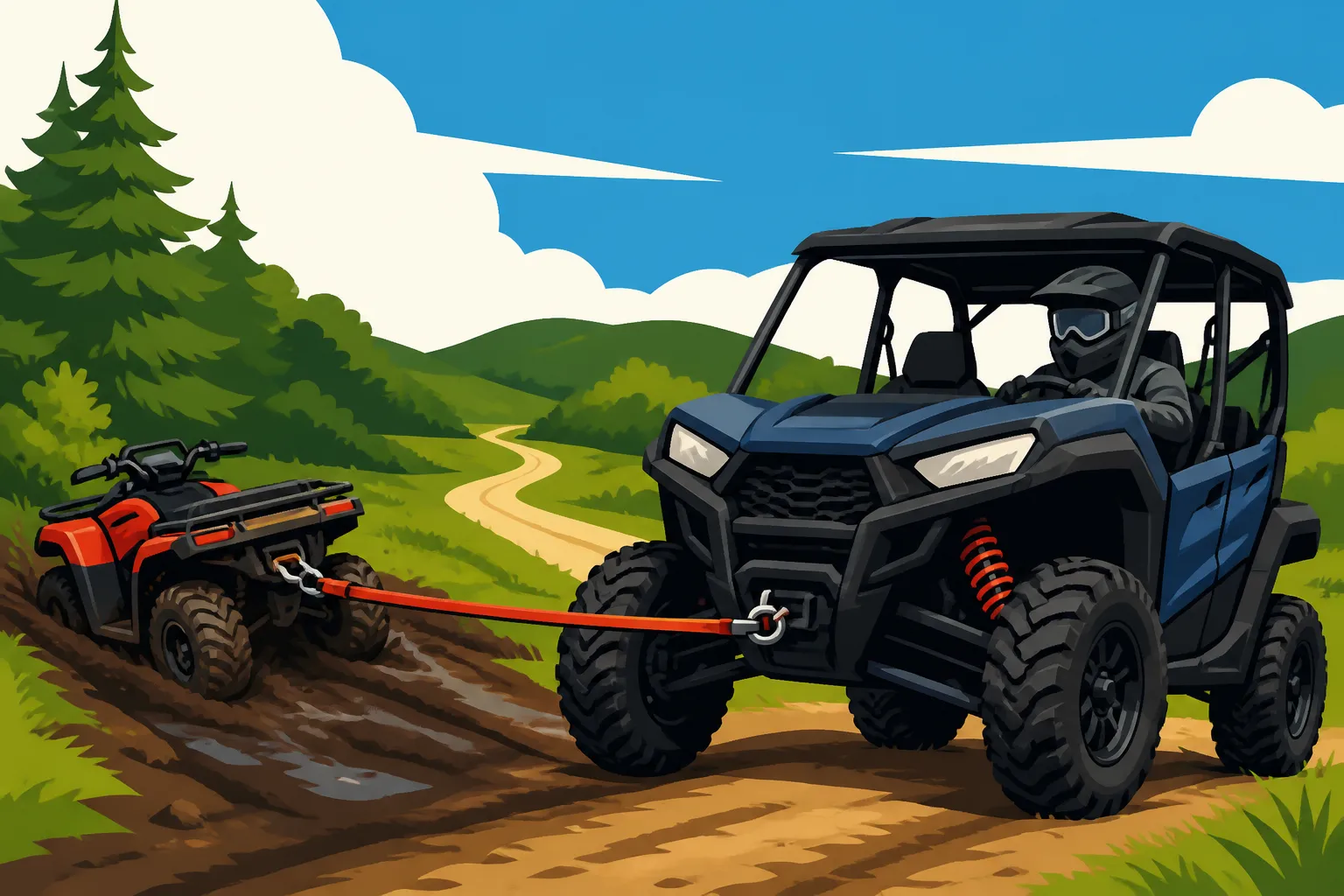
For a minor bog or a machine that can still roll, a winch or properly rated recovery strap may help. Use designated recovery points, not a trailer-ball hitch, axle, steering component, rack, or other part that is not intended to take a pulling load. A tow ball can fail under a sudden load and become a dangerous projectile. If you are unsure where to attach, stop and consult the machine manual or a qualified recovery operator.
Keep the pull controlled and as straight as the situation allows. Sudden acceleration, jerking, and improvised extensions can shock-load equipment. If using a winch, keep hands clear of the drum and line, and follow the manufacturer’s instructions for the winch and any accessories. Never stand in the line’s path or lean over a loaded strap. A tree used as an anchor needs an appropriate tree-saver strap; wrapping a cable directly around a trunk can damage the tree and may not provide a secure anchor.
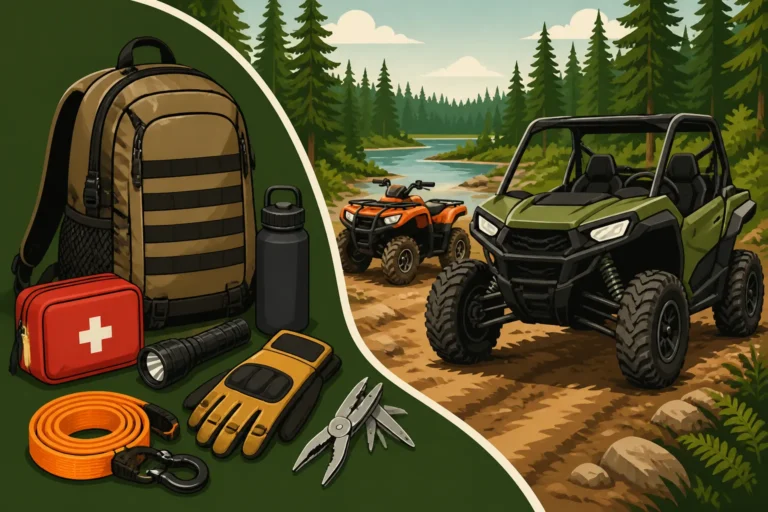
The right gear makes a difference, but carrying gear is not the same as being ready to use it safely. Before a trip, learn how your winch operates, where your machine’s recovery points are, and how your strap or shackles connect. A practical packing list is covered in [Recovery Gear for Wisconsin Mud]. If the machine is buried deeply or the pull would require a steep sideways angle, do not keep escalating the force just because you have equipment.
Know when not to tow
Some problems should not be handled with a casual pull. Avoid towing a machine that has a damaged steering system, a wheel that may come off, a compromised frame, or a drivetrain problem that could lock up. A machine on its side or close to tipping can shift unexpectedly during recovery. Likewise, do not try to pull a machine uphill or across a slope if the recovery vehicle could slide, roll, or be dragged toward the disabled one.
If one machine is towing another, check both owners’ manuals for safe towing procedures. Keep the tow line short enough to maintain control but long enough to avoid the machines colliding, and agree on simple signals before starting. The person operating the disabled machine should steer and brake only if the controls work and doing so is safe. If the machine cannot be controlled, a moving tow may create more risk than leaving it in place until help arrives.
When a machine is stuck in a bog, a controlled winch pull from a suitable anchor may be safer than trying to yank it free with another ATV. [Winching Out of a Northwoods Bog] covers the specific challenges of that situation. If you lack the right anchor, recovery point, or experience, calling for help is a sensible decision—not a failure.
Protect the trail and arrange outside help
Avoid turning a breakdown into trail damage
Wisconsin county trails can pass through fragile ground, wet areas, and narrow corridors where a recovery attempt can cause lasting damage. Do not drive around a stuck machine onto vegetation or unmarked ground just to get a better angle. That can widen the trail, damage habitat, and create a hazard for the next rider. If a recovery requires leaving the marked route, stop and check what access is allowed before moving another machine off-trail.
Pay particular attention to wet conditions. Spinning tires can dig ruts quickly, and repeated attempts often make a machine sink deeper. A slow, deliberate recovery is usually kinder to the trail than revving hard and hoping for traction. If the machine cannot be moved without tearing up the surface, leave it secure and seek assistance from the appropriate county or recovery contact.
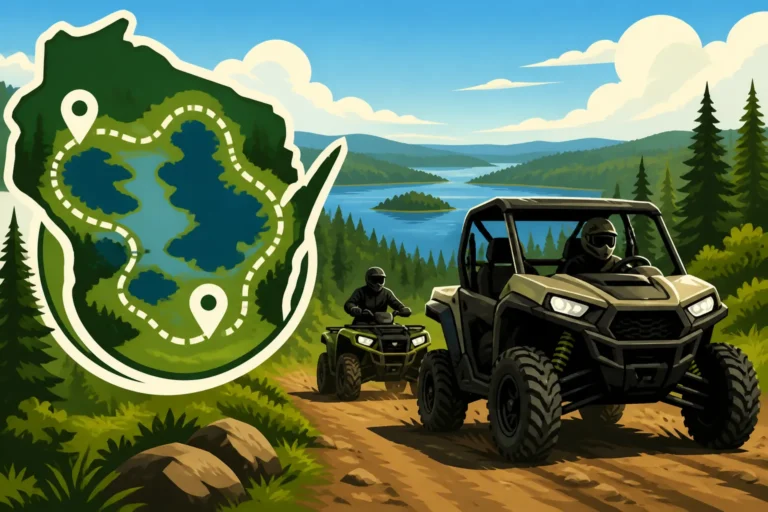
Rules and access arrangements can vary by county and trail system. Before heading out, check the local trail information and closures, especially after rain or during seasonal restrictions. [Wisconsin County Forest Trail Systems] explains why local management matters, while [Checking Wisconsin Trail Status Before You Drive] can help you build a trail-status check into your trip planning. A map app such as onX Offroad can help you understand your location and nearby mapped routes, but a mapped line should not be treated as permission to use an unmarked road or private access.
Give rescuers useful information
If you need outside help, share details that make the location easier to find: the trail name or number, nearest intersection or landmark, direction of travel, machine type, number of people with you, and whether anyone is injured. If you have a map pin or coordinates, send them clearly. Mention hazards such as a steep approach, flooded section, blocked trail, or a machine that cannot roll.
Do not assume a commercial towing or roadside service can reach the machine. County forest trails may be too narrow, soft, or remote for a standard tow truck. Ask whether the person you contact has experience recovering off-road machines and whether they can legally and safely access that location. A local ATV club, trail contact, nearby repair shop, or county forestry office may be able to point you toward an appropriate option, but availability varies by area and situation.
If the recovery blocks the trail or causes damage, report it to the appropriate local authority or trail manager once the immediate safety issue is handled. Include the location and a plain description of what happened. [Reporting Trail Damage in Wisconsin] can help you think through what details are useful. For a collision involving injury or other reportable circumstances, consult [Wisconsin ATV Crash Reporting] rather than treating it as an ordinary equipment breakdown.
Prepare before the next ride
Carry what matches the trip
A short ride near a well-used staging area has different needs from a long day on remote forest trails. At minimum, think through communication, basic tools, tire repair, water, first aid, and the recovery equipment suited to your machine. A full-size UTV may need different gear and a different recovery plan from a compact ATV. Check equipment ratings and your vehicle manual instead of assuming one strap or accessory works for every setup.
Plan around the terrain and season. Rocky sections can damage tires, while spring mud and low-lying areas can make a minor stop much harder to manage. Cold weather adds another concern: a delayed recovery can leave riders exposed while they wait. Tell someone where you expect to ride and when you expect to return, particularly if the route crosses areas with limited service.
Use onX Offroad or another mapping tool as one part of your preparation, not as your only safety plan. Download or save the information you need before entering an area with weak coverage, and carry a backup way to navigate if your phone battery dies or the device fails. For a broader checklist, see [What to Carry on a Northwoods Ride] and [Carrying a Satellite Messenger Up North].
Reduce the odds of needing a tow
A quick pre-ride inspection can catch problems that are easier to fix at the trailer than in the woods. Check tire condition and pressure, lights, fuel, visible leaks, battery connections, and any accessories that could come loose. If the machine has been making a new noise or behaving differently, do not assume the issue will wait until after the ride.
Match your route to the machine and the group. A narrow or rough trail can be a poor fit for a wide side-by-side, while a newer rider may need a shorter route with easier access points. Check trail conditions before setting out, and avoid pushing through a section that is already taking repeated attempts to cross. If the machine starts to lose traction, stop early and reassess instead of digging deeper.
Finally, agree on a simple group plan: who carries recovery gear, who has the map, how you will contact one another, and what to do if the group gets separated. Those conversations can feel unnecessary when the day is going smoothly, but they make a breakdown much less chaotic. When a machine does need towing off a Wisconsin county trail, the safest recovery is usually the one that protects people first, uses the right equipment, and leaves the trail in good condition.
Disclaimer
This article is for general informational purposes only and does not constitute professional advice. Laws, prices and regulations vary by location and change over time. Consult a qualified professional for guidance on your specific situation.