Fuel Planning for a Wisconsin Trail Day
A trail day in Wisconsin can go sideways when the next fuel stop is farther away than expected, a machine burns more than it did on the test ride, or a route detour adds unplanned miles. This guide shows you how to estimate fuel needs, plan around uncertain access, carry fuel safely, and build a practical backup plan before leaving the trailhead.
Estimate your machine’s real-world fuel range
Treat the owner’s manual as a starting point
Your ATV or UTV’s owner’s manual is the first place to check for tank capacity, recommended fuel, and any guidance on fuel storage or operation. But tank capacity alone does not tell you how far you can ride. Two machines with similar-sized tanks can use fuel differently, and the same machine can cover very different distances depending on how it is driven.
Use your own riding history to estimate range whenever possible. Record how much fuel you add before and after a familiar ride, along with the route length and conditions. A ride on easy, dry trails at a steady pace may give you a very different result from a muddy day with frequent stops, steep sections, or extended low-speed operation.
If you have only just bought the machine, avoid planning a long remote loop around a brochure estimate or a single short test ride. Start with a conservative local outing, refill afterward, and note the fuel used. Repeat in different conditions if you can. That practical baseline is much more useful than assuming the machine will always get the same mileage.
Build in a reserve rather than planning to arrive nearly empty
A fuel estimate should include a margin for the things that rarely go exactly to plan. A group may take a wrong turn, a trail may be closed, or a rider may need to slow down and wait for others. In Wisconsin’s county forests and Northwoods trail systems, routes can connect through a mix of trails and roads, so an unplanned change can add meaningful distance.
For a simple planning method, estimate fuel use on a route you know, then add a reserve that you will not count as available for the planned ride. The right buffer depends on your machine, route, group, weather, and how far you are from a reliable place to refuel. When fuel access is uncertain or the route is remote, make the plan more conservative rather than trying to calculate to the last drop.
Do not treat a low-fuel warning as a dependable trip-planning tool unless you have tested how it behaves on your machine. Warning systems can differ, and a gauge may be hard to read on rough terrain. If you are not sure how much fuel remains, act as though you have less than the display suggests and head toward a known refueling option.
Plan fuel stops around the route, not just the map
Confirm where refueling is possible
A map can show a town, road, or cluster of businesses without telling you whether fuel will be accessible to riders during your trip. A station may be away from the trail, have limited hours, or be difficult to reach without riding on a road route. Do not assume that a nearby town means a convenient fuel stop.
Before leaving, identify a primary refueling option and at least one backup. Check the location, opening information, access route, and whether your group can legally reach it on the machines you are riding. Local route rules vary, so verify that a road connection is open to ATVs or UTVs rather than assuming that every public road between trail sections can be ridden.
This is especially important when staging near communities such as Eagle River, Rhinelander, or Black River Falls. The surrounding trail network may offer riding opportunities, but the exact route access and services available to you depend on where you start and which trails or routes are open. Local maps, posted notices, and county information can help confirm the day’s plan.
Use [Wisconsin Trailhead Parking and Staging] to think through where you will leave a truck and trailer, and check [Wisconsin Gas Stations Along the Routes] for fuel stops.
Check conditions and access before driving to the trailhead
Fuel planning starts before you load the machines. Wisconsin trail status can change with weather, seasonal closures, maintenance, or local restrictions. A closure or detour may alter the distance you can travel and whether your planned fuel stop is reachable. Review the local county or land-manager information before departure, then check again if conditions change.
A route app can help you visualize distance and connections, but don’t rely on a single digital map as proof that a route is open or legal. Apps such as onX Offroad can be useful for reviewing your planned route and marking places you may want to check, while official local information should guide decisions about closures and access. Save important details for offline use if your route could take you beyond reliable cell coverage.
If you are riding in a group, share the route and planned fuel stops with everyone before you leave. A rider who joins at the trailhead may have a smaller tank, a different machine, or less familiarity with the area. Agree on where the group will regroup and what to do if one machine needs fuel sooner than expected. For map preparation, see [Reading a Wisconsin County Trail Map] and [Checking Wisconsin Trail Status Before You Drive].
Account for riding style, terrain, and group differences
Expect conditions to change fuel use
Fuel consumption is not fixed from one outing to the next. Deep mud, soft sand, snow, hills, repeated stops, heavy loads, and low-speed maneuvering can all make a ride more demanding than a smooth, steady trip. A route that looks short on a map may still use more fuel if it involves difficult terrain or lots of time spent working the machine.
Riding pace matters, too. Fast acceleration, high engine speed, and frequent hard throttle inputs can use more fuel than a relaxed pace. That does not mean you need to crawl along or avoid challenging terrain; it means your estimate should reflect how your group actually rides. If your usual outing includes spirited riding or demanding trail sections, use a baseline from similar conditions rather than one measured on a gentle path.
Weather and temperature can also affect how a ride feels and how machines perform. Cold starts, long warm-ups, and winter equipment may change the day’s fuel needs. In winter, allow for the possibility that a route will take longer than expected and that access to services may differ from a summer ride. [Winter Trail Riding in Wisconsin] and [Fuel Costs for a Northwoods Trail Weekend] can help you think through seasonal trip planning.
Plan for the machine with the shortest practical range
A group is only as capable as its least-resilient fuel plan. Do not base the whole day on the biggest tank or the most efficient machine. Consider each rider’s machine, how much fuel it starts with, any added cargo, and whether the operator knows its real-world range.
Ask each rider to arrive with a full tank when practical, and confirm that everyone understands the planned distance and refueling points. If a youth machine or a smaller ATV is part of the group, account for its fuel capacity and the possibility that its rider will need more frequent breaks. The pace may need to suit the youngest or least experienced rider, and a shorter loop can be a better choice than trying to stretch a small machine’s range.
| Planning factor | Why it matters | Practical response |
|---|---|---|
| Tank capacity | A larger tank does not guarantee greater range | Use observed fuel use, not capacity alone |
| Terrain | Mud, sand, hills, and snow can increase demand | Choose a conservative estimate for difficult conditions |
| Group machines | Range and fuel displays vary by machine | Plan around the machine with the shortest practical range |
| Route access | A fuel stop may not be legally reachable from the trail | Confirm connections and local rules in advance |
| Detours and delays | Closures or navigation mistakes can add distance | Keep an unused reserve and identify a backup stop |
If your group has several machine types, choose a route and schedule that do not pressure the shorter-range rider to continue past a sensible point. You can split into smaller groups only if everyone has a safe, agreed plan and understands the meeting place. For youth riders, [Riding Wisconsin Trails With Kids] offers useful context for adapting a day to the people in the group.
Carry extra fuel carefully when it makes sense
Decide whether a fuel container is necessary
A spare container can provide a useful safety margin when fuel options are sparse, the route is remote, or your machine has a limited practical range. But carrying extra fuel is not automatically the best answer. It adds weight, requires secure storage, and brings additional fire and spill risks. First look at whether a shorter route, an earlier refueling stop, or a different staging point can solve the problem more simply.
If you do carry fuel, use a container intended for fuel and follow its manufacturer’s instructions. Keep it closed, upright, and secured so it cannot shift, tip, rub against hot components, or interfere with steering and visibility. Do not put a container where it can be crushed by cargo or struck during a rollover. Check the machine and container guidance before deciding where or how to mount it.
Avoid carrying extra fuel in an improvised bottle, household jug, or container that is not designed for the purpose. Heat, vibration, and rough trails are a poor match for a loose or unsuitable container. If you are unsure whether a setup is safe on your particular ATV or UTV, ask a qualified mechanic or consult the manufacturer’s instructions before riding.
Refuel away from heat and ignition sources
Refueling requires care whether you are at a station or using a carried container. Stop the machine, follow its shutdown and refueling instructions, and keep fuel away from flames, smoking materials, and other ignition sources. Avoid spilling fuel on hot parts. If a spill occurs, address it safely before restarting or moving the machine.
Choose a stable, appropriate place to refuel rather than stopping wherever the machine happens to run low. Keep the container and nozzle controlled, avoid overfilling, and close caps securely. Never refuel inside an enclosed trailer or poorly ventilated space. If you are fueling a group of machines, take turns and keep other riders and passengers clear of the immediate area.
Fuel storage and transport rules can vary by location and situation, so check applicable requirements before carrying fuel in a truck, trailer, or on a machine. Keep fuel out of passenger areas, away from food and gear, and secured during transport. For the rest of your hauling setup, [Strapping a Machine Down for the Freeway] and [Wisconsin Trailhead Parking and Staging] address related preparation concerns.
Build a dependable fuel plan for the day
Use a simple pre-ride checklist
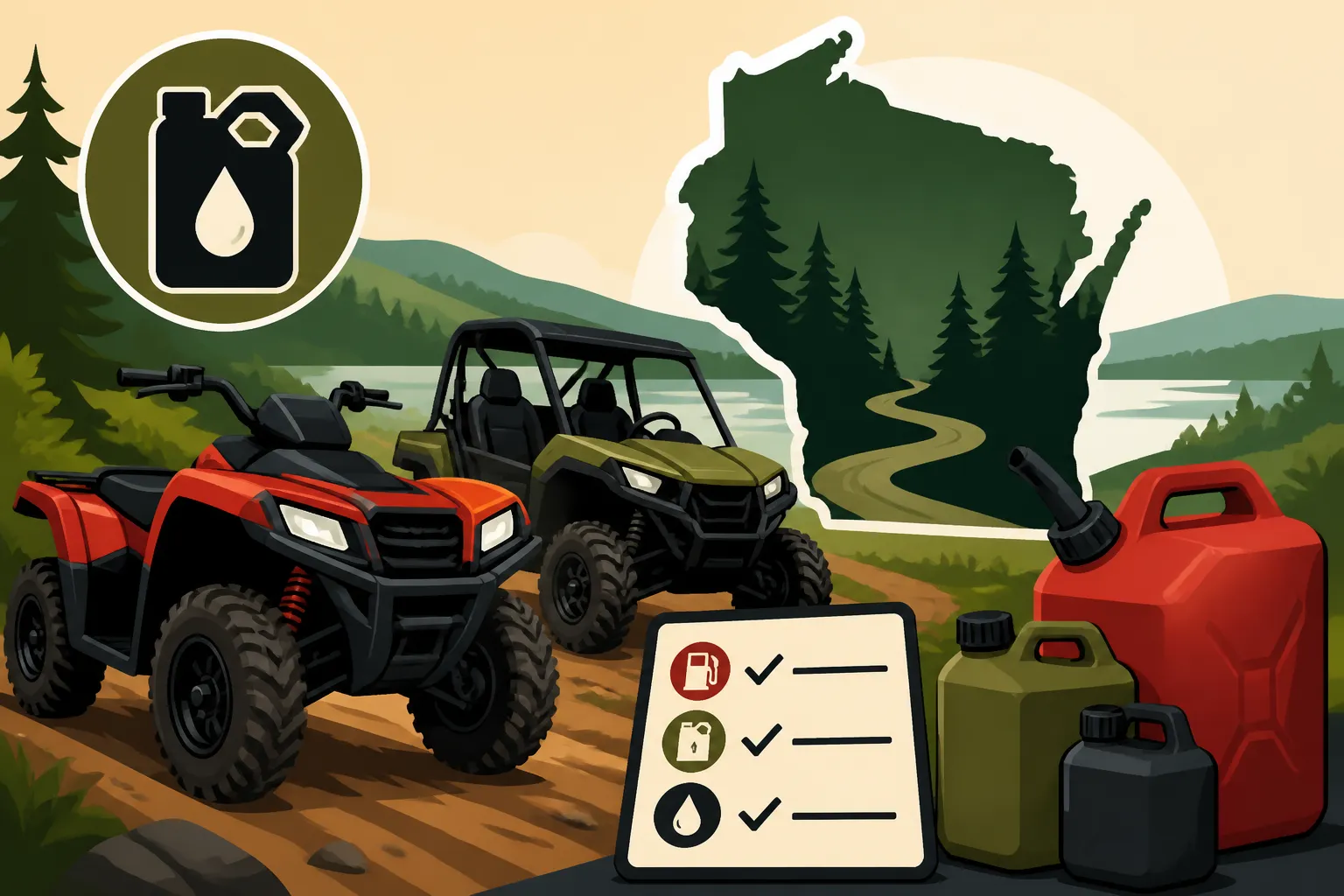
A short checklist can prevent the familiar trailhead scramble: one rider has a nearly empty tank, someone forgot a cap, or the group is unsure which town has fuel. Before loading, confirm that each machine has enough fuel for the planned route plus a reserve. Check that fuel caps close correctly, gauges or warning systems are behaving normally, and any carried container is suitable and secure.
Write down the planned route, expected refueling point, backup option, and turnaround point. A turnaround point is particularly helpful when the group is behind schedule or fuel use is higher than expected. Decide in advance that reaching it means turning back or switching to a shorter loop, rather than debating the choice after the reserve is already being used.
A practical checklist can include:
- Confirm the day’s trail status and any local access restrictions.
- Estimate the route distance and compare it with your tested range.
- Identify a primary and backup refueling location.
- Confirm that each rider starts with adequate fuel.
- Secure any approved spare fuel and keep it away from heat and passengers.
- Share the route, meeting points, and turnaround plan with the group.
- Save maps or directions for areas where cell coverage may be unreliable.
Make decisions early when plans change
The best time to change the plan is before anyone is close to empty. If a route is closed, the group is delayed, or a machine’s fuel level drops faster than expected, pause somewhere safe and reassess. Compare the remaining fuel with the distance to the nearest confirmed refueling point or trailhead, not merely the next place name on a map.
Do not let group momentum turn a manageable change into a stressful one. A rider may feel embarrassed about stopping the group, especially if the issue comes from an inaccurate gauge or an overlooked fuel check. Treat fuel checks as normal trail etiquette. A quick stop early in the day is easier than trying to solve a range problem far from the trailhead.
After the ride, note how much fuel each machine used and what conditions were like. Record whether the group followed the planned route, encountered detours, or spent time in slow terrain. Over a few outings, those notes will give you a realistic range for your machine and help you plan future trips with less guesswork. For broader preparation, [What to Carry on a Northwoods Ride] and [Planning a Wisconsin Riding Trip] can help round out your checklist.
Disclaimer
This article is for general informational purposes only and does not constitute professional advice. Laws, prices and regulations vary by location and change over time. Consult a qualified professional for guidance on your specific situation.