Wisconsin Registration for an Out-of-State Machine
Moving your life to Wisconsin, or just spending extended periods here, can bring a whole host of questions, especially when you have an ATV or UTV from another state. Many riders find themselves scratching their heads, wondering if their existing out-of-state registration is enough or if they're now stuck navigating a whole new set of rules to get their machine legal for Wisconsin's incredible trails and routes. This guide aims to clear up that confusion, helping you understand exactly what's needed to register your out-of-state machine here in America's Dairyland.
Understanding Wisconsin's Registration Philosophy
Wisconsin has a unique way of handling ATV and UTV ownership that can be quite different from other states. If you're coming from a state where your quad has a title, you're in for a bit of a paradigm shift.
Why Wisconsin Does Not Title ATVs (and What That Means)
One of the biggest head-scratchers for new Wisconsin residents or frequent visitors is the fact that Wisconsin simply does not title ATVs. That's right, there's no official paper title like you'd get for a car, truck, or even some boats. For many, this feels a bit unsettling, as a title is often seen as the ultimate proof of ownership. However, in Wisconsin, the registration itself serves as the primary legal document linking you to your machine. This can create a lot of confusion, especially when you're trying to transfer ownership or prove that the machine you brought from out of state is indeed yours.
This lack of a title means that the paperwork you do have – like a bill of sale, previous registration from your home state, or a Manufacturer's Statement of Origin (MSO) – becomes incredibly important. Without a title, these documents are your best friends in establishing a clear chain of ownership, which is absolutely critical when you approach the Wisconsin Department of Natural Resources (DNR) to register your machine. Imagine trying to explain to a registration agent why your machine has a title from Minnesota but Wisconsin doesn't issue one – it can feel like you're speaking two different languages! Understanding that Wisconsin relies heavily on registration for official identification helps bridge this gap. If you're used to the security of a title, the absence here might make you feel a little exposed, but rest assured, the registration process is designed to formalize your ownership in the Wisconsin system. For more on this, check out [Why Wisconsin Does Not Title ATVs].
Public Use Versus Private Use: The Core Distinction
Before you even think about submitting paperwork, you need to understand the fundamental split in Wisconsin's ATV and UTV world: public use versus private use. This distinction dictates whether you need a Wisconsin registration at all, or if a non-resident trail pass will suffice. Public use means you intend to ride on designated public trails, routes, or frozen waterways open to ATV/UTV traffic, or access state-managed lands for hunting or fishing. If you're planning to explore the vast trail networks of northern Wisconsin, like those in Vilas or Marinette counties, you're firmly in the public use category.
Private use, on the other hand, means your machine will only be operated on private property where you have permission, and it will never touch a public trail, route, or frozen lake. Think of a quad strictly used for chores on your own farm, or for riding around a friend's hunting land in central Wisconsin. For these situations, a Wisconsin registration is typically not required. However, if your out-of-state machine will be ridden on public lands here, then you'll absolutely need to get it properly registered in Wisconsin as a public use machine, unless you're truly just visiting. This is where many people get tripped up: they assume their out-of-state plates cover everything, but Wisconsin wants to see its own sticker if you're going to be a regular rider on its public system. Knowing this distinction from the start will save you a lot of time and potential hassle. More information can be found in [Wisconsin's Public Use ATV Registration] and [Wisconsin's Private Use ATV Registration].
Bringing Your Machine to Wisconsin: The Initial Considerations
When you're bringing an ATV or UTV from another state into Wisconsin, your status as a resident — or even a seasonal visitor — can significantly impact your registration requirements. It's not always a clear-cut answer, and there are situations where what starts as a temporary visit can quickly necessitate a full Wisconsin registration.
Seasonal Residents and Wisconsin Registration
Wisconsin is a popular destination for seasonal residents, whether it's for a summer cabin on a Northwoods lake or a hunting camp in the fall. Many of these folks bring their ATVs or UTVs with them, assuming their existing registration from their home state is perfectly fine. For truly short-term visits, this might be true if you're only purchasing a non-resident trail pass. However, if you establish a residence in Wisconsin, even a seasonal one, and plan to use your machine on public trails and routes with any regularity, Wisconsin generally expects you to register it here. The DNR defines a resident as someone who has maintained their primary residence in Wisconsin for 30 consecutive days. So, if your summer stay extends past that, or if you're spending spring, summer, and fall at your cabin, you're likely considered a Wisconsin resident for registration purposes.
The grey area comes into play when you're technically still a resident of another state, but your machine spends the majority of its useful life on Wisconsin soil and trails. While specific rules can be complex and sometimes depend on interpretation, the safest bet for frequent or long-term seasonal use on public lands is to go through the Wisconsin registration process. It prevents awkward conversations with wardens and ensures you're fully compliant with local regulations. Many seasonal residents eventually find it simpler to get a Wisconsin registration than to constantly worry if their out-of-state status is sufficient.
Moving to Wisconsin With an Out-of-State Quad
If you're making a permanent move to Wisconsin and bringing your ATV or UTV with you, there's no escaping it: you'll eventually need to get that machine registered in Wisconsin. This isn't just a suggestion; it's a requirement once you establish residency. Wisconsin wants its residents' public-use machines to be properly documented and to contribute to the state's trail system through registration fees. This process can feel a bit daunting, especially if your previous state had a titling system that Wisconsin lacks.
The DNR generally allows a grace period for new residents to register their vehicles, but it's not unlimited. You should aim to complete the registration within a reasonable timeframe after moving. The conversion process involves essentially starting fresh in Wisconsin's system. You'll need to provide robust proof of ownership from your previous state, often a combination of your old registration card, a bill of sale, or even the title itself (even though Wisconsin won't issue a new one). This is where having all your ducks in a row with your existing paperwork becomes paramount. The goal is to prove to the Wisconsin DNR that you are the rightful owner and that the machine is legitimate, even if your previous state's documentation looks different. This is a common situation that many new residents face, and it's definitely achievable with the right documentation. You can learn more about this process in [Moving to Wisconsin With an Out-of-State Quad].
The Documents You'll Need for Wisconsin Registration
Successfully registering an out-of-state ATV or UTV in Wisconsin hinges on having the correct paperwork. Since Wisconsin operates without traditional titles for these machines, the burden of proof for ownership falls heavily on other documents. This is often the trickiest part of the process for newcomers.
Proof of Ownership Without a Title
This is frequently the biggest hurdle for machines coming from states that do issue titles, or even from those with less stringent documentation requirements. Since Wisconsin won't issue a new title, you must clearly demonstrate that you are the legal owner. The most common and accepted forms of proof include:
- Manufacturer's Statement of Origin (MSO) or Certificate of Origin (MCO): This is typically issued by the manufacturer to the dealer and then transferred to the first retail buyer. If your machine is relatively new and you're the original owner, this is ideal.
- Previous State's Registration Card: This is crucial. Even if your previous state titled the machine, Wisconsin will primarily look at your most recent registration card as proof that the machine was legally operated and registered to you elsewhere. Make sure it's current or recently expired.
- Bill of Sale: A detailed bill of sale, especially if it's from a reputable dealer or a private sale that clearly lists the buyer, seller, date, price, and most importantly, the Vehicle Identification Number (VIN), is incredibly valuable. This document establishes the transfer of ownership. If you purchased it privately, having a robust bill of sale can be the linchpin of your application. Tools like LawDepot offer templates for creating comprehensive bills of sale that can satisfy these requirements, even for private transactions.
- Previous State's Title (if applicable): While Wisconsin won't issue you a new title, having the title from your previous state, clearly showing you as the owner, is still excellent supporting documentation. It acts as additional proof of your claim to the machine.
Imagine you bought your quad ten years ago in a state that didn't even require registration for ATVs. You never got an MSO, and your bill of sale is long lost. This is where it gets tough. You might need to contact the original dealer, if possible, or even use an affidavit of ownership. The key is to compile as much verifiable information as possible to present a clear picture of your ownership. More details can be found in [Proof of Ownership Without a Title].
Verification of Vehicle Information VIN
The Vehicle Identification Number (VIN) is the machine's unique fingerprint, and it's absolutely non-negotiable for registration. The DNR will need to verify this number against your submitted documents and possibly against the machine itself. You'll typically find the VIN stamped on the frame of the ATV or UTV, usually on the front left side, beneath the handlebars, or on the frame near one of the wheels. For UTVs, it can sometimes be found on the driver's side door jamb or under the seat. It's critical that the VIN on all your ownership documents precisely matches the VIN on the machine. Any discrepancy, even a single digit, can halt your registration process dead in its tracks.
What if there's a mismatch? This can be a real headache. It could be a simple clerical error on an old bill of sale, or it could indicate a more serious issue, such as a stolen machine or one that has been illegally modified. If you suspect an error, try to obtain corrected documentation. In some cases, the DNR might require a physical inspection of the machine to verify the VIN. This step is designed to protect against fraud and ensure that only legitimately owned machines are registered in Wisconsin. So, before you even start the registration application, take a moment to locate and double-check the VIN on your machine against all your supporting paperwork. Where the VIN Sits on a Utility Quad offers some helpful tips for locating this critical number.
Proof of Sales Tax Paid (or Exemptions)
Wisconsin has a 5% state sales tax on most purchases, including ATVs and UTVs. When you register your out-of-state machine, the DNR will want to ensure that Wisconsin has received its due sales tax, or that you qualify for an exemption or credit. If you purchased the machine in another state, you might be eligible for a credit for tax paid to that state. This is a huge relief for many, as it prevents double taxation. You'll need to provide proof that you paid sales tax to the other state, typically in the form of a bill of sale that itemizes the tax paid or a separate tax receipt.
However, if you bought the machine in a state that has no sales tax, or if you purchased it from a private party who didn't charge sales tax, you will likely be responsible for paying Wisconsin's 5% state sales tax (plus any applicable county sales tax) when you register the machine here. This can sometimes come as an unwelcome surprise, so it's best to be prepared. There are certain exemptions, such as for gifts or transfers between immediate family members, but these usually require specific affidavits or forms. Understanding these sales tax rules upfront will prevent sticker shock during the registration process. Make sure your financial records are clear on this point. More information is available at [Credit for Tax Paid to Another State] and Wisconsin Sales Tax on an ATV Purchase.
The Actual Registration Process for Out-of-State Machines
Once you've gathered all your documents and understand the tax implications, it's time to tackle the actual registration. Wisconsin offers a couple of avenues for this, and knowing which one might be best for your out-of-state machine can save you time and frustration.
Registering Through the Wisconsin DNR Website
The Wisconsin DNR website is often the quickest and most convenient way to register or renew a machine for in-state residents. However, for machines coming from out of state, especially if it's your first time registering it in Wisconsin, the online portal might have limitations or require additional steps. You can typically find forms to print and mail, or sometimes a direct online option for new registrations, but it might not fully handle all the nuances of an out-of-state transfer seamlessly. If your out-of-state machine doesn't have a previous Wisconsin registration record, the online system might flag it for further review or require you to mail in supporting documents.
Common pitfalls include not having all the correct digital documentation ready, or encountering prompts that don't quite fit your out-of-state situation. For example, if the system asks for a previous Wisconsin registration number and you don't have one, it can be confusing. It's always a good idea to carefully read the DNR's specific instructions for new registrations and those converting from out-of-state status. After you submit your application and payment online, be prepared for a waiting period. The DNR processes applications in batches, and it can take several weeks for your new registration card and decals to arrive in the mail. Don't plan a trail trip for the very next weekend expecting your stickers to magically appear! You can learn more about this process in [Registering Through the Wisconsin DNR Website].
Registering Through Wisconsin Registration Agents
For many people bringing an out-of-state machine into Wisconsin, using a DNR authorized registration agent can be a real lifesaver. These agents, often found at sporting goods stores, bait shops, or even some municipal offices, are equipped to handle registrations in person. The huge benefit here is that they can review your documents on the spot, catch any missing information, and often process your registration immediately, handing you a temporary registration card right there. This instant gratification is invaluable, especially if you're eager to hit the trails.
When visiting an agent, make sure to bring all your supporting documents: your out-of-state registration, bill of sale, MSO, proof of sales tax paid (or money to pay it), and photo identification. The agent will typically fill out the necessary Wisconsin registration forms and process your payment. They act as a helpful intermediary, guiding you through what might otherwise be a confusing process of translating your out-of-state paperwork into Wisconsin's system. They can also explain common issues and help you navigate any unique circumstances. Locating a registration agent, particularly in popular riding areas up north, can make the whole experience much smoother. Check out [Wisconsin Registration Agents and Where They Are] for tips on finding one.
Understanding the Fees and Expiration Dates
Registering your out-of-state machine in Wisconsin involves specific fees, and it's essential to understand them, especially the distinction between public and private use.
- Public Use Registration Fee: This is what most riders will pay. It allows you to operate your ATV/UTV on Wisconsin's extensive network of public trails, routes, and frozen lakes. The fee is a standard amount that helps fund the maintenance and development of these trails. You can find the specific current amount in [Wisconsin ATV Registration Fee for Public Use].
- Private Use Registration Fee: If your machine will only be operated on private land (your own or someone else's with permission) and never on a public trail or route, you can opt for a private use registration. This fee is typically lower, and the registration generally doesn't expire, making it a one-time purchase.
- Expiration Dates: This is critical. Public use registrations in Wisconsin expire annually on March 31st, regardless of when you initially registered the machine. So, if you register your out-of-state quad in February, you'll still need to renew it by March 31st of the following year. If you register in July, it will still expire the following March 31st. This can catch new residents off guard, as they might expect a full year from their registration date. Private use registrations, as mentioned, are generally permanent.
It's vital to budget for these fees and to mark that March 31st renewal date on your calendar if you're a public-use rider. Missing the deadline can result in fines for riding an unregistered machine. For the exact, current fee amounts, always refer to the Wisconsin DNR's official website or consult with a registration agent.
Specific Scenarios for Out-of-State Machines
While the general process applies to most out-of-state machines, there are specific situations and geographical origins that can present unique considerations when registering your ATV or UTV in Wisconsin.
Registering a Minnesota Quad in Wisconsin
Our neighbors to the west in Minnesota often have a different system for ATVs and UTVs, which can lead to questions when bringing a machine across the St. Croix River. Minnesota does register ATVs, but their system for certain items might vary. If you're a Minnesotan moving to Wisconsin or a seasonal resident spending extensive time here, you'll need to follow the Wisconsin registration process. The good news is that Minnesota's registration card, combined with your bill of sale, should serve as excellent proof of ownership for the Wisconsin DNR.
One key difference is that some Minnesota machines might have different equipment standards or interpretations of what constitutes an ATV or UTV. Ensure your machine meets Wisconsin's equipment requirements, especially concerning lights, spark arresters, and exhaust sound limits, if you plan to ride public trails. Also, remember that even if you have a valid Minnesota registration, if you become a Wisconsin resident, you'll need the Wisconsin public use registration to ride public trails here. Your existing Minnesota safety certificate might also be accepted, but it's always wise to check with the DNR, especially if you were born on or after January 1, 1988, as Wisconsin has specific safety course requirements. [Registering a Minnesota Quad in Wisconsin] dives deeper into this topic.
Registering a Michigan Side-by-Side in Wisconsin
Michigan, like Minnesota, has its own rules for off-road vehicles. Side-by-sides (UTVs) are particularly interesting because some states might issue a traditional title for them, similar to a car. If your Michigan side-by-side has a title, you'll bring that along with your Michigan registration card and bill of sale to the Wisconsin DNR. Even though Wisconsin won't issue a new title, your Michigan title serves as strong proof of ownership. This can actually make the process smoother, as it's a clear, formal document.
Beyond paperwork, be mindful of equipment. Michigan's laws regarding UTV width, occupant restraints, and other features might differ slightly from Wisconsin's. Before you hit Wisconsin trails, double-check that your Michigan side-by-side complies with all Wisconsin regulations, especially for things like mirrors, headlights, and turn signals if you plan to ride on designated road routes. It's not uncommon for minor modifications to be needed to meet a different state's specific standards, so plan ahead if necessary. [Registering a Michigan Side-by-Side in Wisconsin] offers more detailed information.
Registering a Machine Still Under Warranty or With a Lien
Bringing a relatively new machine from out-of-state often means it's still under a manufacturer's warranty, or you might even have an outstanding loan on it, meaning a lienholder still has a financial interest.
- Manufacturer's Warranty: Generally, manufacturer warranties are tied to the machine itself and the VIN, not necessarily the state of registration. So, changing your registration from one state to another typically won't void your manufacturer's warranty. However, it's always a good idea to confirm with your machine's manufacturer or the dealership where you purchased it, just for peace of mind. Keep all your original purchase paperwork, including the warranty information.
- Machine with a Lien: If you have an outstanding loan on your out-of-state ATV or UTV, the original lienholder (the bank or credit union) will typically hold the title (if your previous state issues one) or be listed on the registration. When you go to register the machine in Wisconsin, you'll need to provide documentation from your lienholder showing their interest. The Wisconsin DNR will record the lien on their registration record, even though they don't issue a physical title. You'll often need to ensure your lender is aware you're moving the machine to Wisconsin and registering it there. Sometimes, lenders have specific requirements for out-of-state registration, so proactive communication with your bank is key to a smooth process. [Liens on a Wisconsin ATV Record] provides more context on how these financial interests are handled in Wisconsin.
What Happens After You Register (or Choose Not To)
Once you've navigated the paperwork and successfully registered your out-of-state machine in Wisconsin, there are a few final steps to ensure you're fully compliant. And if you opt not to register, it's crucial to understand the potential consequences.
Sticker Placement on a Wisconsin Machine and Carrying Your Card
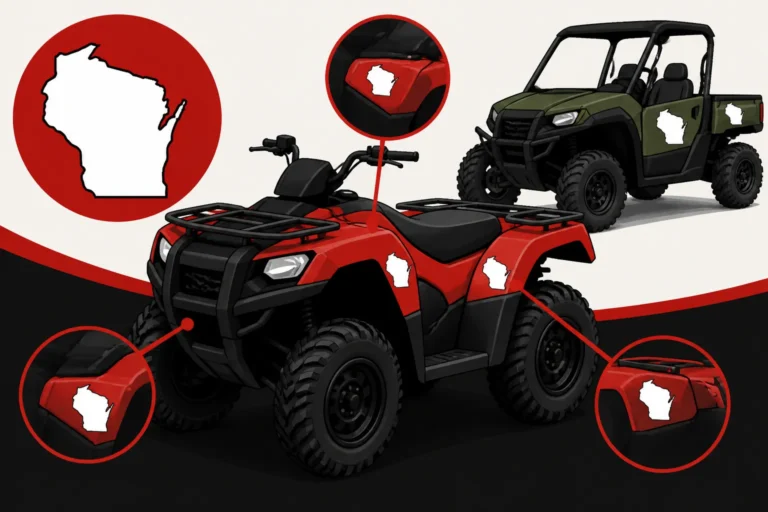
After your registration is processed, you'll receive your new Wisconsin registration card and decals (stickers). Proper placement of these decals is not just a suggestion; it's a legal requirement. The decals must be affixed in a clearly visible location on the front and rear of the machine. Typically, this means on the front cowl or fender and the rear fender. They should be clean, unobstructed, and legible. Getting this wrong can lead to a citation, even if your machine is technically registered. Read the instructions that come with your decals carefully, as placement specifics can sometimes vary slightly between ATVs and UTVs. [Sticker Placement on a Wisconsin Machine] offers guidance on this.
Equally important is carrying your registration card with you whenever you operate the machine on public lands. This is your proof of registration. A Wisconsin warden or law enforcement officer will almost certainly ask for it during a stop. While most people put it in a waterproof bag in a storage compartment or glove box, make sure it's accessible. Don't leave it at home! Having it readily available shows you're a responsible rider and can expedite any interactions with authorities. [Keeping the Registration Card With the Machine] emphasizes why this small piece of paper is so important and details [What a Wisconsin Warden Asks a Rider For].
Wisconsin's Non-Resident Trail Pass Versus Registration
This is a point of frequent confusion for out-of-state riders. A non-resident trail pass is not a substitute for registration if you're a Wisconsin resident. Rather, it's specifically for those who are not residents of Wisconsin and are bringing their properly registered machine from another state to ride Wisconsin's public trails.
- When a Non-Resident Needs Only a Pass: If you live in, say, Illinois, and you're visiting Wisconsin for a long weekend of riding, your Illinois-registered ATV/UTV remains registered in Illinois. To legally ride Wisconsin's public trails and routes, you would purchase a non-resident trail pass. This pass grants you access but doesn't change your machine's primary state of registration.
- When Out-of-State Registration is Sufficient for a Trail Pass Purchase: You cannot buy a Wisconsin non-resident trail pass for an unregistered machine, even if it's from out of state. You must show proof of valid registration from your home state to purchase the non-resident trail pass. The pass essentially layers on top of your home state's registration to give you legal access to Wisconsin's trails.
The key takeaway is this: if you're a Wisconsin resident, your machine needs a Wisconsin registration. If you're a non-resident, your machine needs to be registered in your home state and you need a Wisconsin non-resident trail pass to ride public trails here. Confusing the two can lead to problems.
Penalties for an Unregistered ATV in Wisconsin
Riding an unregistered ATV or UTV on Wisconsin's public trails and routes is a violation of state law, and the penalties can be significant. It's not just a slap on the wrist; these fines are designed to deter illegal riding and ensure that all public-land users are contributing to the trail system's upkeep.
- Fines: Expect a monetary fine if you're caught operating an unregistered machine. The amount can vary depending on the specific circumstances and the discretion of the enforcement officer, but it's typically a few hundred dollars.
- Impoundment: In some cases, especially for repeat offenders or particularly egregious violations, a warden has the authority to impound your machine. Getting your ATV or UTV back from impound can be costly, involving impound fees, storage fees, and potentially other administrative charges, in addition to the original fine.
- Loss of Riding Privileges: Persistent violations could even lead to a temporary or permanent loss of your riding privileges in Wisconsin.
- Insurance Implications: Operating an unregistered machine can also impact your insurance coverage. If you're involved in an accident while riding an illegally unregistered machine, your insurance company might deny coverage, leaving you personally liable for damages or injuries.
The risks far outweigh the cost and effort of proper registration. It's much better to spend a bit of time and money upfront to get your machine legal than to face the stress, cost, and potential loss of your machine later. Make sure you understand [Penalties for an Unregistered ATV in Wisconsin] to fully grasp the seriousness of riding without proper documentation.
Common Questions and Troubleshooting
Even with all the guidelines, unique situations inevitably arise when trying to register an out-of-state machine. Here are some common scenarios and how to approach them.
Buying a Machine With No Registration History
This is a particularly tricky situation, often encountered with older machines, those from states with minimal or no ATV/UTV registration requirements, or even machines that have simply been "farm queens" and never ridden off private land. When you try to register a machine with no prior registration history in Wisconsin, the DNR's primary concern will be establishing clear proof of ownership. Without a previous registration card or MSO, you'll heavily rely on a robust bill of sale.
A well-drafted bill of sale, especially for a private party sale, is paramount. It should include:
- Full names and addresses of both buyer and seller.
- Date of sale.
- Purchase price.
- A clear description of the ATV/UTV, including make, model, year, and—most importantly—the VIN.
- A statement that the seller attests to being the legal owner and has the right to sell the machine.
If you don't have a formal bill of sale, or if the one you have is minimal, you might need to create an affidavit of ownership, a sworn statement affirming your legal claim to the machine. You can find templates for such documents from resources like LawDepot, which specializes in legal forms for various situations. The DNR may also require additional documentation or even a physical inspection to verify the VIN and ensure the machine isn't stolen. It's a bit more work, but a legitimate sale can certainly be registered. For more details on what should be included in a bill of sale, review [What a Wisconsin ATV Bill of Sale Should Carry].
Recovering a Stolen Machine in Wisconsin After an Out-of-State Purchase
The thought of a stolen machine is every owner's nightmare. If you've purchased an out-of-state machine, brought it to Wisconsin, and it's subsequently stolen, proper registration is your best friend for recovery. Your Wisconsin registration record, which includes your name and the machine's VIN, provides a clear, verifiable link between you and the ATV/UTV.
When you report a stolen machine to local law enforcement, they will use the VIN to enter it into national databases. If your machine was registered in Wisconsin, the police will have an easier time confirming your ownership, which is crucial for successful recovery. Without proper registration, proving ownership can be significantly harder, especially if you lack other robust paperwork. This underscores why taking the time to correctly register your out-of-state machine is not just about legality, but also about protecting your investment. Make sure to keep a copy of your registration card and record the VIN in a safe place, separate from the machine itself. Running a Used Quad Past Theft Records can provide additional preventative measures.
Out-of-State Machines Used for Farm Work in Wisconsin
Wisconsin offers specific exemptions for ATVs and UTVs used exclusively for farm work, but it's important to understand the nuances, especially for machines coming from out of state. Generally, if an ATV or UTV is only used for agricultural purposes on a farm, including operating on a highway (not a trail) for distances of less than one-half mile from one farm field to another, it may be exempt from public use registration.
However, the "farm work" exemption has strict limits. If you bring an out-of-state machine and use it for anything beyond direct agricultural tasks—like riding it on public trails for recreation, or even using it on public land for hunting—then the farm exemption likely does not apply, and you'll need to get it registered for public use. The DNR is quite clear on these distinctions. A common mistake is assuming that because a machine can be used for farm work, it's always exempt. This isn't the case. Always consider how you actually use the machine on Wisconsin soil. If there's any recreational public use involved, you'll need that Wisconsin public use registration. For more information on these specific rules, refer to [Wisconsin Exemptions for Farm Machines].
| Scenario | Wisconsin Resident | Seasonal Resident | Out-of-State Visitor | Documents Needed |
|---|---|---|---|---|
| Permanent Move | Yes | Yes (if public use) | N/A | Bill of Sale, previous registration, VIN verification, proof of tax paid |
| Regular Visits (Public Land) | N/A | Yes | No (Trail Pass instead) | Bill of Sale, previous registration, VIN verification, proof of tax paid |
| Occasional Visit (Public Land) | N/A | No (Trail Pass instead) | No (Trail Pass instead) | Out-of-state registration (for pass purchase), proof of insurance (if applicable) |
| Private Land Only | No (Public use reg only) | No | No | Proof of ownership (recommended, e.g., Bill of Sale from LawDepot) |
| Farm Use Only (Limited Road Use) | No (Special exemption) | No (Special exemption) | No (Special exemption) | Proof of ownership, proof of farm use (if questioned) |
Disclaimer
This article is for general informational purposes only and does not constitute professional advice. Laws, prices and regulations vary by location and change over time. Consult a qualified professional for guidance on your specific situation.